🍬 Better sugar math for bakers and baristas
Sugar Converter Calculator
Convert granulated, brown, powdered, caster, turbinado, coconut, demerara, maple, and superfine sugars between grams and milliliters with density-aware kitchen math.
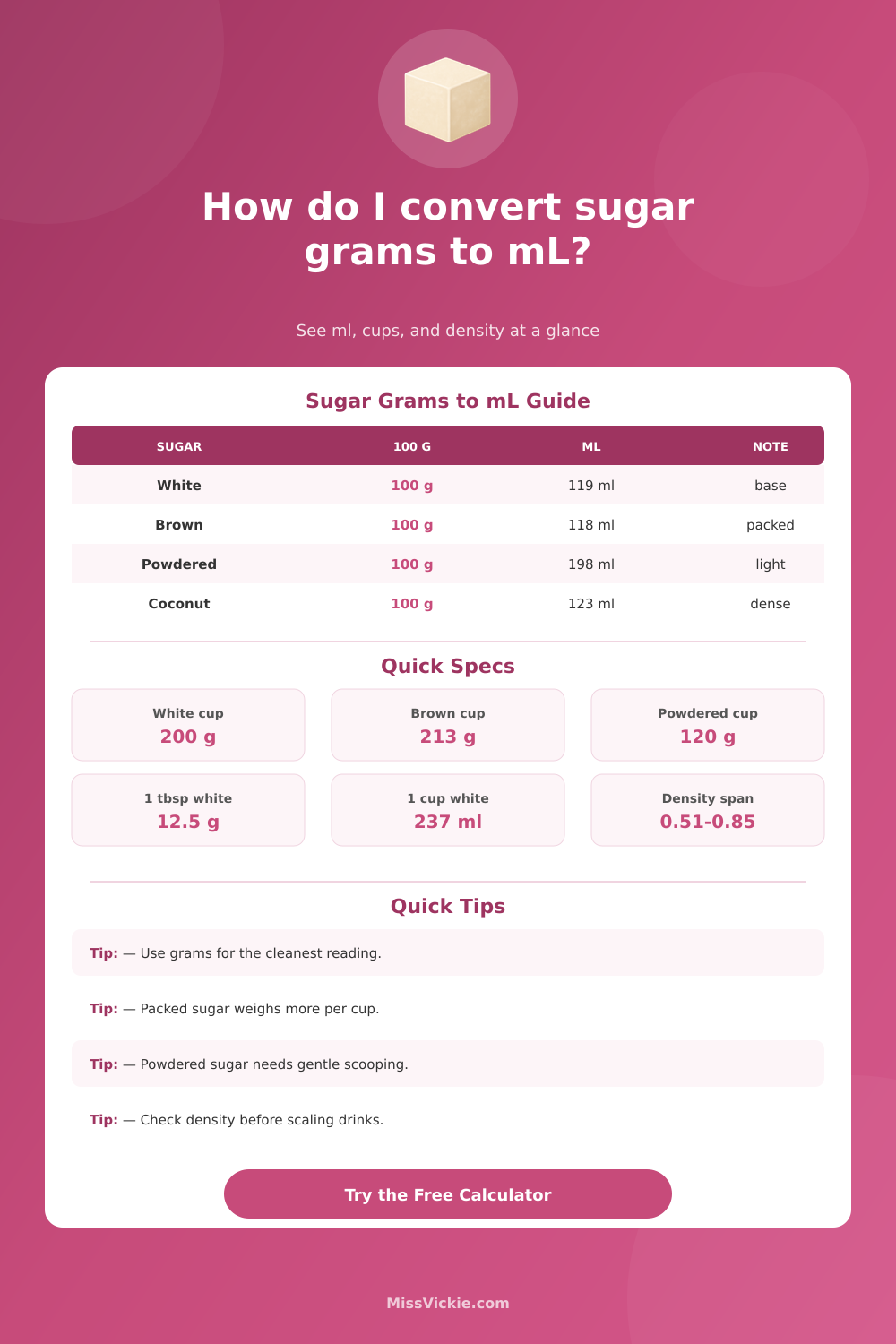
Sugar weights shift by crystal size, moisture, and packing, so this converter uses sugar-specific cup weights and sweetness factors to scale kitchen measurements cleanly.
Granulated
200 g/cup
Standard baseline for cakes, syrups, and drinks.
Brown Sugar
213 g/cup
Moist and compact, so packed cups run heavier.
Powdered
120 g/cup
Best for glaze, frosting, and dusted finishes.
Turbinado
220 g/cup
Large crystals stay crunchy and dissolve slower.
| Sugar Type | 1 Cup Weight | Sweetness | Common Use |
|---|---|---|---|
| Granulated | 200 g | 1.00x | Cookies, cakes, syrups |
| Light Brown | 213 g | 0.97x | Cookies, streusel, sauces |
| Dark Brown | 220 g | 1.00x | Gingerbread, barbecue glaze |
| Powdered | 120 g | 0.95x | Icing, glaze, dusting |
| Caster | 225 g | 1.00x | Meringue, sponge cakes |
| Superfine | 200 g | 1.00x | Cocktails, quick dissolve |
| Turbinado | 220 g | 0.95x | Toppings, coffee, crusts |
| Demerara | 220 g | 0.95x | Crunchy tops, sauces |
| Coconut | 192 g | 0.92x | Bars, muffins, granola |
| Maple | 165 g | 1.10x | Dry rubs, frostings |
| Sugar Type | 1 Tbsp | 1 Tsp | 4 Tbsp |
|---|---|---|---|
| Granulated | 12.5 g | 4.2 g | 50 g |
| Light Brown | 13.3 g | 4.4 g | 53 g |
| Powdered | 7.5 g | 2.5 g | 30 g |
| Caster | 14.1 g | 4.7 g | 56 g |
| Turbinado | 13.8 g | 4.6 g | 55 g |
| Coconut | 12.0 g | 4.0 g | 48 g |
| Recipe | Original Sugar | Double Batch | Half Batch |
|---|---|---|---|
| Chocolate chip cookies | 1 cup white | 400 g | 100 g |
| Brownie pan | 1.5 cups white | 600 g | 150 g |
| Cinnamon filling | 0.75 cup brown | 320 g | 80 g |
| Buttercream | 4 cups powdered | 960 g | 240 g |
| Sweet tea pitcher | 0.5 cup white | 200 g | 50 g |
| Creme brulee tops | 6 tbsp caster | 169 g | 42 g |
Sugar density is an variable factor in baking and cooking due to the different weight that various type of sugar can have depending on how it is packed into a measuring cup. While many people uses volume measurements to add sugar to their recipes, volume measurements are often inaccuracy when using sugar as an ingredient. If people dont take the density of sugar into consideration when using volume measurements, their baking recipes might fail due to the amount of sugar in a cup potentially being too high or than too low in weight.
To avoid these issue with baking recipes, it is essential to understand how to convert grams to milliliters or cups as this will allow people to maintain the correct ratio of ingredients to the recipe that is being followed. Granulated sugar is a uniform type of sugar and will weigh approximately 200 grams per cup. Brown sugar contain molasses which makes the sugar stick together.
How to Measure Different Types of Sugar
Because brown sugar stick together, you can pack it into the measuring cup and it will weigh more than granulated sugar, a cup of packed brown sugar will weigh 220 grams. Powdered sugar is a light type of sugar and will weigh approximately 120 grams per cup. If powdered sugar is not sifted when measure, it will clump and change the weight of the sugar in the measuring cup.
Sugars vary in texture which impact how much each type of sugar will weigh. Turbinado and demerara sugar are both coarse sugars and will not compress when packed into a measuring cup. The volume of these two type of sugar will weigh less per gram than fine caster sugar.
Coconut sugar have a fibrous texture which makes it less dense than white sugar. Finally, maple sugar is another type of sugar that can be used in baking but will contribute an intense flavor to the recipe in a lighter volume. Due to these differences in texture, the density of each type of sugar will vary, making it necessary to adjust recipes according to the type of sugar being use in place of another.
When doubling or halving a recipe, it is necessary to understand how the density of the ingredients will impact the outcome of the recipe. If a recipe use brown sugar, it is necessary to ensure that the recipe is measured in the same way when doubling the recipe… Packing more of the sugar will make it weigh more than the original recipe intend.
If halving a recipe that includes powdered sugar, it is necessary to account for the fluffiness of the sugar. If not accounted for, the texture of the final product could be an issue. Finally, when using sugar in the preparation of drinks, the type of sugar will impact the recipe; coarse sugars will not dissolve in the drink the same as fine sugar.
Some recipes will ask for the sugar to be packed while others will require the sugar to be fluffed. Recipes that require packed sugar, such as brown sugar, will ensure that the sugar is packed into the measuring cup to ensure the even distribution of molasses. However, recipes that use powdered sugar will ask for it to be fluffed so that it does not make the glaze too thick.
It is important to follow these instruction for the sugar to be measured as the recipe intends for the sugar to be measured. Common mistakes with sugar weighing may be using grams to measure the sugar for baking recipes. Using grams will allow people to avoid the mistake of scooping sugar from the bag.
Scooping sugar directly from the bag may lead to clumping of the sugar. Additionally, storing the brown sugar in a way that allows it to dry out will make the brown sugar harder to pack. Additionally, using granulated sugar in place of caster sugar may make the texture of items such as cookies sandier.
To achieve the best results in baking, use grams as the primary unit of measurement for all recipe ingredients. Grams can be converted to milliliters for ingredients that require pouring or converted to tablespoons for dry ingredients. Additionally, if people use grams as a unit of measurement for the weight of the sugar, the recipe will inherently require that brown sugar is pack and powdered sugar is fluffed.
Additionally, measuring ingredients in grams will allow bakers to scale their recipes as they wish without changing the density of the ingredients. Thus, using grams as the unit of measurement for sugar will ensure that peoples baked goods is tender and their drinks smooth.