🍬 Better sugar math for bakers and baristas
Sugar Converter Calculator
Convert white, brown, powdered, caster, coconut, turbinado, demerara, maple, and superfine sugars between spoons, cups, ounces, grams, and scaled recipe batches.
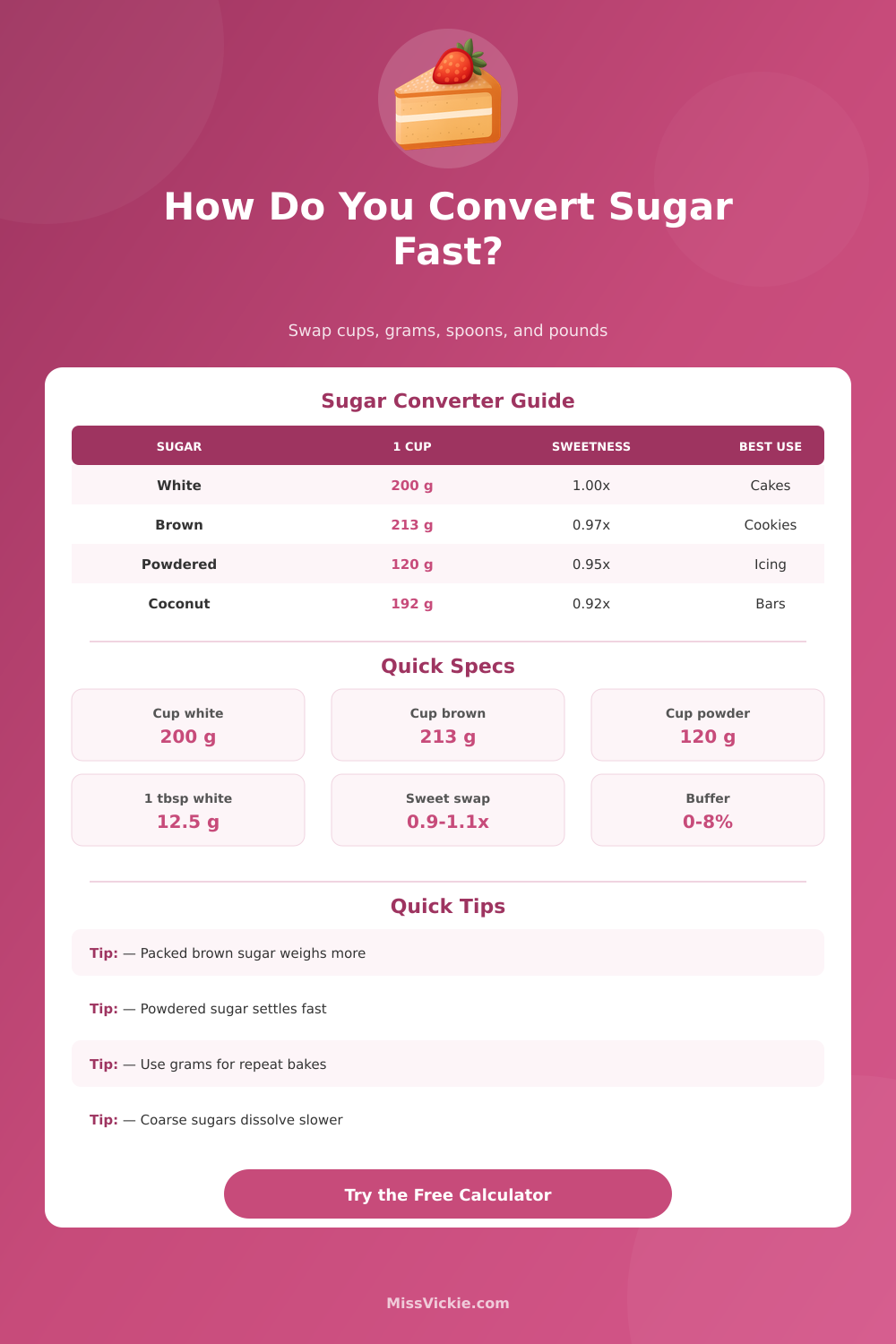
Sugar weights shift by crystal size, moisture, and packing, so this converter uses sugar-specific cup weights and sweetness factors to scale kitchen measurements cleanly.
Granulated
200 g/cup
Standard baseline for cakes, syrups, and drinks.
Brown Sugar
213 g/cup
Moist and compact, so packed cups run heavier.
Powdered
120 g/cup
Best for glaze, frosting, and dusted finishes.
Turbinado
220 g/cup
Large crystals stay crunchy and dissolve slower.
| Sugar Type | 1 Cup Weight | Sweetness | Common Use |
|---|---|---|---|
| Granulated | 200 g | 1.00x | Cookies, cakes, syrups |
| Light Brown | 213 g | 0.97x | Cookies, streusel, sauces |
| Dark Brown | 220 g | 1.00x | Gingerbread, barbecue glaze |
| Powdered | 120 g | 0.95x | Icing, glaze, dusting |
| Caster | 225 g | 1.00x | Meringue, sponge cakes |
| Superfine | 200 g | 1.00x | Cocktails, quick dissolve |
| Turbinado | 220 g | 0.95x | Toppings, coffee, crusts |
| Demerara | 220 g | 0.95x | Crunchy tops, sauces |
| Coconut | 192 g | 0.92x | Bars, muffins, granola |
| Maple | 165 g | 1.10x | Dry rubs, frostings |
| Sugar Type | 1 Tbsp | 1 Tsp | 4 Tbsp |
|---|---|---|---|
| Granulated | 12.5 g | 4.2 g | 50 g |
| Light Brown | 13.3 g | 4.4 g | 53 g |
| Powdered | 7.5 g | 2.5 g | 30 g |
| Caster | 14.1 g | 4.7 g | 56 g |
| Turbinado | 13.8 g | 4.6 g | 55 g |
| Coconut | 12.0 g | 4.0 g | 48 g |
| Recipe | Original Sugar | Double Batch | Half Batch |
|---|---|---|---|
| Chocolate chip cookies | 1 cup white | 400 g | 100 g |
| Brownie pan | 1.5 cups white | 600 g | 150 g |
| Cinnamon filling | 0.75 cup brown | 320 g | 80 g |
| Buttercream | 4 cups powdered | 960 g | 240 g |
| Sweet tea pitcher | 0.5 cup white | 200 g | 50 g |
| Creme brulee tops | 6 tbsp caster | 169 g | 42 g |
Sugar density vary depending on the type of sugar that is used. Sugar density vary depending on the type of sugar because different type of sugar contain different amounts of moisture and have different crystal size. Granulated sugar has a specific density.
However, brown sugar contain molasses, which causes the brown sugar to stick together. Because brown sugar stick together, it can be packed into the measuring cup. Packed brown sugar will weigh more than loose brown sugar.
Why Sugar Types and Weight Matter
Powdered sugar is very light in weight. Therefore, powdered sugar will occupy more volume yet have a lower weight than granulated sugar. In both instance, it is necessary for bakers to use sugar converters to change the volume measurements of the sugar to the correct weight measurements of the sugar.
Using correct weight measurements of the sugar will ensure that baking remain the same, even if the size of the recipe is changed. When baking, it is common to scale the recipe to accommodate more or fewer individual. If someone doubles the recipe, they will have to multiply the ingredient by two.
However, using volume measurements for these ingredients can cause errors in the recipe. For example, a cup can be used to measure granulated sugar. However, another person may pack the brown sugar into the cup.
Using too much force when packing the brown sugar will increase the weight measurement of the brown sugar. Using a sugar converter will allow a baker to avoid these type of errors. When using a sugar converter, the baker can read the recipe and see the weight of the sugar in gram.
Using the weight of the sugar in grams allows the baker to maintain the proper balance of ingredient in the recipe. Not all types of sugars contain the same level of sweetness. Therefore, if someone is to substitute one type of sugar for another, the baker will have to adjust the amount of sugar to account for the difference in sweetness of each type of sugar.
For example, coconut sugar is less sweet than granulated sugar. However, maple syrup contain more sweetness than granulated sugar. If the baker replaces granulated sugar with maple syrup, the flavor of the recipe will change.
Sugar converters allow bakers to target a specific level of sweetness in the final product. Additionally, sugar converters also allow bakers to scale the recipe to determine the final amount of sugar that will be used. A small percentage of sugar can be added to the recipe as a buffer to account for any sugar that stick to the spoon used to measure the sugar.
The texture of the baked goods will change depending on the type of sugar used and the weight of the sugar that is used in the recipe. For example, if the recipe call for brown sugar to be packed tightly, the cookies will be chewy if brown sugar is used. However, a baker can also fluff brown sugar to create lighter baked goods.
Coarse sugars will remain crunchy when baked, like turbinado sugar. Fine sugars will dissolve quick when mixed into a recipe, like caster sugar. Each type of sugar will weigh a different amount per tablespoon.
For example, granulated sugar will weigh 12.5 grams per tablespoon, but powdered sugar will weigh 7.5 grams per tablespoon. Because each type of sugar weigh differently, it is necessary to perform sugar specific math to determine the weight of the sugar that should of been used in the recipe. There are several error that can occur when measuring sugar for a recipe.
One common error is scooping the sugar too loose with the spoon. If the baker does not use too much force to scoop the sugar into the spoon, the weight of the sugar will be less than what the recipe require. The result of using too little sugar could lead to dry cake.
Another error is using powdered sugar that has become stale. Stale powdered sugar will clump together. These clump will make the volume measurements incorrect.
Using weight measurements instead of volume measurements will help to avoid these common pitfalls. Using a buffer for the final recipe will round the weight of the sugar to the nearest whole number. Rounding the weight of the sugar to the nearest whole number will make it easier for the baker to measure the sugar accurately.
Using gram as the anchor for the recipe will ensure that everyone maintain the same consistency in the baking process.