🍬 MissVickie sugar calorie math
Sugar to Calories Converter
Convert teaspoons, tablespoons, cups, grams, and ounces into sugar calories, then scale recipes with type-aware density and serving math.
Each preset loads a real kitchen scenario and recalculates calories immediately.
Pick a sugar type, the way it was measured, and the serving scale. The calculator converts to grams first so the calorie total stays steady.
This table shows the standard cup weight and calorie density used by the calculator for each sugar family.
| Type | Cup Weight | Calories / 100g | Best Note |
|---|---|---|---|
| Granulated sugar | 200 g | 387 | Baseline white sugar |
| Caster sugar | 200 g | 387 | Fine crystals |
| Light brown sugar | 213 g | 380 | Usually packed |
| Dark brown sugar | 220 g | 380 | Heavier molasses |
| Powdered sugar | 120 g | 389 | Light and sifted |
| Raw sugar | 220 g | 377 | Coarse crystals |
| Demerara sugar | 220 g | 377 | Crunchy grain |
| Coconut sugar | 200 g | 375 | Similar cup mass |
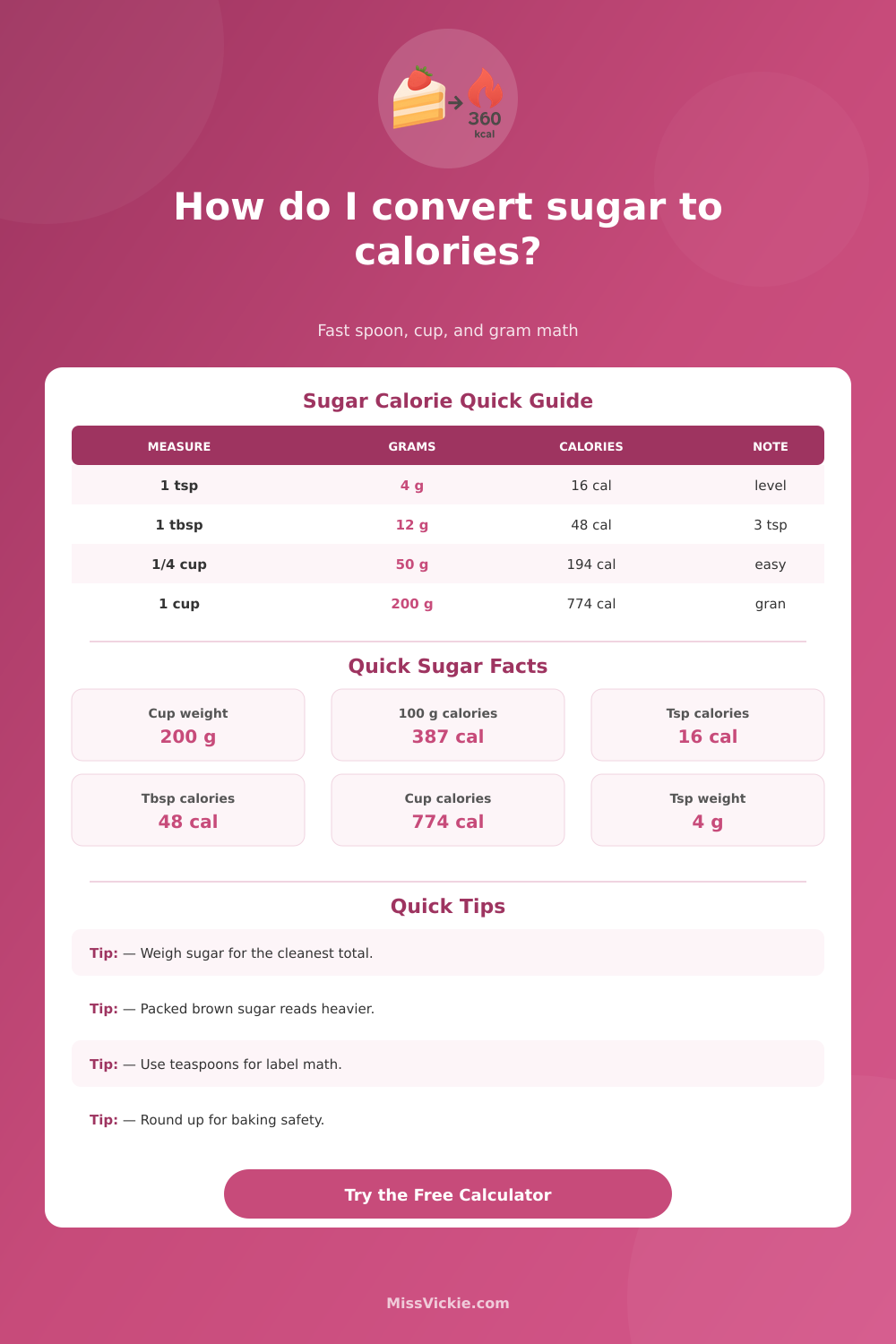
Use these spoon and cup anchors when you need a fast conversion without opening the main calculator form.
| Measure | Grams | Calories | Equals |
|---|---|---|---|
| 1 tsp | 4 g | 16 cal | 3 tsp = 1 tbsp |
| 1 tbsp | 12 g | 48 cal | 3 tbsp = 1/4 cup |
| 1/4 cup | 50 g | 194 cal | 4 tbsp |
| 1/3 cup | 67 g | 259 cal | 5 tbsp + 1 tsp |
| 1/2 cup | 100 g | 387 cal | 8 tbsp |
| 1 cup | 200 g | 774 cal | 16 tbsp |
These common amounts are handy when you are scaling a recipe, sweetening drinks, or checking a label-style serving size.
| Use | Amount | Grams | Kcal |
|---|---|---|---|
| Coffee sweetener | 2 tsp | 8 g | 31 |
| Tea sweetener | 1 tbsp | 12 g | 48 |
| Small bake | 1/4 cup | 50 g | 194 |
| Cake layer | 1/2 cup | 100 g | 387 |
| Cookie tray | 3/4 cup | 150 g | 581 |
| Batch jar | 1 cup | 200 g | 774 |
Style matters because sugar can settle, mound, or sift. These reference rows show how the input style shifts the cup weight.
| Style | Density | Best For | Watch |
|---|---|---|---|
| Loose fill | -5% | Quick spoons | Air gaps |
| Level fill | Base | Label math | Standard cup |
| Packed cup | +8% | Brown sugar | Press lightly |
| Sifted light | -10% | Powdered sugar | Very airy |
Best when sugar calories must repeat exactly.
Great for coffee, tea, and tiny checks.
Helpful for sauces, glazes, and mixes.
Useful for larger recipes and dessert scaling.
Sugar is a carbohydrate that contains an energy needed by the human body. One gram of sugar contain approximately four calories. Since sugar contain no protein and no fat, it is a source of carbohydrate energy alone.
One hundred gram of granulated white sugar contain 387 calories. A standard cup of granulated white sugar weigh approximately 200 grams. Therefore, a standard cup of granulated white sugar contains 774 calories.
How to Measure Sugar and Count Calories
The density of sugars change depending on the type of sugar that is use. For example, powdered sugar is very lightly and contains alot of air. One cup of powdered sugar weigh only 120 grams.
Brown sugar contain molasses and is, therefore, more denser than white sugar. One cup of packed brown sugar weigh between 213 and 220 grams. Since brown sugar is more dense than white sugar, one cup of packed brown sugar contains more calories than one cup of white sugar.
In order to calculate calories in sugar products, it is first necessary to understand how the density of various types of sugar change the number of calories in a cup of that sugar. In order to calculate the number of calories in a recipe that contains sugar, it is first necessary to convert the volume of sugar to its weight in gram. A level teaspoon of granulated sugar weigh four grams.
Four grams of granulated sugar contains 16 calories. A level tablespoon of granulated sugar weighs 12 grams and contain 48 calories. Half a cup of granulated sugar weigh 100 grams and contains 387 calories.
Many recipe use the terms “packed” or “sifted” in their instructions. These terms change the weight of the sugar. The weight of the sugar change the number of calories in the recipe.
In order to properly measure the amount of sugar in a recipe, it is first necessary to understand how different style of filling a cup of sugar change the density of that sugar. Using a loose fill of sugar will leave air gaps within the cup such that the sugar will weigh less than if it were leveled. Leveling the sugar will provide a baseline from which other spoon or cup measurement can be made.
Packing the sugar will make it denser. This is often used with moist brown sugar. Sifting the powdered sugar will make it less dense.
It will weigh less than if it were pack. Using a scale to measure the weight of the sugar in grams will provide the most precise measurement. Using teaspoons or tablespoons of sugar can also be used to estimate the amount of sugar for recipe without a scale.
Depending on the type of sugar that is used in a recipe, the sugar will behave in different ways in the kitchen. For instance, brown sugar may harden if it is not store in an airtight container. Using hardened brown sugar can lead to scooping amounts of brown sugar that differ from those that is solidify.
Coconut sugar may appear the same as white sugar when used in recipes, but it can have a stronger flavor to it. Using coconut sugar may lead to the addition of more sugar to food. Raw demerara sugar has coarse grain that add to the total calories of food like oatmeal.
Added sugars are often found in food like yogurt and sauces. The sugars in these foods can add to the total daily sugar intake of an average individual. According to health guidelines, the recommended daily intake of sugar is between 25 and 36 gram per day.
Most individuals consume more sugar than the recommended amount daily, especially from sugary drink. In order to save time, many cooking programs offer presets for calculating the calories in sugar for specific task. For instance, there are presets for calculating the calories in three sifted cups of powdered sugar for recipes like frosting.
Presets can also calculate the calories in 1.5 cup of demerara sugar for making simple syrup. Presets can calculate how many calories are in a sugar product and how many calories is in each serving of that product. Common mistake in measuring sugar include packing the sugar properly and using level measurements in a cup.
If these step are skipped, the sugar will weigh less than the recipe require. If the amount of sugar is merely “eyed” in the cup rather than leveled, there is a chance of using too much sugar. Weighing the sugar in grams will ensure that the amount of sugar used in a recipe is accurately measure.
Using teaspoons for liquid recipes, tablespoons for sauce recipes, and cups for baking project are all acceptable methods of estimating the amount of sugar needed. However, it is important to consider the density of the type of sugar that is to be use in the recipe.