Stuffing Per Pound of Turkey Calculator
Calculate stuffing for a turkey by pounds, guests, cavity fill, pan dressing, bread cube style, broth absorption, aromatics, egg binder, oven-pan capacity, safe internal temperature, and leftover buffer.
Choose a real holiday setup, then adjust turkey weight, guest count, bread style, broth, cavity share, pan capacity, eggs, aromatics, and leftovers.
Your Stuffing Plan
Adjust the inputs to calculate stuffing amounts.
Turkey And Serving Breakdown
Ingredients Breakdown
Cavity, Pan, And Safety Breakdown
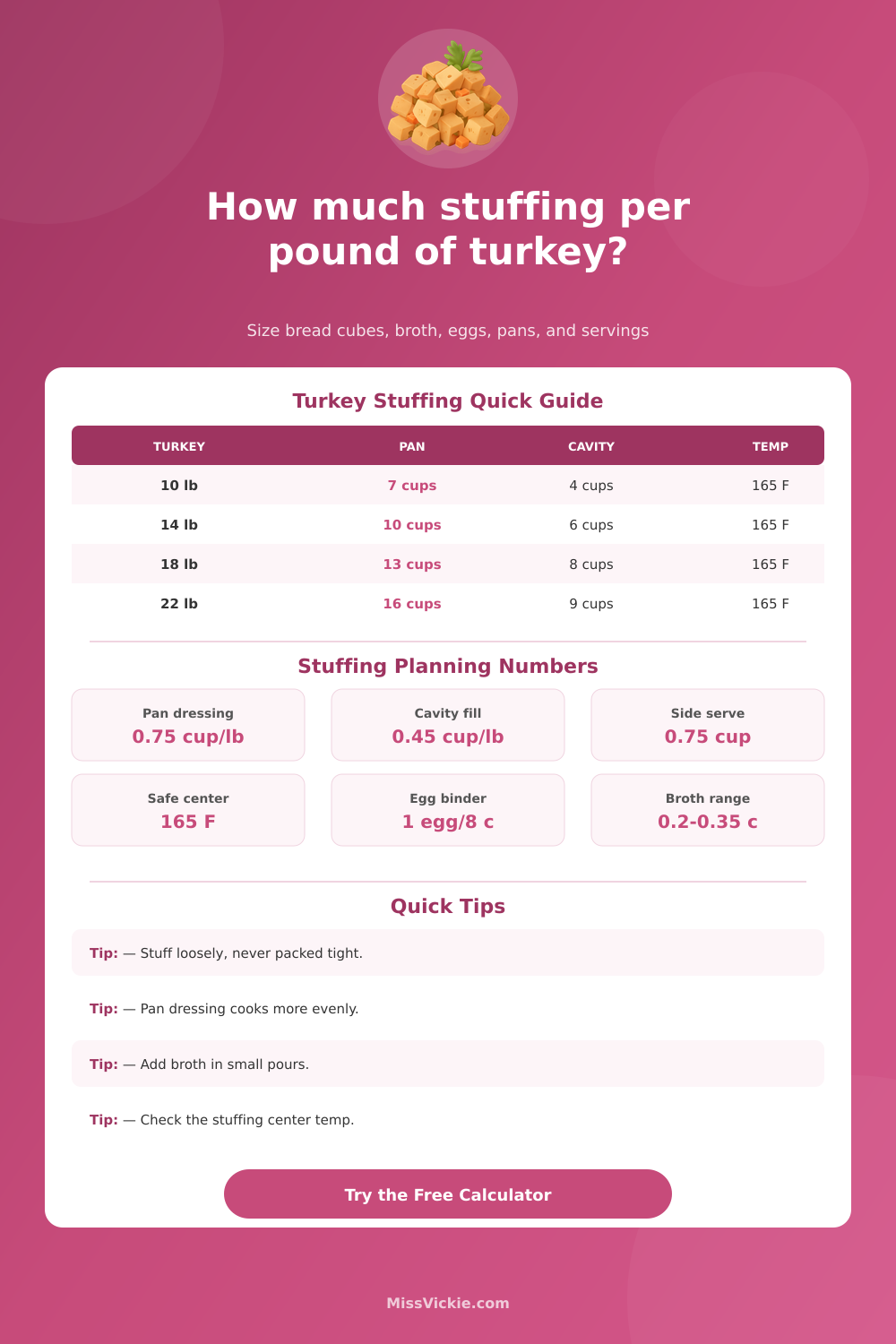
| Turkey Size | Pan Dressing Estimate | Loose Cavity Estimate | Guests Served | Notes |
|---|---|---|---|---|
| 8 to 10 lb turkey | 6 to 8 cups | 3.5 to 4.5 cups | 6 to 8 guests | Small pans dry faster, so check early. |
| 12 to 14 lb turkey | 9 to 11 cups | 5 to 6 cups | 8 to 12 guests | Most holiday tables need one 2 to 3 quart dish. |
| 16 to 18 lb turkey | 12 to 14 cups | 7 to 8 cups | 12 to 16 guests | Split batches help protect texture and temperature. |
| 20 to 24 lb turkey | 15 to 18 cups | 8.5 to 10 cups | 16 to 22 guests | Use multiple shallow pans for quicker heating. |
| Bread Base | Dry Cube Weight | Broth Per Cup | Best Binder | Texture Note |
|---|---|---|---|---|
| Classic white bread | About 1.25 oz per cup | 0.28 cup | 1 egg per 8 cups | Balanced and easy to season. |
| Cornbread | About 1.4 oz per cup | 0.22 cup | Light egg binder | Crumbly, so add broth slowly. |
| Sourdough | About 1.35 oz per cup | 0.32 cup | Standard binder | Chewy cubes can absorb more broth. |
| Brioche or challah | About 1.2 oz per cup | 0.24 cup | Light to standard binder | Soft and rich; avoid flooding. |
| Gluten-free bread | About 1.1 oz per cup | 0.30 cup | Standard binder | Rest briefly after adding broth. |
| Dish Size | Usable Capacity | Typical Stuffing Load | Best For | Pan Tip |
|---|---|---|---|---|
| 8 inch square dish | 6 to 7 cups | 5 to 6 servings | Small dinners | Keep depth near 2 inches. |
| 9 inch square dish | 8 to 10 cups | 8 to 10 servings | Standard holiday side | Cover first, uncover to brown. |
| 9 by 13 inch dish | 12 to 15 cups | 12 to 16 servings | Larger gatherings | Rotate once if the oven has hot spots. |
| Half sheet pan | 14 to 18 cups | 16 to 20 servings | Crisp top dressing | Use shallow layers for even heating. |
| Item | Target | Where To Check | Why It Matters | Serving Move |
|---|---|---|---|---|
| Pan dressing | 165 F center | Middle of the pan | Confirms a safe heated center. | Rest before scooping. |
| Cavity stuffing | 165 F center | Deepest stuffing point | Turkey can finish before stuffing does. | Remove after resting. |
| Leftover stuffing | 165 F reheated | Thickest chilled portion | Dense leftovers heat unevenly. | Add broth before reheating. |
| Loose cavity fill | Not packed | Visual check before roasting | Air spaces help heat move through. | Mix just before cooking. |
Food safety note: poultry and stuffing should reach 165 F in the measured center. Pan dressing is often easier to heat evenly than stuffing inside the turkey cavity.
Best for predictable texture, larger batches, and easier thermometer checks.
Use smaller amounts, spoon loosely, and confirm the stuffing center reaches target.
Put a small loose portion in the turkey and finish the rest in a shallow dish.
Best when the guest count is high or stuffing is the favorite holiday side.
Thanksgiving is all about juggling several competing dishes and figuring out who can fit where. But none are more logistically tricky then stuffing. How do you get enough volume without it being too dense? How much moisture can you add before it gets soggy? How do you guarantee the heat penetrates, even though you’re cramming it in a bird?
Most home cooks rely on instinct when making bread cube stuffing. You just have to hope the dressing reaches a safe temperature before the turkey dry out. Here’s this calculator, which takes away the guesswork and lets you actualy plan. It do the math on things like egg binding, broth absorption, pan capacity, and bread volume. This ensures you don’t find yourself looking down at an empty casserole dish halfway through roasting.
Use a Calculator for Perfect Stuffing
And really, that’s just one of the core metrics: How do I know if my dressing will fit? First, enter the raw weight of your turkey and then indicate whether you plan to put dressing in the bird or in a pan beside it. Because metal conducts heat but meat insulates it, the latter cooks faster; the calculator takes that into consideration.
If you’re planning to cook stuffing inside the bird, the calculator will adjust based off how loose your stuffing is. A common mistake are packing the stuffing in so tightly that it traps steam, creating cold pockets that let bacteria grow. Keep the mixture loose to allow more hot air to move through the dressing. This results in better texture and a quicker cooking time.
This is more important than any variation in recipes. Density does matter, though: Different bread types contains different amounts of water (which they soak up and then…uh-oh, there goes mush city). Cornbread, for instance, is dense and somewhat dry; white bread is porous and thirstier. The calculator will adjust it broth estimates to avoid drowning the densest loaf or leaving the lightest one too dry. And it accounts for things like apples, celery, onions, sausage, etc., that adds water when cooked but take up space beforehand. By entering amount of mix-ins, it calculates that minus the dry-bread requirement (so the total yield remains equal to number of guests).
This calculator shifts that guesswork into actual planning and handles the math for you. But hey. Other variables includes people tripping over serving size. Typical servings of stuffing is around three-quarters of a cup each (although of course some at your table will live for it, others will be there just for the bird). Appetite level can be adjusted along with a leftover buffer. Adding a twenty percent buffer now would of save you scrambling with day-old bread later if you’re planning tomorrow’s sandwiches.
It also calculates amount of binder needed (eggs) in relation to the overall volume of dry cubes. Because eggs give binding, they helps the stuffing stick together; slice it and it holds its shape instead of falling apart as a loose salad of ingredients.
No matter what your style preferences are, safety never takes a back seat. Regardless of whether the stuffing goes inside or outside the bird, center of any stuffing needs to hit an internal temp of 165 degrees Fahrenheit. It’s simple to check with a thermometer, which you can push straight into the middle of a pan of dressing (easier than poking through all that turkey skin). With cavity dressing, however, it gets trickier; sometimes the exterior of the bread mixture has cooked long enough before the interior reaches safe temps. Wrapping the bird in foil will help hold things together while the core come up to temp, but there’s always the risk of steamed-to-death skin.
To get a sense for yield per bird, consult the reference tables at the bottom of the page, which provide ballpark figures based on turkey weight, so you’ll know ahead of time if a single casserole dish can handle all the dressing or if the batch should be divided between two adult-sized sofa. Dividing also guarantees even baking and avoids the problem of over-browned outer layers and a still-raw center.
In the end, stuffing comes down to cooking; balancing heat and moisture against each other, and prepping, not simply throwing things into a bowl and hoping it turns out OK. That’s where the calculator comes in: It does the math for you, so you can concentrate on the stuff, the stuff that realy makes stuffing what it is. Seasoning adjustments will always have to happen along the way; tasting as you do is part of this process. But it takes the guesswork of “how many eggs should I beat?” and “how much broth goes in here?” away from your busiest times during the holidays.
By the time that oven chimes, you aren’t going to ask yourself if it’s cooked all the way through or if there’s enough to feed the masses. You’re going to carve.