🥘 How Many Stuffing Balls Per Person
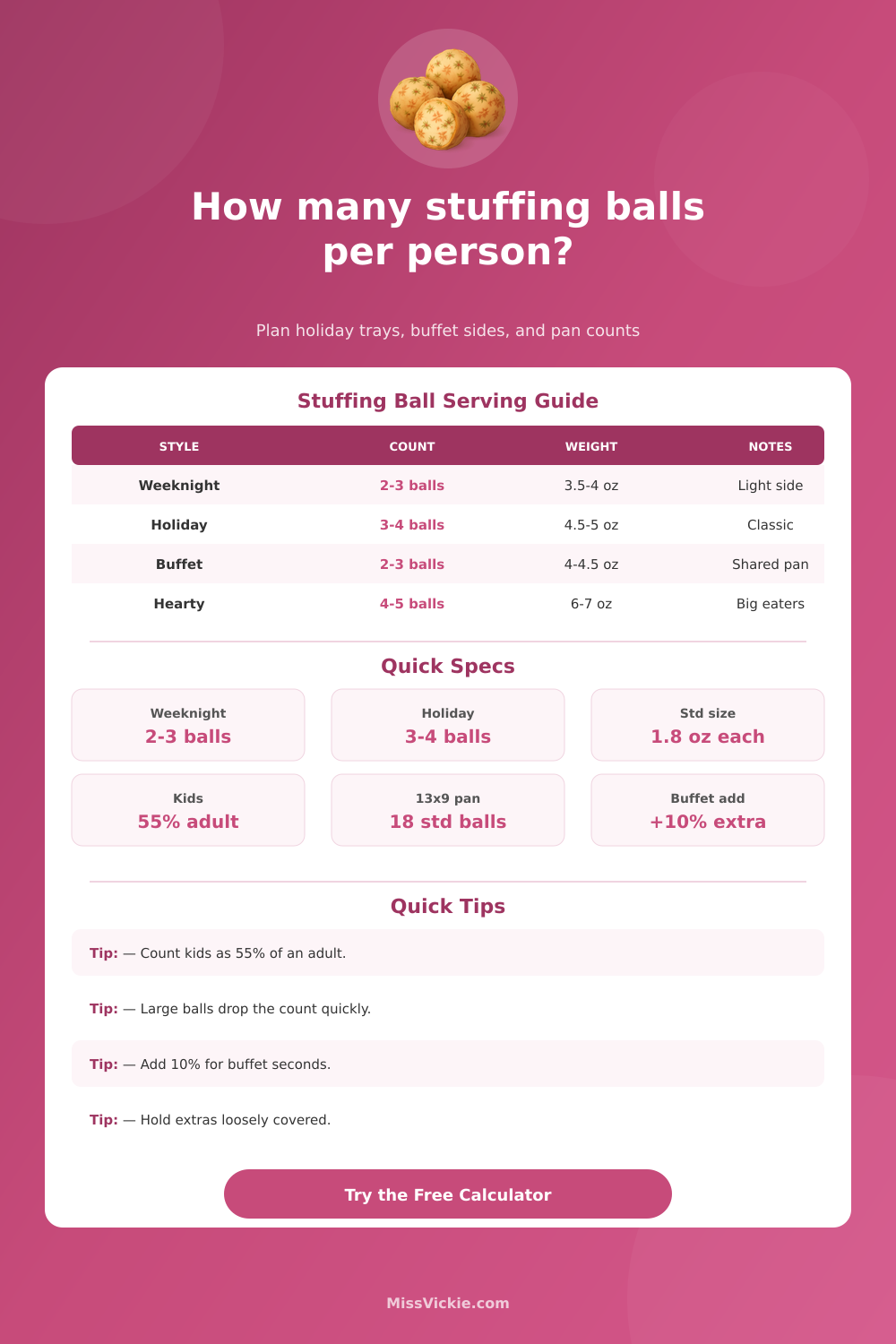
Plan stuffing ball counts for holiday dinners, buffet pans, and family meals with guest mix, stuffing style, ball size, hold time, and extra servings already built in.
Weeknight Side
Best when stuffing balls share the plate with a protein and one other side.
Holiday Dinner
Classic family-table planning where seconds are likely and plates stay generous.
Buffet Pan
Lower portions per guest, but the table needs enough extra for return trips.
Main Starch
Use when stuffing balls replace mashed potatoes, rice, or another main starch side.
| Serving Style | Typical Count | Cooked Weight Per Person | Planning Note |
|---|---|---|---|
| Kids table | 2 small balls | 2.5-3.0 oz | Good with turkey, ham, or roast chicken |
| Weeknight side | 2-3 balls | 3.5-4.0 oz | Typical family dinner with one starch |
| Holiday dinner | 3-4 balls | 4.5-5.5 oz | Seconds are common at holiday tables |
| Main starch | 4-5 balls | 6.0-7.0 oz | Use when stuffing replaces another starch |
| Stuffing Type | Cooked Weight Each | Raw Mix Each | Nutrition Snapshot |
|---|---|---|---|
| Classic bread and herb | 1.8 oz | 2.2 oz | 105 cal, 2.9 g protein |
| Cornbread | 1.8 oz | 2.1 oz | 112 cal, 2.4 g protein |
| Sausage sage | 2.0 oz | 2.3 oz | 138 cal, 4.8 g protein |
| Wild rice blend | 1.7 oz | 2.0 oz | 98 cal, 2.7 g protein |
| Guest Count | Weeknight Standard | Holiday Table | Big Eaters |
|---|---|---|---|
| 8 guests | 18-22 balls | 24-30 balls | 30-36 balls |
| 12 guests | 28-34 balls | 36-44 balls | 45-54 balls |
| 20 guests | 46-56 balls | 60-74 balls | 76-92 balls |
| 40 guests | 92-112 balls | 120-148 balls | 152-184 balls |
| Ball Size | Cooked Weight Each | 13x9 Capacity | Best Use |
|---|---|---|---|
| Small party ball | 1.4-1.6 oz | 22 balls | Buffets, kids, appetizer trays |
| Standard side ball | 1.7-1.9 oz | 18 balls | Holiday sides and weeknight dinners |
| Large hearty ball | 2.1-2.3 oz | 14 balls | Main starch portions and meal prep |
| Half hotel pan | 32 standard | 32 balls | Best for potlucks and service lines |
When you prepare stuffing balls for your meal, you must calculate how many stuffing balls you will need to serve to all of your guests. If you dont calculate the proper number of stuffing balls to prepare, you could either end up with too little stuffing for your guests or too many leftover for your guests to eat. To calculate the proper number of stuffing balls for your guests, you must consider a few different factor of the stuffing balls.
For instance, standard stuffing balls weighs approximately 1.8 ounces when cooked. If you prefer to make larger stuffing balls for your guests, you will need to make less stuffing balls of that size than if you made smaller stuffing balls. Children tend to eat smaller portion of food than adults; they typicaly eat about 55% of the amount of food that an adult eats.
How Many Stuffing Balls to Make for Your Guests
Additionally, not all type of stuffing balls are the same. For instance, because cornbread is denser than bread, cornbread stuffing balls will weigh more than bread stuffing balls. Sausage stuffing balls contain more fat than bread stuffing balls, so a person will feel full more quick with sausage stuffing balls.
Similarly, wild rice hold its shape well when cooking stuffing balls, but the stuffing balls made with wild rice will feel lighter than stuffing balls with an other ingredient. Furthermore, depending on how you serve the stuffing balls will change the number of stuffing balls that you need to prepare. For standard dinners that include mashed potatoes and green beans, two or three stuffing balls may be served to each guest.
For holidays when guests may eat second helping, three to four stuffing balls may be prepared per guest. For buffet, smaller stuffing balls may be prepared so that guests can easily access the stuffing balls while at the buffet line. However, because some guest may eat from the buffet line more than once during the meal, you should prepare extra stuffing balls.
The length that the stuffing balls sit after cooking may also impact the number of stuffing balls that should be prepared. When stuffing balls sit, they may lose some moisture and, therefore, some weight. If the stuffing balls sit for thirty minutes or less, it is unlikely that the weight will decrease to the point where stuffing balls should be increased in numbers.
However, if the stuffing balls sit for thirty minutes or more, they may lose some of their weight and moisture. In this case, it is suggested that extra stuffing balls be prepared. Furthermore, it is also suggested that an extra 10% of stuffing balls be prepared for those who would like second or who has large appetite for the stuffing balls.
The other foods that are served with the stuffing balls may also impact how many stuffing balls each guest will eat. For instance, if mashed potatoes are served with the stuffing balls, guests may eat fewer stuffing balls because there is less starches in the meal. Additionally, if gravy is served with the stuffing balls, there may be fewer stuffing balls eaten because the gravy is heavy and contain more calories than the stuffing balls.
Preparing the stuffing balls in specific sized pan will help ensure that the stuffing balls are distributed evenly to the guests. For instance, a 13-by-9 inch baking pan can hold approximately eighteen standard-sized stuffing balls when you place them snugly into the pan. If you are preparing stuffing balls to bring to a potluck, a half hotel pan could be used instead.
A half hotel pan is half the size of a hotel pan, and can hold approximately thirty-two stuffing balls. The total amount of raw stuffing balls should be calculated prior to placing them into stuffing balls of the size that will be served to the guests. The raw stuffing will increase in volume during the cooking process.
Now that we have discussed the factors that impact the number of stuffing balls that should be prepared for the guests, calculating the weight of the stuffing balls and the appetite of the guests will ensure that each guest is presented with the correct amount of food. By accounting for the size and type of stuffing ball, the other types of food that will be served with the stuffing balls, and the need for a 10% buffer for those who eat more stuffing balls than others, you will know how many stuffing balls you will need to prepare to ensure that there are no leftover.