🍞 Stretch and Fold Sourdough Calculator
Plan your folding schedule, timing, and rounds for perfect sourdough structure
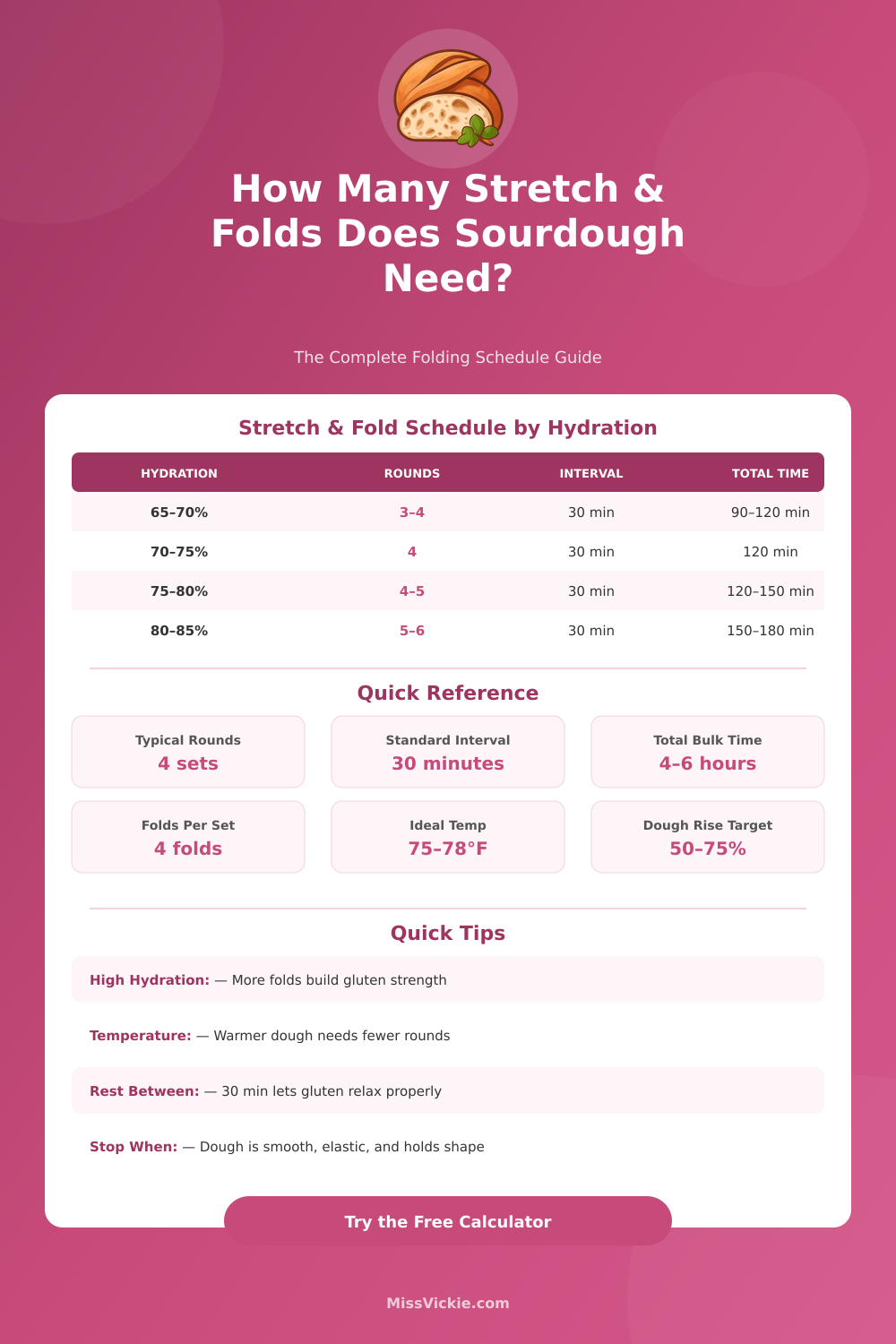
| Hydration | Recommended Rounds | Interval | Total Folding Window | Est. Bulk Ferment |
|---|---|---|---|---|
| 65–68% | 3 rounds | 30 min | 60 min | 4–5 hours |
| 68–72% | 3–4 rounds | 30 min | 60–90 min | 4–5 hours |
| 72–76% | 4 rounds | 30 min | 90 min | 4–6 hours |
| 76–80% | 4–5 rounds | 30 min | 90–120 min | 5–6 hours |
| 80–84% | 5–6 rounds | 30 min | 120–150 min | 5–7 hours |
| 84–90% | 6 rounds | 30 min | 150 min | 6–8 hours |
| Temperature | Fermentation Speed | Bulk Estimate | Adjustment |
|---|---|---|---|
| 65°F / 18°C | Very Slow | 8–10 hours | Add 1–2 extra rest hours |
| 68°F / 20°C | Slow | 6–8 hours | Add 1 extra rest hour |
| 72°F / 22°C | Moderate | 5–7 hours | Standard schedule |
| 75°F / 24°C | Ideal | 4–6 hours | Standard schedule |
| 78°F / 26°C | Fast | 3.5–5 hours | Watch dough closely |
| 80°F / 27°C | Very Fast | 3–4 hours | Reduce interval to 20 min |
| 82°F / 28°C | Rapid | 2.5–3.5 hours | Reduce interval to 15 min |
| Step | Action | Duration | Notes |
|---|---|---|---|
| 1 | Wet your hand | Seconds | Prevents sticking |
| 2 | Grab one side of dough | — | Reach under and lift |
| 3 | Stretch upward, fold over | 2–3 sec | Stretch until resistance |
| 4 | Rotate bowl 90° | — | Quarter turn |
| 5 | Repeat 3 more times | ~20 sec | 4 folds = 1 full round |
| 6 | Cover and rest | 30 min | Let gluten relax |
| Method | Best For | Gluten Strength | Difficulty |
|---|---|---|---|
| Stretch & Fold | All hydrations | Very Good | Easy |
| Coil Fold | High hydration 75%+ | Excellent | Moderate |
| Lamination | 80%+ dough | Excellent | Advanced |
| Slap & Fold | Lower hydration | Good | Moderate |
| Rubaud Method | Sticky high hydration | Good | Easy |
Sourdough bread is bread that ferments naturally using a sourdough starter instead of commercial yeast or chemical agents like baking powder or baking soda Sourdough starter is a live culture of flour and water. It ferments the dough without any commercial yeast. You can prepare starter, buy it or receive it from another baker.
Naturally occurring yeast and lactobacillus bacteria in sourdough raise the dough. The fermentation produces lactic acid, that gives the bread its taste. That a bit bitter, tangy taste of the starter is simply impossible to resist.
What is Sourdough Bread and How to Make It
Proteins in sourdough bread are indeed better digested in the body. The culture breaks down glutenin and gliadin, so bread becomes more easly digested. It also breaks down phytates, that stop the absorption of minerals.
Good sourdough has a light, airy inside with a crisp brown crust outside. A classic recipe gives an oval pain au levain, a sourdough loaf, that is mildly tangy and rich in flavor.
There is a genuinely easy way to sourdough, that skips many difficult stages. No feeding the starter, no kneading the dough and no shaping the loaf. Just mix, wait, put the wet dough in a bread pan, wait a bit more and bake.
That gives one of the best sourdough sandwich loaves. Strong white flour is a good base for beginners.
Common proportion for sourdough is 1:2:3. So one part starter, two parts water and three parts flour, all by weight. Salt goes in at two percent of the flour weight.
For instance: 100 g starter, 200 g water, 300 g flour and 6 g salt. Other popular recipe uses 290 g water, 400 g all-purpose flour, two spoons of salt and 90 g starter.
To start a starter from scratch, you can use whole grain flour and juice. One way is to mix two spoons whole grain flour with two spoons unsweetened pineapple juice or orange juice, then cover and leave at room temperature for 24 hours. It requires both yeast and lactobacilli for sourdough starter.
Yeast are not bacteria. They are fungi.
Sourdough dates maybe until 10,000 BC. Until the 19th century it was almost the only available leavening. Baking sourdough is fun, it is a science experiment in the kitchen.
It just tastes good, and that is plentyreason.