Sticky Rice Soaking Time Calculator
Estimate glutinous rice soaking time, drain time, steaming method timing, cooked yield, serving count, and texture risk from rice type, amount, soak temperature, grain age, batch depth, and serving plan.
🍚Sticky Rice Presets
Choose a common sticky rice batch, then adjust the rice type, cups or grams, water temperature, steaming setup, grain age, batch depth, serving plan, texture target, and drain time.
⚖Soak And Steam Details
Sticky rice soaking plan
Enter your batch details to estimate soak, drain, steam, and yield.
Timing Breakdown
Steam And Serving Breakdown
Step Plan
📊Sticky Rice Batch Snapshot
Sticky rice is soaked first, then steamed without simmering in cooking water. The calculator assumes the rice is rinsed well and fully submerged during soaking.
📘Glutinous Rice Type Table
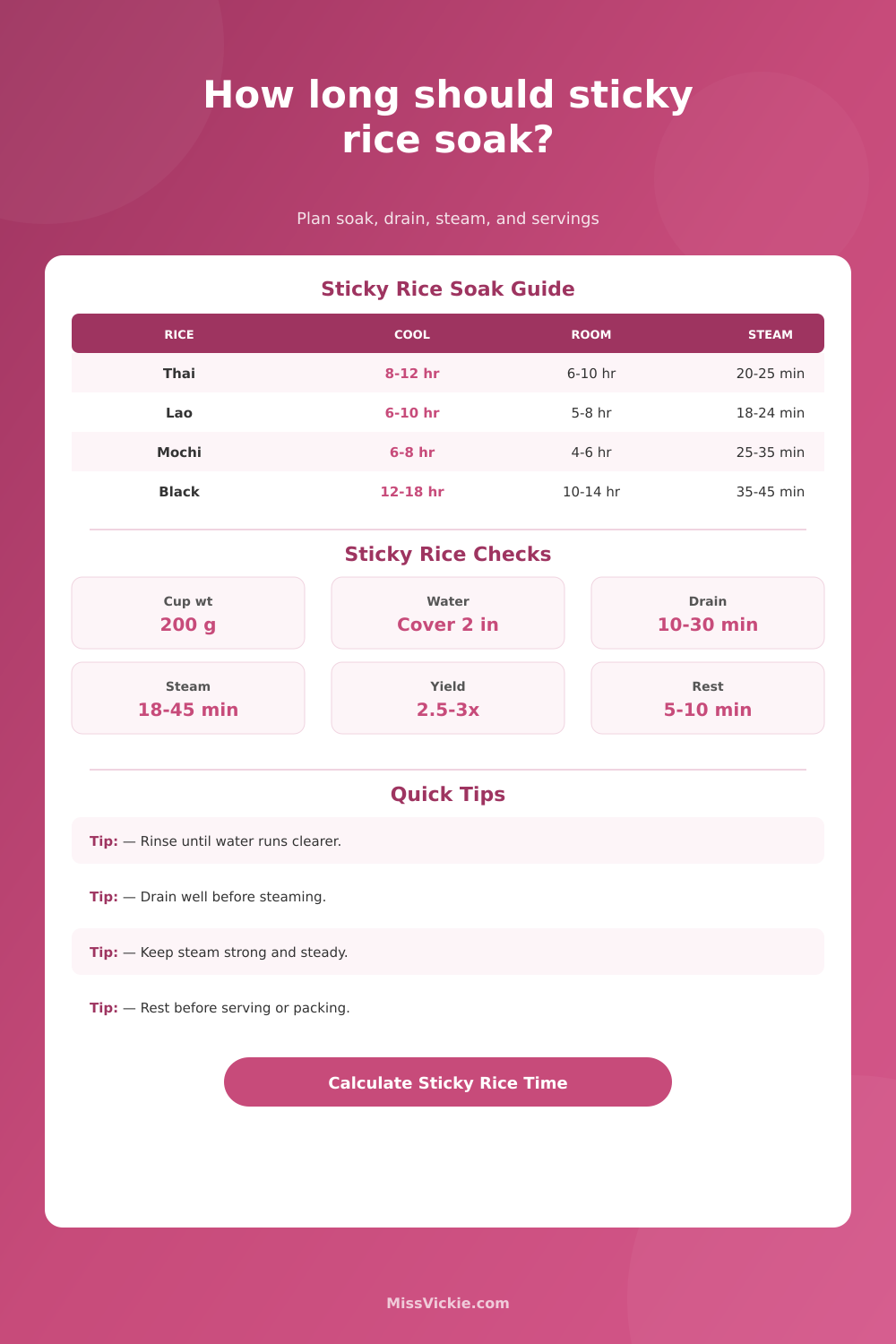
| Rice Type | Typical Soak Range | Steam Texture | Calculator Note |
|---|---|---|---|
| Thai long-grain sticky rice | 6 to 12 hours | Chewy, cohesive, classic basket rice | Best everyday baseline for Lao and Thai meals. |
| Lao or Thai new-crop sticky rice | 5 to 9 hours | Softer grains, quicker hydration | Shorten long room-temperature soaks to avoid mushy edges. |
| Aged long-grain glutinous rice | 9 to 14 hours | Chewy when hydrated through the center | Older grains need more patience and a strong steam. |
| Japanese mochigome | 4 to 8 hours | Short-grain, dense, elastic | Often used for mochi, sekihan, and sweet rice dishes. |
| Black or purple sticky rice | 10 to 18 hours | Firm bran, nutty chew | Needs a longer soak and a longer steam than white sticky rice. |
| Mixed white and black sticky rice | 8 to 14 hours | White grains soften before black grains | Soak for the black rice portion and steam until the firm grains yield. |
🌡Soak Temperature And Grain Age Table
| Condition | Timing Effect | Texture Risk | Kitchen Move |
|---|---|---|---|
| Refrigerator soak | Adds about 35 percent | Lowest warm-hold risk | Useful for overnight or next-day prep. |
| Cool water | Adds about 12 percent | Centers hydrate slowly | Good for older rice when time allows. |
| Room water | Baseline timing | Balanced grains | Most common choice for evening-to-morning prep. |
| Warm water | Cuts about 25 percent | Surface can soften early | Check earlier and avoid long holding. |
| Hot-start quick soak | Cuts about 50 percent | Higher uneven texture risk | Use only when you will steam the rice soon. |
| Very old grains | Adds 30 percent or more | Dry centers after steaming | Soak longer and steam with a flip halfway. |
💨Steaming Method Table
| Method | Typical Steam Time | Best Batch Depth | Handling Note |
|---|---|---|---|
| Bamboo cone basket | 18 to 28 minutes | Mounded, 1 to 3 inches | Flip the rice bundle once for even steam. |
| Metal steamer basket | 22 to 32 minutes | Thin to standard layer | Line with cloth if grains can fall through. |
| Cloth-lined tray steamer | 24 to 36 minutes | Wide shallow layer | Good for party trays and large flat batches. |
| Rice cooker steamer insert | 26 to 38 minutes | Small or moderate batch | Keep water below the rice and maintain steam. |
| Pressure cooker steam rack | 8 to 15 minutes | Small bowl or packet | Use natural release briefly to reduce surface wetness. |
| Banana leaf packet | 28 to 42 minutes | Small packets | Leaf wrapping slows steam entry but adds aroma. |
🥣Serving And Yield Table
| Serving Plan | Cooked Portion | Dry Rice Per Person | Best Texture |
|---|---|---|---|
| Side dish with curry or grilled meat | 130 to 160 g cooked | 45 to 60 g dry | Classic chewy clumps. |
| Main starch for dinner | 180 to 220 g cooked | 65 to 80 g dry | Chewy and cohesive. |
| Sweet coconut dessert | 120 to 150 g cooked | 45 to 55 g dry | Soft enough to absorb coconut cream. |
| Meal prep portions | 150 to 180 g cooked | 55 to 65 g dry | Slightly firm so it reheats cleanly. |
| Party tray or buffet | 100 to 140 g cooked | 38 to 52 g dry | Moist but not wet after resting. |
| Snack portions | 80 to 110 g cooked | 30 to 40 g dry | Compact, hand-held clumps. |
⚖Sticky Rice Comparison Grid
Thai or Lao long-grain sticky rice soaked at room temperature and steamed in a bamboo cone.
Warm water can rescue timing, but the rice should be steamed soon after draining.
Bran-rich black sticky rice needs more soaking and a longer steam than white grains.
Large mounds need extra steam time and a mid-steam turn for even centers.
💡Sticky Rice Timing Tips
This calculator estimates practical kitchen timing. Rice brand, harvest moisture, rinse quality, steamer airflow, and batch shape can shift the final doneness check.
It’s a nightmare: you’re 2 hours out from eating but that sticky rice is still rock-hard. What happened? That fear isn’t unfounded. Glutinous rice have different characteristics than long-grain rice. Unlike the latter, which cooks like pasta (boil it), this type requires time and water, not to mention some finesse.
That’s where the calculator comes in. But knowing why the digits add up will save you from the dreaded dry center or mushy rice. So what is the variable? The answer: Temperature.
How to Cook Sticky Rice Perfectly
How quickly does water penetrate the starch matrix? It will cook most slowly in the fridge (meaning you should of added about thirty-five percent more liquid than the recipe says). This makes it safe, if necessary, to prep some rice now to eat tomorrow morning.
At room temp, that’s our benchmark normal situation. It is warmer yet, and it reduces soaking time a lot. But it also has a tendency to soften just the exterior layer of grain before the interior is penetrated. That means that when you go to steam it, the exterior disintegrates but the center stays uncooked. Think of it as a texture trap. Use warm water only if you plan to drain and immediately proceed to cooking. Otherwise, it’s good for something you’re planning to cook up right away.
Less experienced cooks underestimate importance of age. Rice that’s been freshly harvested and milled in the past six months will take up water faster because its kernel hasn’t completely lost the moisture it held at harvesting, nor has its bran layer hardened into something that blocks water. Bagged rice that’s sat on a shelf too long has had time to dry out, sealing off its starch granules and making them uninviting to moisture. To hydrate such older grains thoroughly, you need more soaking time so the water can reach all the way through to middle. Rushing a batch of aged rice results in chewy exteriors and hard middles.
The tool takes that into account. When you choose older inventory, it gives you benefit of the doubt and extends the soaking time. This spares you the guesswork of having to test each grain for resistance between your teeth.
Good texture depends on depth in the steamer. Steam reaches every grain and cooks them quickly when there’s just a small amount. Deeply packed mounds form insulation barriers and take longer to cook; the heat must first break through before reaching the middle of the pile. If your rice is going into a bamboo cone (or any other big party tray) then this factor need to be considered. Halfway through cooking, flip the rice to even out the heat, but only if it was properly soaked first. Otherwise, uneven soaking plus a high pile equals quick disappointment.
Soak them, then drain them. It is very important and also very easy. They should be matte but not wet. They shouldn’t drip with water or steam into a gluey mass of grains. Instead, they should be separate and chewy in distinct little clumps. Too dry, they’ll steam up unevenly; too wet, and…you get the idea. Let them have a quick sit in the colander to drain off any surface moisture, but not dry them out inside. It’s a small step, but it makes all the difference when you eat them.
The texture is a matter of serving style: Do you want grains to be distinct and firm, holding up well to strong sauces in the side dish? Or do they need to be more yielding, almost soft, so they won’t break down completely when bathing them in coconut cream at dessert time? Does it matter if you’re cooking a side, a main starch, or something sweeter, like mango sticky rice? This tool will adjust its suggestions accordingly. (It’ll even estimate yield, to help with portion control.)
Two and a half cups of cooked sticky rice come from one cup of dry; that’s rough guess based off variety, and how long you plan to let it soak. The other thing about black sticky rice is that it needs much more care due to its bran layer: Soak longer, steam longer… if you try to rush the cooking of black rice like white Thai sticky rice, you’re going to end up with some hard, not-cooked-in-the-middle bites. This is clear from the chart on the page, which explains that each grain wants a different timeline.
But really, sticky rice’s all about letting go and trusting the process. Letting it hydrate is one thing you can’t rush. Plan accordingly. And let the grain do its thing, absorbing water gradually and uniformly. When you get past the variables (depth, age, temperature), when you know those interactions, your stress goes away. You’re no longer making wild guesses, but instead are able to plan.
The outcome? A perfectly cooked basket of fragrant, chewy rice that stays intact; just right. Ready to eat by hand. Or plated with loving care. Patience is the secret ingredient, not just adding more salt or sugar at the end. That’s what most people don’t get.