
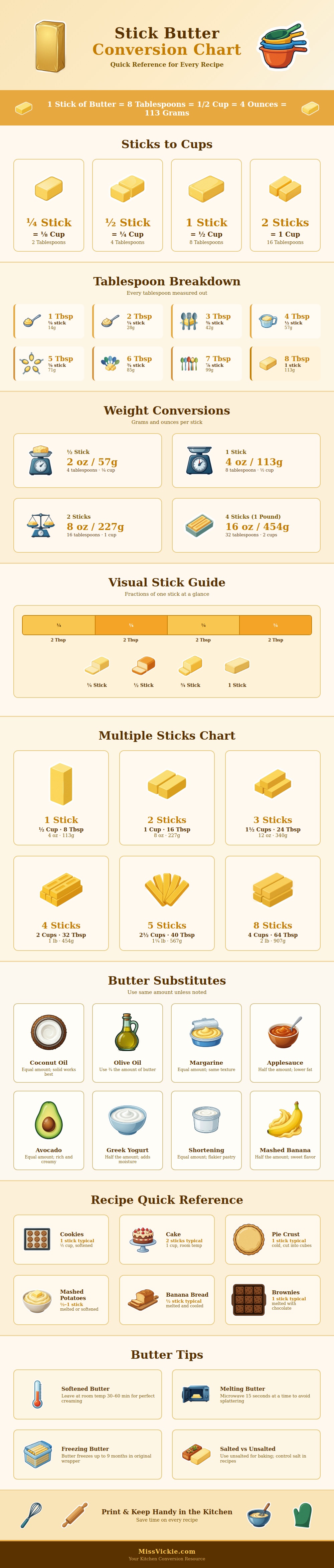
A stick of butter is actualy four times as large as one single serving (one tablespoon), divided that way by standard US butter packaging: each stick have eight segments. By knowing measurements, you’ll be able to bake precisely. Fat impacts both how fast goods rise and their texture. It also makes measuring out any odd number of tablespoons (say, three) possible without having to hunt around for spoons. Simply count the indentations on your butter package!
Half a cup is one stick of butter. But in cooking, you want to know precisely how much; a recipe may call for two sticks while a delicate cake demand exactly three quarters of a stick. You don’t want to go by guesswork with your eyes, this will throw off the ratio of ingredients and thus final dish. Butter is not like flour when it comes to its chemical behavior: Using less will result in something that’s dry; using too much will be…well, just greasy.
How to Measure Butter Easily
Here’s what it means, according to conversion chart: A quarter stick is an eighth of a cup (or two tablespoons). Knowing this comes in handy if you’re only using a tablespoon here and there (for example, three tablespoons) rather than having a whole stick on hand. Rather than scoop up a sticky mess of melted fat afterwards, simply break off what you need based off the lines of the wrapper. This keeps both your hands and kitchen clean and saves you time.
The other reliable way to measure at home is by weighing ingredients on your kitchen scale. Fat solids like butter is more difficult to measure by volume; they compress different, making a cup measurement less accurate. However, the same amount of fat will weigh the same every time: A stick should of be about 113 grams, meaning two sticks = 1 cup or 227 grams. If you cook from recipes that include grams, this method works well, especially since many international ones don’t call for cups. It’s an all-American/global solution, and it doesn’t involve any added math.
Butter, too, must be handled correctly for good results in the kitchen. It’s important that butter softens enough so you can dent it with your finger but doesn’t gets fully melted. Letting it sit out on counter will soften properly within 30 to 60 minutes; popping it in the microwave runs the risk of partially melting it. Depending on what you’re making, butter needs to be either in its cube form (as in a pie crust) or at room temperature (for things like cookies). Butter that’s the wrong temperature can result in structural problems for baked goods.
However, when dietary restrictions or pantry shortages strike, there is substitutes: you can try swapping butter with unsweetened applesauce or even coconut oil. Remember that each of those has different characteristics than butter. The fruit will add sweetness and moisture; oil doesn’t have any water at all. In some cases, you might be able to make a straight substitution, though others will require adjusting other elements in the recipe. Knowing how butter functions in a recipe will determine whether it makes sense to use an alternative.
Learning these conversions makes cooking easier because now you know how to rely on your measurements more. Instead of wondering if you measured enough, you can rely on precision. When a recipe has strange amounts and makes you nervous, you’ll have these at your fingertips so you don’t freak out. Have them somewhere handy in your kitchen so you can just snap off the segments you need and be confident in what you’re doing. Once you learn the layout, the stick is easy.