MissVickie kitchen calculator
Stevia to Sugar Conversion Calculator
Convert sugar to stevia by format and sweetness strength, then rebuild the missing sugar bulk, browning, tenderness, and moisture support your recipe still needs.
Pick a starting point, then fine tune the stevia format, sweetness strength, recipe type, bulk replacement, and texture support. Stevia sweetens without the weight, spread, browning, or syrupy body of sugar, so baked goods need more than a direct sweetness swap.
Conversion Breakdown
Bulk Loss Meter
Most of the original sugar volume is gone, so structure support matters for spread, crumb, gloss, and browning.
Pure stevia powder
Liquid drops or extract
Spoonable cup-for-cup blends
Packets
Drinks, smoothies, and yogurt
Cookies and bars
Cakes, muffins, and quick breads
Jams, syrups, and fruit fillings
Best for sweetness reduction, but concentrated forms do not replace sugar structure.
Browns and adds syrupy body better than many low-calorie sweeteners, but can soften baked goods.
Adds bulk and crunch, but can taste cooling and may recrystallize in sauces or frostings.
Works similarly to spoonable stevia blends when the carrier sweetener provides volume.
Adds moisture, browning, and aroma, but needs liquid adjustment in baking.
Provides bulk, browning, aeration, tenderness, spread, preservation, and moisture retention.
When you remove 1 cup sugar from cookies
When you remove 1 cup sugar from cake
When you remove sugar from sauces
When you remove sugar from yeast bread
Tip 1: Convert sweetness first, then rebuild bulk.
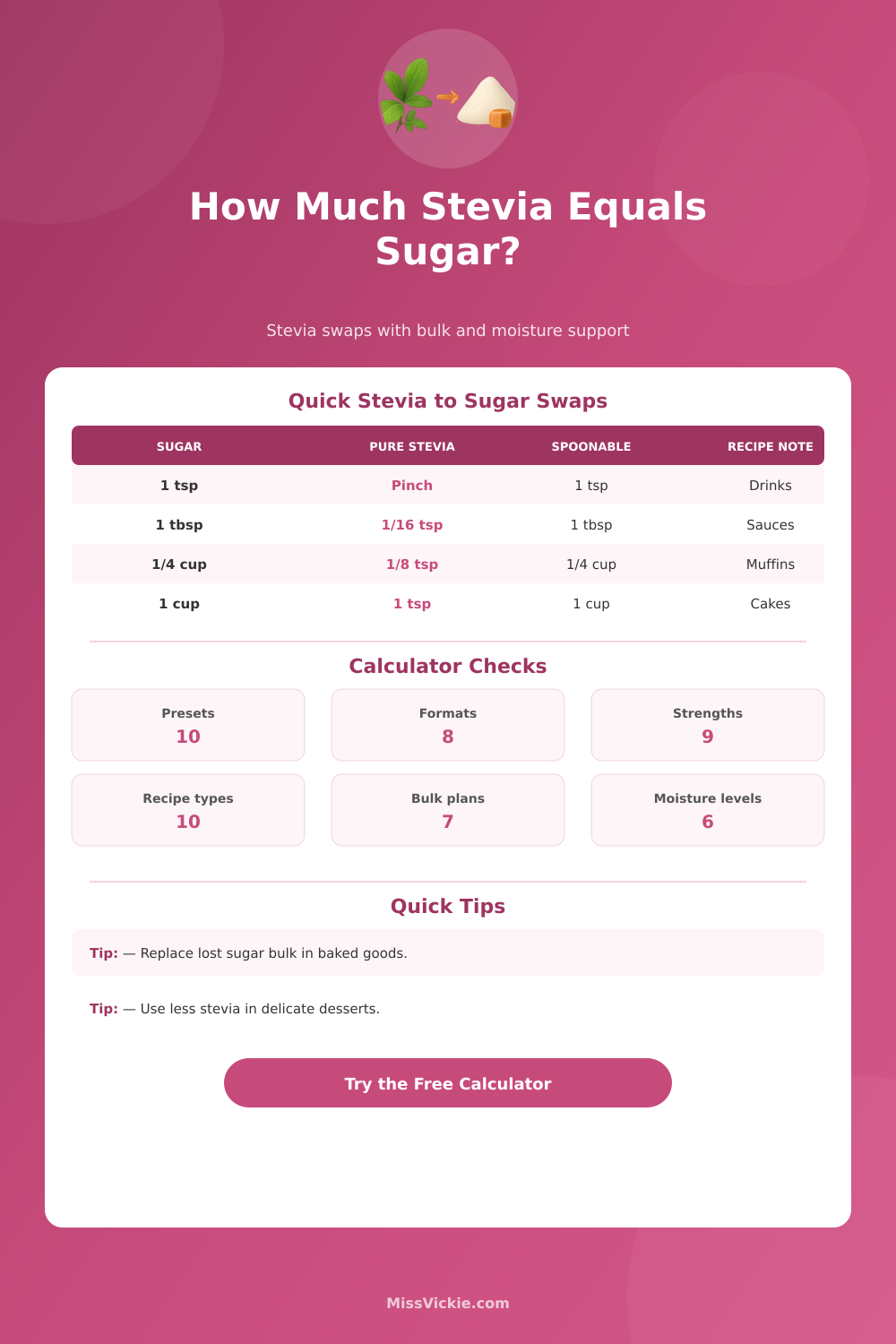
A tiny amount of pure stevia can match the sweetness of a large amount of sugar, but it cannot cream with butter, trap air, caramelize, or hold moisture. If the recipe uses more than 1/4 cup sugar, treat the missing bulk as a separate ingredient decision.
Tip 2: Stop before the aftertaste line.
Stevia can turn bitter when pushed too high. For delicate cakes, custards, whipped toppings, and vanilla desserts, start slightly under the calculated amount, rest the mixture for a few minutes, then adjust in tiny increments.
This calculator estimates the stevia needed to match a selected sugar amount, then separately estimates the volume of sugar bulk that disappears. That split matters because stevia is a sweetener, while sugar is also a structural ingredient.
For drinks and simple sauces, the stevia amount may be all you need. For cookies, cakes, muffins, quick breads, jams, frostings, and fillings, use the bulk and moisture cards as a starting point, then judge the batter or dough by feel.
Brand labels can vary dramatically. If your stevia package gives its own equivalency, use that label as the final authority and use this calculator for bulk, recipe type, and texture planning.
Stevia is a sweetener that many person use as an replacement for sugar. Many people desire to use stevia in they recipes in order to reduce the amount of sugar that they consume. However, stevia do not work in the same manner as sugar does.
While sugar add sweetness to a recipe, it also adds structure and moisture to that recipe. Stevia only adds sweetness to a recipe, but does not add structure or moisture to a recipe. Because stevia is much more concentrated than sugar, a much smaller amount of stevia is required to provide the same level of sweetness as sugar.
How to Replace Sugar with Stevia
However, using such a small amount of stevia will leave an empty space in the recipe in which the structure of sugar used to filling. The structure of sugar helps to hold moisture in the recipe, as well as air in the recipe. Additionally, sugar allow the edges of food to brown.
The calculator allows you to enter the original amount of sugar that was included in the recipe. Additionally, the calculator allows you to select the format of the stevia that you will use. Stevia can come in a variety of formats, and some formats contains more filler than others.
For example, stevia can be available in a powder form, in drops, or in spoonable blends. The calculator will calculate for you the amount of stevia that you need to use, as well as estimate the amount of volume of sugar that will be missing from your recipe if you use the calculated amount of stevia. This estimation of the volume of sugar that will be missing can help you to decide what additional ingredient to use in your recipe to fill that empty space that sugar created.
Many people make the mistake of using stevia to replace the sugar in their recipe, but they do not account for the bulk of the sugar. Bulk refer to the physical matter that sugar is to the recipe. For example, the bulk of the sugar can steam in the baking process, as well as the ability of sugar to play a role in the browning of the surface of the food.
When sugar is replaced with stevia, physical matter is removed from the recipe. The calculator makes it possible for you to account for and compensate for the removed physical matter of the recipe. You can choose to replace sugar with ingredients like allulose, oat flour, or yogurt.
However, each of these ingredients have different properties. For instance, allulose can help with browning of the food, whereas yogurt will add moisture to the recipe. Additionally, if you use extra flour to replace the bulk of the sugar, you will need to add liquid to the recipe to make the texture of the food even more.
Depending upon the type of recipe that you are creating, the calculator may have different requirements for your recipe than others. For instance, a lemonade recipe will not require much structure of the ingredients of the recipe. However, recipes that contain cookies or cakes requires more structure from the ingredients.
Thus, a cookie or cake recipe will be less forgiving if you remove sugar from the recipe. The calculator will ask for the type of recipe that is being made. Based upon the answer to this question, the calculator can inform you of the amount of structure that is required by the recipe.
For instance, cookies will not spread as much if the bulk of the sugar is removed from the recipe. The same can be said for cakes. They will not provide the same amount of lift if sugar is removed from the recipe.
Jam recipes will lose their glossy appearance if the bulk of sugar is removed from the recipe. Stevia products are not all the same. Some brands of stevia are 100 times as sweet as sugar, while other brands are 300 times as sweet as sugar.
The strength setting on the calculator will allow you to account for the strength of the brand of stevia that you are using. For example, if you know that your brand of stevia is 300 times as sweet as sugar, you can set the multiplier to 300. This will allow the calculator to provide you with the amount of stevia that you should use in your recipe to provide the same level of sweetness as the amount of sugar that was originally in the recipe.
The calculator also includes options for users to account for bulk and moisture in their recipes. Because sugar contributes to both bulk and moisture in the recipe, you will need to account for this when you are using stevia to replace the role of sugar. You can decide how you would like to replace the bulk in the recipe, as well as how you want to replace the moisture in the recipe.
The bulk and moisture options will be combined with the recipe type that you selected in the calculator. Based upon these variables, the calculator can suggest an adjustment to the recipe. However, this suggestion is not a guarantee that the recipe will turn out as you would like.
The calculator was created to help you make fewer mistake when you are learning how to mix ingredients together. You should not assume that every type of stevia product is the same as every other type of stevia product. For instance, stevia blends that contain brown sugar will behave differently from products that are 100% pure stevia powder.
The calculator adjusts the bulk credit for each type of stevia format to account for these differences in each product. One common mistake that many cooks and bakers make is adding too much stevia to recipes that contain delicate dessert products. Because too much stevia can impart a bitter flavor into the recipe.
The calculator has a flavor guardrail so that you can avoid this mistake. For items like custards or frostings, the calculator will suggest using slightly less stevia than you may otherwise use. Even with the calculator, there are still some variables in the recipe that the calculator cannot account for.
For instance, the level of humidity in the environment in which the recipe is being made can still have an impact upon the recipe. Additionally, the way that the oven evenly browns the food can also have an impact upon the outcome of the baking process. Thus, the calculator still cannot account for these variables.
While the calculator was created to help you account for as many variables as possible in the recipe, you may still have to use your own judgment in the baking process. The calculator was created to help you reduce the number of variables that you have to account for when learning how to make recipes with the ingredients that you use in your kitchens at home. The best way to use the calculator is to first account for the sweetness of your recipe, this should be the first step in the process.
You may also want to account for the bulk and moisture elements of the recipe at this stage. If the sugar was used in your recipe for browning or tenderness, you may need to make a second adjustment to the recipe. However, if the sugar was only used for sweetness to the recipe, then using stevia may be all that you need for your recipe.
This two-step process will help you to not waste your ingredients as well as your time in the kitchen.