Steamed Salmon Time Calculator
Estimate steamed salmon time from fillet thickness, steamer type, liquid level, aromatics or vegetables, starting temperature, doneness target, lid tightness, batch load, and altitude.
🍲 Steamed Salmon Presets
Choose a kitchen setup, then fine tune the thickness, steamer, lid fit, liquid level, vegetable bed, and final temperature.
⚖ Salmon and Steamer Details
Your Steamed Salmon Timing
Results update as you adjust the steamer setup.
Timing Breakdown
Steam Plan
🌡 Steamed Salmon Timing Anchors
Often checks around 6 to 8 minutes.
Most stovetop baskets land near 9 to 12 minutes.
Needs a wider check window and a tight lid.
Use an instant-read thermometer for final safety.
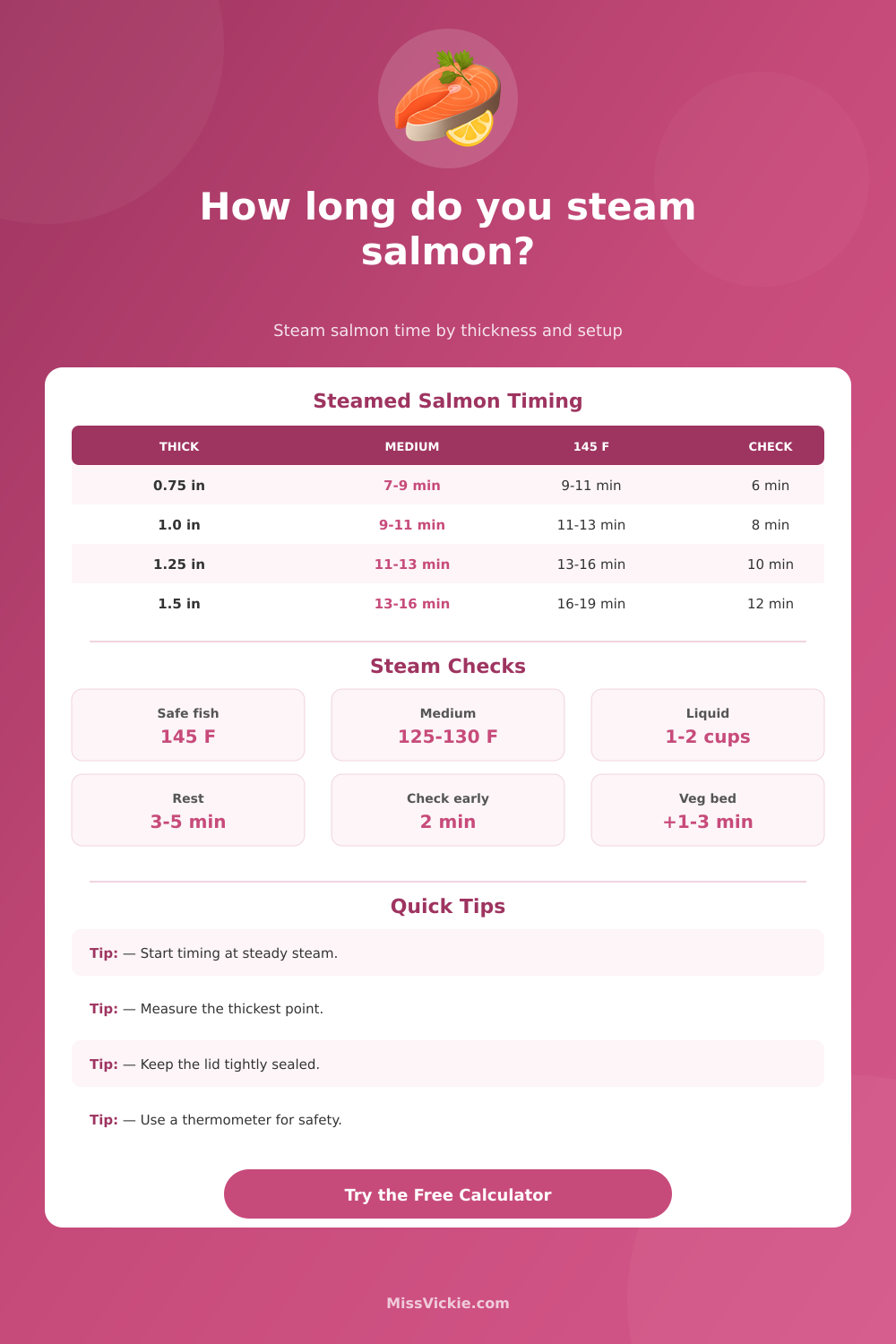
📋 Thickness Timing Table
| Fillet Thickness | Medium Moist Flakes | 145°F Safe Finish | First Check |
|---|---|---|---|
| 0.5 to 0.75 inch / 1.3 to 1.9 cm | 6 to 9 minutes | 8 to 11 minutes | At 5 to 6 minutes |
| 1 inch / 2.5 cm | 9 to 11 minutes | 11 to 13 minutes | At 8 minutes |
| 1.25 inches / 3.2 cm | 11 to 13 minutes | 13 to 16 minutes | At 10 minutes |
| 1.5 inches / 3.8 cm | 13 to 16 minutes | 16 to 19 minutes | At 12 minutes |
| 2 inches / 5 cm or whole side | 17 to 21 minutes | 21 to 25 minutes | At 15 minutes |
Times assume steady steam, a tight lid, refrigerator-cold salmon, and a single layer. Start checking earlier for wild salmon or tail pieces.
🍜 Steamer Setup Table
| Steamer Type | Timing Effect | Liquid Guidance | Best Use |
|---|---|---|---|
| Stovetop basket | Baseline | 1 to 2 cups, below basket | Everyday fillets and small batches |
| Bamboo steamer | Add about 5% | Wide pan with active simmer | Gentle steaming with herbs or leaves |
| Electric steamer | Add about 10% | Fill to appliance line | Hands-off batches and meal prep |
| Multi-tier stack | Add 15% or more | Keep strong steam under lower tier | Large batches with space between pieces |
| Pressure trivet | Short cook, longer recovery | Use the cooker minimum | Thick portions when texture is less delicate |
🌿 Aromatics and Vegetable Bed Table
| Under the Salmon | Timing Change | Moisture Effect | Watch Point |
|---|---|---|---|
| Bare rack or plate | No change | Cleanest steam contact | Oil lightly to prevent sticking |
| Dill, scallion, ginger, herbs | Add 0 to 3% | Aromatic but little insulation | Keep stems thin and even |
| Lemon slices | Add about 3% | Protects underside, adds acidity | Thin slices steam more evenly |
| Spinach, zucchini, asparagus | Add about 8% | Soft vegetable bed releases water | Do not mound under the thick center |
| Carrots, potatoes, dense vegetables | Add 15% or more | Insulates the fish heavily | Slice very thin or pre-steam first |
🧪 Doneness and Carryover Table
| Doneness Target | Pull Temperature | Final Temperature | Texture Cue |
|---|---|---|---|
| Medium-rare | 118 to 120°F | 120 to 125°F | Silky center, translucent stripe |
| Medium | 127 to 130°F | 130 to 135°F | Moist flakes, slightly glossy center |
| Medium-well | 137 to 140°F | 140 to 143°F | Firm flakes, mostly opaque |
| Safe minimum | 142 to 145°F | 145°F | Opaque and separates easily with a fork |
| Well-done | 150°F plus | 150°F plus | Firm throughout, more albumin likely |
🔄 Steaming Method Comparison
Fastest everyday setup for 1-inch fillets with a tight lid and steady steam.
Gentler heat and fragrant aromatics, especially with parchment or leaves.
Useful for larger batches, but recovery time depends on the appliance.
Short cook time after pressure, with extra time for heat-up and release.
💡 Steamed Salmon Tips
The beauty of steamed salmon is that you don’t think of it as a set amount of time; you treat it as a variable result. At home, many people put a timer on for 10 minutes, then pull it out only to discover it’s either still raw in the middle or overdone in flakes. Rarely is it because there was anything wrong with the fish. It’s because you didn’t quite grasp how heat behaves in water vapor under certain conditions. Steaming, though gentle, are unforgiving if you’re not properly set up.
Too many holes in your steamer lid? Your basket crowded with food? You’ll drop the temperature down to the point where the cook stalls and you might not even realize it till it’s too late. So what do those variables mean? Once you plug in your own values, the fancy math becomes the work of a couple button clicks on this calculator. It eliminates the guesswork with varying equipment and thicknesses.
Why Your Steamed Salmon Is Never Cooked Right
A fillet appears as just a piece of fish to most folks. Physics knows it has three heat resistant zones. You can’t cook an entire piece based off the thickest portion until the center is safe. Uneven thickness fillets is done long before the middle is even close to safe temps. The bulkiest part measures more than the average width because you use it as the starting point for your timing.
The other thing you can’t intuit: your starting temp matters a lot. That cold-core fillet fresh off the fridge will suck down energy just to reach room temperature and begin cooking. Starting with a room-temp fish mean its protein is beginning to break down instantly when exposed to steam. The colder the fish is, the longer it takes to react. The calculator factors in thermal delay (aka “lag”) via added minutes for frig-cold/frozen-starts. This way, you don’t have to chase a finished surface at the expense of an underdone interior. Easy mistake, rushing this step; be patient, save yourself texture heartbreak later.
To complicate things further (and to make generic recipes useless), there’s another wrinkle: What kind of steamer do you have? An electric one holds the level of vapors constant, but it takes longer to recover once the lid’s lifted if the basket is full. Stove-top basket-and-pot ones recovers heat faster when you open the lid because the pot holds its own heat. However, their lids don’t fit tightly. This means precious moisture and heat are lost to the surrounding air.
And then there are the gorgeous bamboo baskets, which look good but also leak heat and moisture into the air. Every device has an efficiency rating, which will affect final clock time. What worked for me in a heavy-bottomed pot with a tight-sealing lid won’t be the same number of minutes as in a bamboo set-up. The reference table on the page breaks down those equipment-specific adjustments so you can adjust your expectations accordingly.
While the vegetables beneath the fish add their flavors to the broth, they also alter its ability to conduct heat underneath the fillet. Steaming freely around thinly-placed items (such as sliced lemons or a bed of dill) adds little resistance. Heavier vegetables (e.g., carrot, potato), on the other hand, form a thermal buffer that takes longer for heat to pass through and reach the fish. Whether this is good or bad depends on your desired result: while it can prevent sticking, it can also cause undercooked spots if you don’t adjust the overall cook time. Taking these material properties into account, the tool ensures accurate timing no matter how complex your plating becomes.
“Because altitude changes how consistently something cooks, and because it’s important to cook precisely, here’s how: The higher the elevation, the lower the boiling point of water. At 5,000 feet, steam has less heat than it does at sea level. That slows down the cooking. Nothing else changes visually, so your fish will look done even when it isn’t. Cooking to time, not to temperature, doesn’t protect from foodborne illness if the water’s not hot enough to do the job fast.
There are no hard-and-fast doneness goals; personal taste plays a larger role here. Many chefs lean toward medium-rare (a meaty silk), while well-done is firmer and flakes nicely, making it good for a heavy sauce or a family-style meal. The calculator enables you to adjust the desired level of doneness. It will figure out what pull temp to aim for so that the fish’s interior has time to continue cooking and increase slightly beyond your target point.
If you let it sit too long in the steam after pulling it, it’ll dry out. If you pull it sooner, some residual heat will gently complete the process. Don’t skip out on rest time. Salmon will continue to cook once removed from the heat just as all meats do. Allowing the proteins to relax and distribute their juices is important. If you don’t give them time they’ll lose moisture to the plate rather than retaining it in your bite.
Trust the timer to get you started, trust the thermometer to get you through the middle, but most importantly trust your patience to help you cross the finish line. Steamed salmon can be more of a craft than a matter of luck when you start working with the physics rather than against the clock. It can transform an ordinary weeknight dinner from routine to savorable.