Steak Doneness Temperature Calculator
Dial in pull temp, carryover, and rest timing for ribeye, strip, filet, flank, and reverse sear steak cooks without guessing the finish.
Each preset loads a real steak scenario with cut, thickness, weight, cooking method, target doneness, and rest so the calculator runs instantly.
📋 Full Breakdown
| Doneness | Pull Temp | Finish Temp | Texture Cue |
|---|---|---|---|
| Blue | 115 F / 46 C | 118 F / 48 C | Very soft |
| Rare | 120 F / 49 C | 125 F / 52 C | Warm red |
| Medium-rare | 130 F / 54 C | 135 F / 57 C | Red center |
| Medium | 140 F / 60 C | 145 F / 63 C | Pink core |
| Medium-well | 150 F / 66 C | 155 F / 68 C | Small pink |
| Well done | 160 F / 71 C | 165 F / 74 C | No pink |
| Cut | Best Thickness | Carryover | Method Fit |
|---|---|---|---|
| Ribeye | 1.25-1.75 in | High | Grill, pan |
| Strip | 1.0-1.5 in | Med-high | Grill, pan |
| Filet mignon | 1.25-2.0 in | Medium | Pan, reverse |
| Sirloin | 1.0-1.5 in | Medium | Grill, broil |
| T-bone | 1.25-1.75 in | Med-high | Grill, reverse |
| Porterhouse | 1.5-2.0 in | High | Reverse, grill |
| Flank | 0.5-0.85 in | Low | Broil, fast pan |
| Skirt | 0.35-0.65 in | Low | Broil, hot pan |
| Chuck eye | 1.0-1.5 in | Med-high | Pan, grill |
| Tomahawk | 2.0-2.75 in | Very high | Reverse, grill |
| Rest | Thin Cut | Medium Cut | Thick Cut |
|---|---|---|---|
| 3 min | +2 F | +3 F | +4 F |
| 5 min | +3 F | +4 F | +6 F |
| 7 min | +4 F | +6 F | +7 F |
| 9 min | +4 F | +6 F | +8 F |
| 12 min | +5 F | +7 F | +9 F |
| 15 min | +5 F | +8 F | +10 F |
Carryover cooking are the process of the internal temperature of the steak continuing to rise after removing it from the heat. The heat that is trapped in the outer layer of the steak can travel into the center of the steak while it rest. If you dont account for carryover cooking, however, you may find that your steak are overcooked.
To avoid this outcome, you must use a pull temperature for your steak, which is the temperature at which you should remove the steak from the heat source in order to reach your desired internal temperature after the steak has rested. The thickness of the steak is one of the factor to consider in determining the pull temperature for the steak. Thick cut of steak will experience more carryover cooking than thin cut of steak.
How carryover cooking affects your steak
For instance, a thick cut of steak, like a ribeye that is one and a half inch thick, will experience more carryover cooking than a thin cut of steak, like a flank steak that is only half an inch thick. To determine the thickness of the steak, measure the thickness of the steak at the center of the cut of meat. Thin cuts of steak can be pulled closer to the target temperature than thick cut of steak, however.
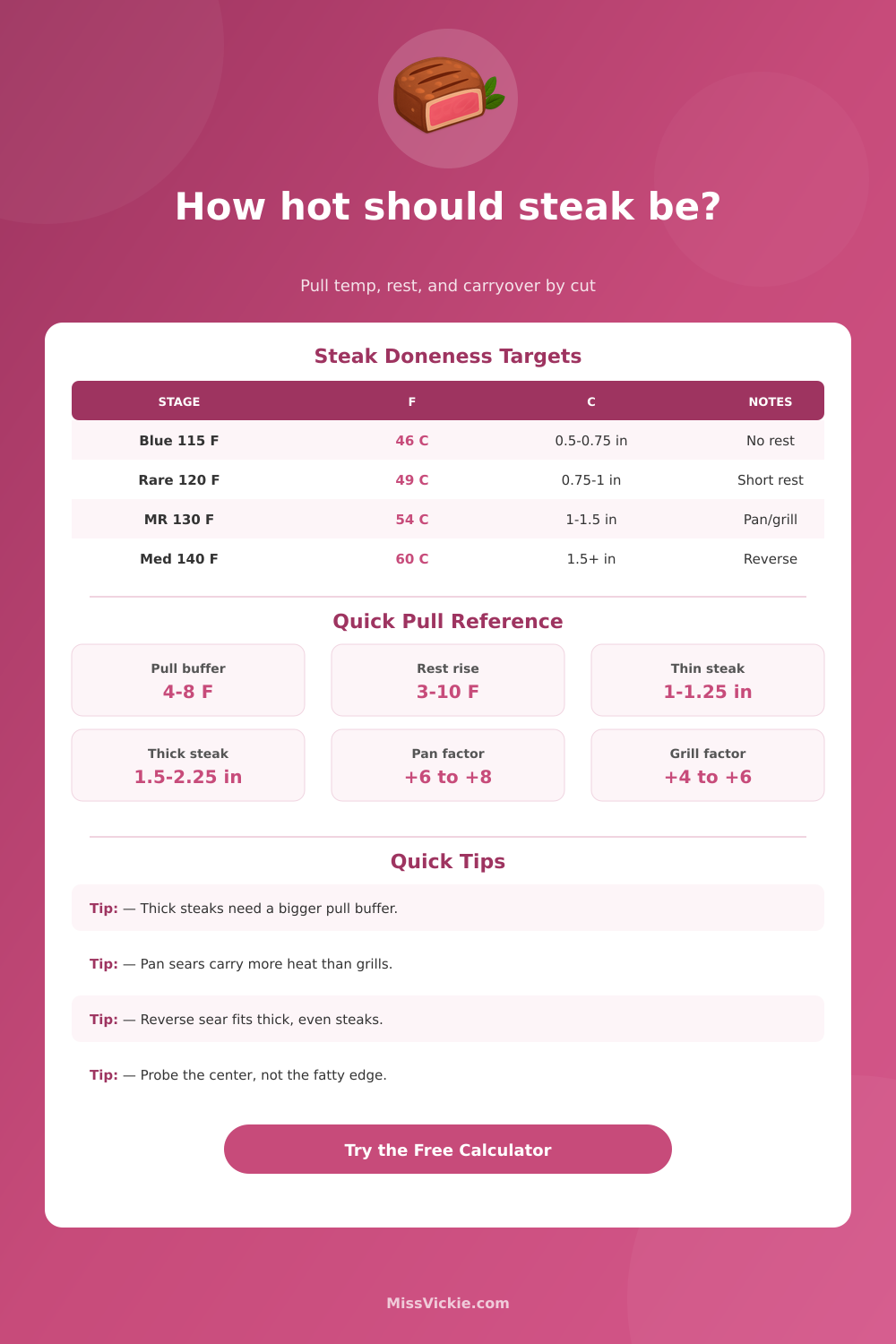
Thick cuts of steak should of been pulled five to ten degrees before the target temperature. The mass of the steak and the presence of a bone in the cut also impact the amount of carryover cooking that may occur. Steaks with a larger mass will retain more heat than steaks with a smaller mass.
Additionally, if the steak contain a bone, like a porterhouse or tomahawk steak, that bone will continue to cook the meat even after you have removed the steak from the heat source. The method in which the steak was cooked also has an impact on the carryover cooking of the meat. For instance, a cast iron pan will retain more heat than an open grill flame, so you will experience carryover cooking with a steak cooked on a cast iron pan rather than on a grill.
The pull temperature will also change depending on the doneness level that you want to cook your steak to. For instance, blue steaks should be pulled at 115 degrees F because a blue steak should have a cool center. Rare steaks should be pulled at 120 degrees F for a warm red center.
Medium rare steaks should be pulled at 130 degrees F, which is the preferred doneness level for most individuals. Medium steak should be pulled at 140 degrees F, but you should take care when cooking to medium doneness because the texture of the steak will be firmer. Finally, you should also take care with medium well and well done steaks, as there is a small window in which to remove the steak from the heat source.
Any longer than that window, and the protein within the steak will begin to dry out. It is necessary to allow the steak to rest after it has been removed from the heat source. This resting period allow for the juices to redistribute within the cut of meat, as well as for the temperature of the steak to even out throughout the cut of meat.
Thin cuts of meat only need to rest for three minute, but thick cuts of meat, like a two inch tomahawk steak, may need to rest for twelve minutes or more. Allowing the steak to rest is important to ensure that the juices will not flood the cutting board when you carve the steak. There are some common mistakes in determining the internal temperature of the steak.
One of the most common is probing the steak for temperature at the fatty edge of the steak rather than the center of the steak. The fat will register at a higher temperature than the center of the steak. Another potential mistake is ignoring the starting temperature of the steak.
If the steak came from the refrigerator, it will be cold to the touch and take longer to cook than if it started at room temperature. Finally, an easy mistake is to skip the resting period altogether. Skipping the resting period will prevent the juices from redistributing throughout the steak.
To avoid these mistakes, use an instant read thermometer to determine the temperature at the dead center of the steak.