🧂 Spice Converter Calculator
Convert spices between teaspoons, tablespoons, cups, and grams instantly
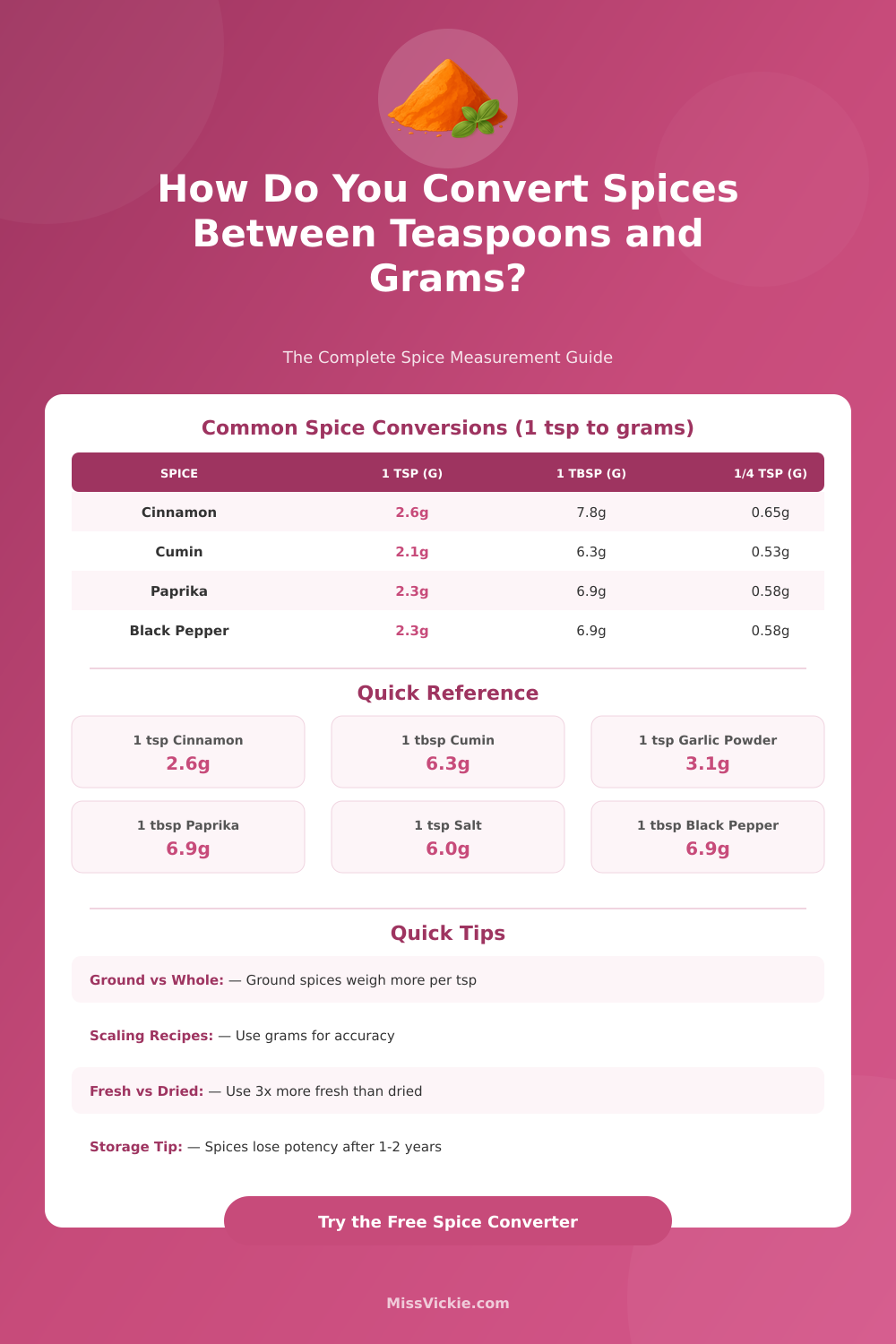
| Spice | 1/4 tsp (g) | 1 tsp (g) | 1 tbsp (g) | 1/4 cup (g) |
|---|---|---|---|---|
| Allspice (ground) | 0.6g | 2.4g | 7.2g | 28.8g |
| Basil (dried) | 0.4g | 1.5g | 4.5g | 18.0g |
| Black Pepper | 0.6g | 2.3g | 6.9g | 27.6g |
| Cardamom | 0.5g | 2.0g | 6.0g | 24.0g |
| Cayenne Pepper | 0.6g | 2.3g | 6.9g | 27.6g |
| Chili Powder | 0.6g | 2.5g | 7.5g | 30.0g |
| Cinnamon | 0.65g | 2.6g | 7.8g | 31.2g |
| Cloves (ground) | 0.7g | 2.8g | 8.4g | 33.6g |
| Coriander | 0.5g | 1.8g | 5.4g | 21.6g |
| Cumin | 0.5g | 2.1g | 6.3g | 25.2g |
| Curry Powder | 0.6g | 2.5g | 7.5g | 30.0g |
| Garlic Powder | 0.8g | 3.1g | 9.3g | 37.2g |
| Ginger (ground) | 0.6g | 2.3g | 6.9g | 27.6g |
| Nutmeg | 0.7g | 2.8g | 8.4g | 33.6g |
| Onion Powder | 0.6g | 2.5g | 7.5g | 30.0g |
| Oregano (dried) | 0.5g | 1.8g | 5.4g | 21.6g |
| Paprika | 0.6g | 2.3g | 6.9g | 27.6g |
| Salt (table) | 1.5g | 6.0g | 18.0g | 72.0g |
| Thyme (dried) | 0.4g | 1.5g | 4.5g | 18.0g |
| Turmeric | 0.75g | 3.0g | 9.0g | 36.0g |
| Measurement | Teaspoons | Tablespoons | Cups |
|---|---|---|---|
| 1/4 teaspoon | 0.25 tsp | 0.083 tbsp | 0.0052 cup |
| 1/2 teaspoon | 0.5 tsp | 0.167 tbsp | 0.0104 cup |
| 1 teaspoon | 1 tsp | 0.333 tbsp | 0.0208 cup |
| 1 tablespoon | 3 tsp | 1 tbsp | 0.0625 cup |
| 2 tablespoons | 6 tsp | 2 tbsp | 0.125 cup |
| 1/4 cup | 12 tsp | 4 tbsp | 0.25 cup |
| 1/2 cup | 24 tsp | 8 tbsp | 0.5 cup |
| 1 cup | 48 tsp | 16 tbsp | 1 cup |
| Herb | Fresh (needed) | Dried Equivalent | Notes |
|---|---|---|---|
| Basil | 1 tbsp fresh | 1 tsp dried | Dried is more concentrated |
| Oregano | 1 tbsp fresh | 1 tsp dried | Dried more pungent |
| Thyme | 1 tbsp fresh | 3/4 tsp dried | Fresh preferred in salads |
| Rosemary | 1 tbsp fresh | 1 tsp dried | Chop fresh leaves finely |
| Parsley | 1 tbsp fresh | 1 tsp dried | Fresh has brighter flavor |
| Dill | 1 tbsp fresh | 1 tsp dried | Fresh better for fish dishes |
| Sage | 1 tbsp fresh | 1 tsp dried | Dried very strong — use sparingly |
| Cilantro | 1 tbsp fresh | 1 tsp dried | Flavor fades quickly when cooked |
Spice is made up of dried seed, fruit, root, bulb or another plant element. One uses it mainly for taste, colour or to preserve foods. Moreover, spices kill dangerous bacteria or slow their development.
They differ from grasses, that is sheets, flowers or stem of plants used to add taste or as decoration. Spices and grasses are seen as flavourings even so they come from different parts of the plant.
How to Choose, Store and Use Spices
Freshness is a key trait of spices. Spice, that is fairly new, have a much richer set of tastes, even if one dried it. It loses its strength long time before genuinely breaking down.
Whole spices preserve their quality more than pre-ground versions. For every food, well roasting and grinding whole spices deliver more effective results. As cumin, coriander and cardamom, whole spices have better taste when one grinds them just before cooking, than even the best powder.
Powder form loses its aroma fairly quickly.
Rule suggests, that one should replace spices and grasses after six months. That is useful for deciding what amount of spice to buy, to escape waste. Most spices own genuinely long shelf life.
One can use them during years after the purchase without risks of harmful side-effects.
Choose a good mark can be hard. Many spice marks exist on the market, and each calls himself the most quality. That commonly does cause confusion.
Between mainstream marks, The Spice Hunter is a reliable option. McCormick answers for something as chili powder. Even so for spices as pepper or saffron, choosing a more special mark is wiser.
Penzeys offers good products, although the prices are a bit high.
Home preparing own spicy mixes is also a fun mode. One famous mix includes granulated garlic, onion powder, New Mexican chili powder, ancho chili powder, cumin, freshly cracked pepper and salt. It works surprisingly for beans, chili, roasted chicken, beef and pork.
Heat level one can set higher or more softly by means of California chili powder, chipotle chili powder or cayenne.
Black pepper together with coriander forms solid base for many foods. Green cardamom and black cardamom go very well with lamb. Allspice has a taste similar to a mix of cinnamon, nutmeg and clove, what explains its name.
It is useful in salty as well as in sweet recipes. Grating fresh nutmeg is another excellent idea for experiment.
Spices also strengthen baking in a nice way. Without them, bread can seem plain and boring, especially while baking with little salt. Adding a bit of lemon juice can revive dull food.
Technically it works as spice used like this, although fewconsider it genuinely a spice.