
Spices lose their flavors because the volatile oil inside the spices evaporate over time. When the volatile oils in spices evaporates, the spices no longer provide the same amount of flavor to a dish. Many people assumes that spices stay fresh as long as the spice jar are closed, but spices can still lose their flavor even if the spice jars are closed.
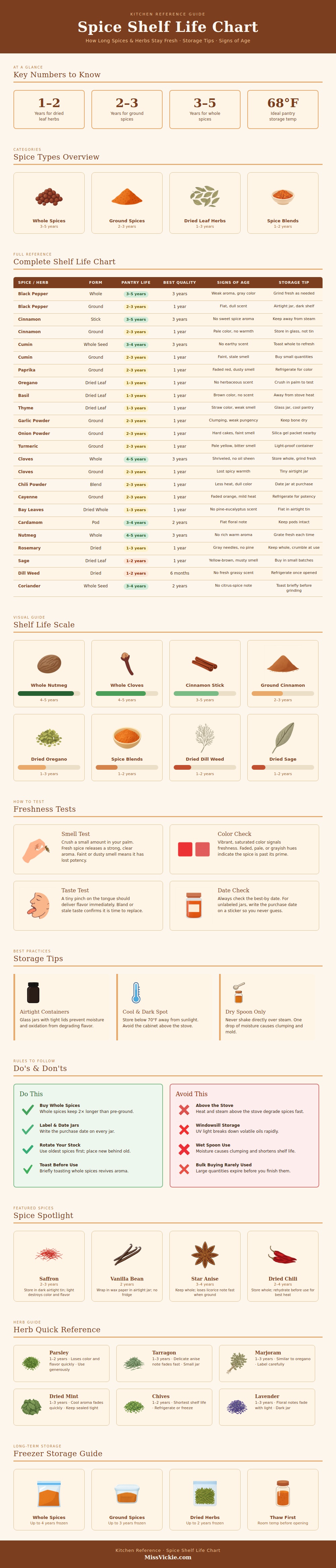
The freshness of a spice depend on the form of the spice, because the form of the spice determines how much surface area is expose to the air. Whole spices, such as whole peppercorns or whole cloves, have a long shelf life because the outer shell of the whole spice protect the oils inside the whole spice. Ground spices has a shorter shelf life because the process of grinding the spices increase the surface area of the spices and allows more air to reach the oils inside the spices.
How to Keep Your Spices Fresh
Consequently, ground spices lose their flavor much more faster than whole spices lose their flavor. You can maintain the flavor of you’re spices by purchasing whole spices instead of ground spices. If you purchase whole spices, you can use a grinder to process the whole spices only when you are ready to cook a meal.
Using a grinder to process whole spices ensure that the oils in the spices remain inside the spices until the moment you use the spices. If you use old, pre-ground spices, you may need to add more of the pre-ground spices to a dish to achieve the desired flavor, but adding more pre-ground spices can change the texture or the salt balance of the food. Therefore, using whole spices is a more efficient way to manage your spices and your moneys.
Different types of spices lose their flavor at different rate. Dried leaf herb, such as oregano or basil, are very fragile and lose their flavor quick. Spice blends are also fragile because spice blends contains many different ingredient, and those different ingredients may lose their flavor at different rates.
This can cause the spice blends to have an inconsistent flavor. You should be aware that moisture and light causes spices to degrade. Because moisture and light cause spices to degrade, the location where you store your spices is very important for the longevity of the spices.
You should not store your spices in a cabinet above a stove because a stove produce heat and steam. Heat and steam create a warm and humid environment, and a warm and humid environment cause the oils in the spices to degrade more quickly. You should store your spices in a cool, dark, and dry environment so that the spices stay fresh for a longer period of time.
Sunlight also causes spices to lose their quality because ultraviolet ray can change the color of the spices. If the color of the spices change, it is often a sign that the flavor of the spices has also changed. You can check the freshness of your spices by using a smell test or an color check.
To perform a smell test, you should crush a small amount of the spice between your finger so that you can release the aroma of the spice. If the aroma of the spice is faint or if there is no aroma, then the spice has lost its flavor. You can also perform a color check by looking at the color of the spices.
If the color of the spices is dull or pale, the spices have likely lost their flavor. Some spices require more specific storage than other spices. Saffron and vanilla bean require dark and airtight environment to keep the saffron and vanilla beans fresh.
If you have a large amount of whole spices that you do not plan to use quickly, you can store the whole spices in a freezer. The freezer can extend the life of the whole spices, but you must let the whole spices reach room temperature before you open the container. If you open a cold container of spices in a warm kitchen, condensation will form inside the container.
Condensation can cause the spices to clump or cause mold to grow on the spices. Finally, you can manage your spices by labeling the jar with the date of purchase and by rotating your stock so that you use the oldest spices first.