Spice Blend Calculator
Scale custom seasonings by target batch weight, teaspoons, jar yield, salt percentage, grind density, heat level, and expected mixing or sifting loss.
Choose whether your target is a final weight, a spoon volume, or a number of jars. The calculator converts everything to grams, adjusts for grind density, and gives a component-by-component batch sheet.
Full Batch Breakdown
| Component | Percent | Finished | Weigh | Spoons |
|---|
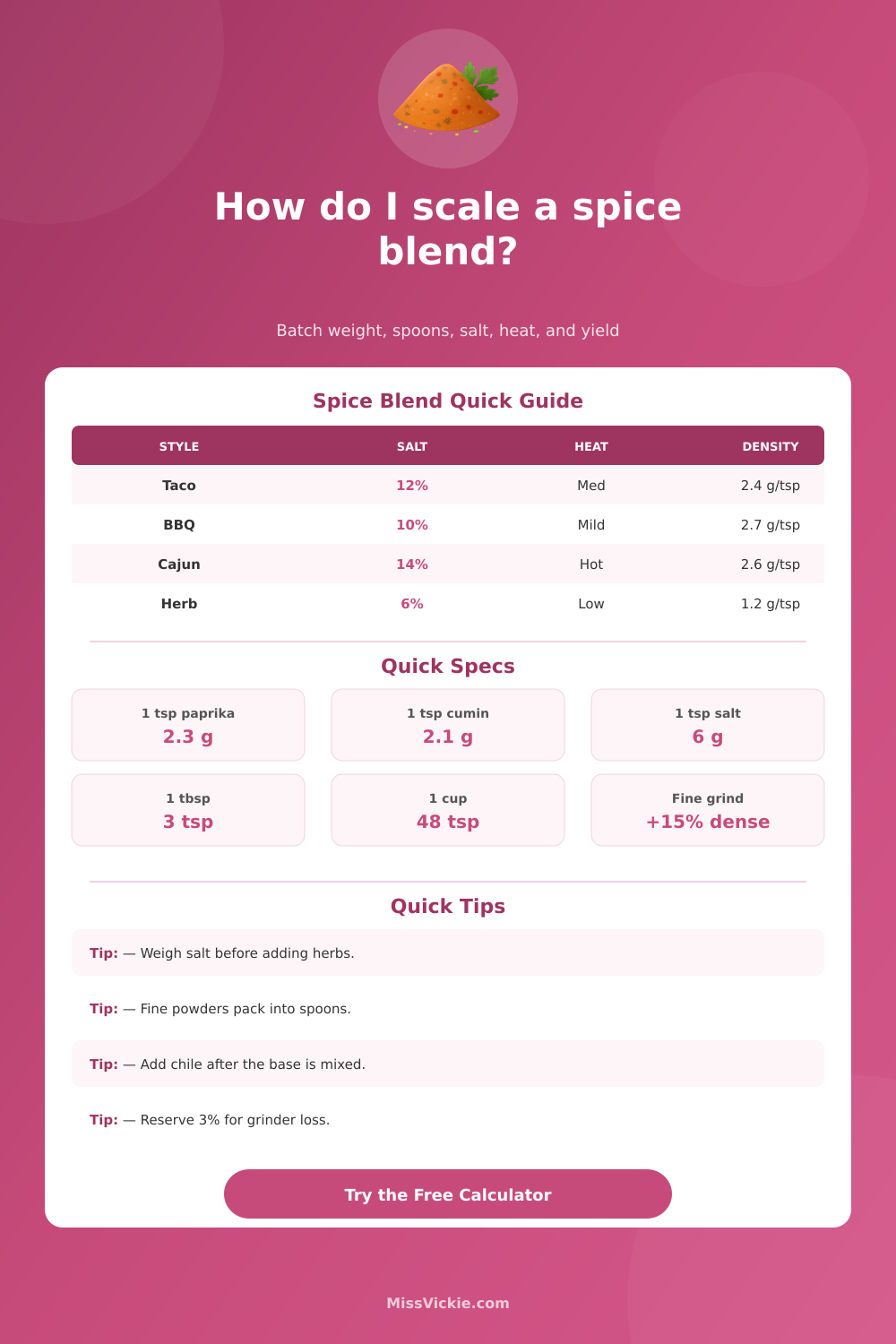
Cumin, chile, garlic, oregano, and paprika with medium heat.
Sweeter paprika base with mustard, pepper, and mild chile.
Paprika, cayenne, garlic, thyme, oregano, and black pepper.
Low-density leaf herbs need larger spoon volume for the same weight.
| Ingredient | Approx g per tsp | Approx g per tbsp | Best Calculator Use |
|---|---|---|---|
| Fine table salt | 6.0 g | 18.0 g | Salt percentage and sodium-style blends |
| Garlic powder | 3.1 g | 9.3 g | Aromatic base for rubs and snack dust |
| Onion powder | 2.4 g | 7.2 g | Rounded savory body in most mixes |
| Smoked or sweet paprika | 2.3 g | 6.9 g | Color, bulk, and mild pepper flavor |
| Chili powder blend | 2.6 g | 7.8 g | Tex-Mex and chili-pot seasoning |
| Ground cumin | 2.1 g | 6.3 g | Earthy taco, curry, and shawarma notes |
| Dried oregano leaf | 1.0 g | 3.0 g | Low-density herb component |
| Ground black pepper | 2.3 g | 6.9 g | Heat and sharpness without chile |
| Ground coriander | 1.8 g | 5.4 g | Citrus-like warmth for curry and shawarma |
| Dry mustard powder | 2.7 g | 8.1 g | BBQ rubs, ranch blends, and steak rubs |
| Granulated sugar | 4.2 g | 12.6 g | Sweet rub balance and browning |
| Citric acid powder | 4.0 g | 12.0 g | Tangy snack seasoning and salt-light blends |
| Finished Blend | At 2.4 g/tsp | At 2 tsp per use | Typical Kitchen Use |
|---|---|---|---|
| 50 g | 20.8 tsp / 6.9 tbsp | 10 uses | One small test jar |
| 100 g | 41.7 tsp / 13.9 tbsp | 20 uses | Meal prep or family jar |
| 225 g / 8 oz | 93.8 tsp / 1.95 cups | 47 uses | Large pantry batch |
| 454 g / 1 lb | 189 tsp / 3.94 cups | 94 uses | BBQ, events, or gifting |
| 900 g | 375 tsp / 7.8 cups | 188 uses | Bulk prep for a busy kitchen |
| Control | Low Setting | Middle Setting | High Setting |
|---|---|---|---|
| Salt percentage | 0-6% for salt-light blends | 8-14% for most rubs | 18-25% for snack dust or salt-forward mixes |
| Heat level | 0-2 uses paprika and pepper only | 3-6 adds chile and cayenne balance | 7-10 pushes chile, cayenne, and black pepper |
| Grind density | Flaky herbs pack lightly | Ground spices average 2.0-2.8 g/tsp | Fine powders and salt pack heavier |
| Yield loss | 0-2% for direct mixing | 3-5% for grinding and sifting | 6-10% for sticky sugar or very fine dust |
Making spice blends requires consideration of numerous variable. These variable is difficult to manage because a spice blend involve weight, volume, salt percentage and grind density. Many people that attempt to make there own spice blends use different measurement of the ingredients in the blend.
Using different measurements for each ingredient often results in inconsistent spice blends. The inconsistency of spice blend recipes often results from the fact that each ingredient has a different ratio within the blend. Using a spice blend calculator can eliminate this inconsistency in the spices that are blended.
Why Use a Spice Blend Calculator
One of the first decision that must be made when using a spice blend calculator is whether the spices are to be measured in terms of weight or volume. Measurements of weight are more accurate than measuring the spices in terms of volume because the weight of the spice can change based on the grind of the spice and the amount of moisture that is contained in the spice. Spice measurements in terms of volume require the use of measuring spoons.
It is easier for individuals to use measurements of volume than weight. Spice blend calculators allow for the user to select whether they would like to measure the ingredients by weight or volume. The spice blend calculator will convert the selected value into grams.
Using grams as the unit of measurement for the ingredients allows for the salt and sugar percentages to remain consistent in the spice blend. In addition to salt and sugar percentages, it is also important for spice blend calculators to account for the loss of yield of spices during the measuring process. During this measuring process, spices often stick to the bowls in which they are measured and to the spice grinders.
Another variable in the spice blend is the level of salt that is used in the blend. The percentage of salt that is used in the spice blend is an important variable to control so that the spice blend does not taste too salty. The amount of salt that an individual thinks to be correct for a spice blend may taste different from that same individual when the spice blend contains different densities of other ingredients.
For instance, the salt level that is used in a heavy spice blend may not taste correct in a leafy herb blend due to the differences in the densities of each of these types of spice blends. The spice blend calculator allows for the percentage level of salt to be set to a specific percentage. This percentage will remain the same whether any other ingredient are changed in the spice blend.
Spice blend calculators prevent individuals from creating spice blends that are too salty when doubled as a recipe. Another of the variables that is necessary for spice blends are the levels of heat that is provided by ingredients like chile powder. The level of heat that is created by chile powder impacts the other ingredients of the spice blend.
Spice blend calculators do not simply increase the level of heat of a spice blend by increasing the amount of chile powder that is used in the spice blend. Instead, the spice blend calculator will adjust the other ingredients in the spice blend according to the increase of heat level of the blend. Spice blends that do not contain enough heat will taste like they do not have enough flavor.
Individuals may believe that the issue with the spice blend with low heat levels is a lack of chile powder, but the issue is likely with the lack of other warm spices to create flavor alongside the chile powder. The type of grind of the spices impacts the weight of the spices in a specific volume. Fine ground spices will weigh more in a given volume than spices that are ground in coarse granules.
This is due to the settling of fine ground spices into a dense layer, as compared to the amount of air in between the particles of coarse ground spices. Spice blend calculators use a density factor in the calculations for each spice blend to account for the impact of different types of ground spices on the total weight of the spice blend. Spice blend calculators account for the differences in weight of each type of spice, allowing the spice blend calculator to provide the amount of the spice blend that will produce a certain amount in teaspoons when ground in specific ways.
For instance, the calculator may account for the fact that if a spice blend that is ground in medium grinds is changed to a flaky grind the amount of teaspoons of the spice blend will change due to the difference in weight between each type of grind. In addition to the variables related to the type and weight of the spices in the spice blend, another variable to account for in spice blend recipes is the yield loss of the spices. Spice blends lose some of their ingredients when they are ground in spice grinders and poured into measuring bowls.
Spices that contain sticky ingredients like sugars and chile powder will stick to the spice grinders and bowls. If the loss of these spices is not accounted for in the spice blend, it is likely that the spice blend that results will not fill the containers in which it is to be stored. Spice blend calculators account for this loss of spices to allow spice cooks to have enough spice blend to fill their containers with the prepared spices.
The output of the spice blend calculator provides multiple values to the spice blend recipe. Spice blend calculators provide the weight of the spices that are to be measured to prepare the spice blend. In addition to the weight of the spice blend, spice blend calculators also provide the volume that the spice blend will fill when measured.
Spice blend calculators display the amount of salt in grams in the spice blend. Spice blend calculators also provide the number of servings that will result from the prepared spice blend. The spice blend calculator provides the number of servings of spice blend that is important to provide to the individual spice cooks as it allows them to know if the spice blend contains enough of the spice to last one meal or if it will last the individual for a span of a month’s worth of cooking.
Spice blend calculators also calculate the number of jars of spice blend that the spice blend recipe that is entered into the spice blend calculator will create. Although spice blend calculators account for most of the variables in spice blends, there are some variables that the spice blend calculator cannot account for. Two of these variables are the impact that humidity can have on spice blends, and the age of the spices.
Humidity can alter the effect that leafy herbs can have on spice blends. Additionally, the oils in the spices can dissipate over time such that even if the weight of the spice is the same, the spice that is used after sitting for some time will be lacking in the flavor that it could produce while new. Spice blend calculators cannot account for these variables.
Spice blend cooks may need to taste the spice blend prior to utilizing the entire batch of spices that are prepared. Although spice blend calculators may eliminate the errors that result from math calculations, individual cooks must use their sense of taste to flavor the spice blend. Spice blend calculators allow cooks to prepare the same recipe of spice blend with consistency from one batch to the next.