🌡 Sourdough Water Temperature Calculator
Find the exact water temperature needed to hit your target dough temperature every time
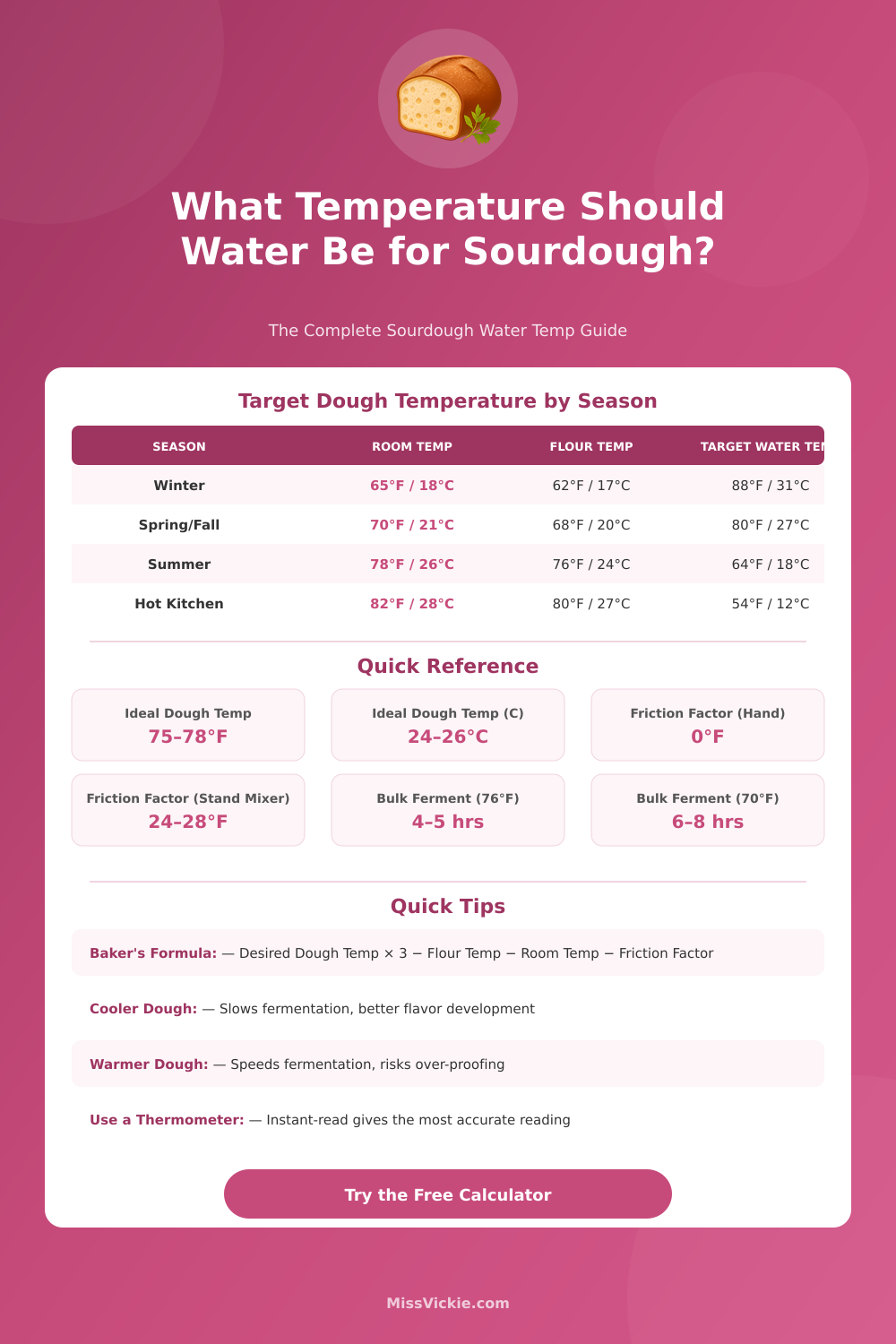
| Condition | Room Temp | Flour Temp | Ideal Water Temp (Hand Mix) | Ideal Water Temp (Stand Mixer) |
|---|---|---|---|---|
| Cold Winter Kitchen | 65°F / 18°C | 62°F / 17°C | ~101°F / 38°C | ~75°F / 24°C |
| Cool Spring / Fall | 68°F / 20°C | 66°F / 19°C | ~94°F / 34°C | ~68°F / 20°C |
| Average Kitchen | 72°F / 22°C | 70°F / 21°C | ~86°F / 30°C | ~60°F / 16°C |
| Warm Kitchen | 76°F / 24°C | 74°F / 23°C | ~78°F / 26°C | ~52°F / 11°C |
| Hot Summer Kitchen | 82°F / 28°C | 80°F / 27°C | ~66°F / 19°C | ~40°F / 4°C (ice water) |
| Mixing Method | Friction Factor (°F) | Friction Factor (°C) | Notes |
|---|---|---|---|
| Hand Mixing / No-Knead | 0°F | 0°C | No heat generated |
| Stretch & Fold Only | 0°F | 0°C | Minimal heat generation |
| Stand Mixer (light knead) | ~22°F | ~12°C | 3–5 min at speed 2 |
| Stand Mixer (average knead) | ~26°F | ~14°C | 5–8 min at speed 2–3 |
| Stand Mixer (heavy knead) | ~30°F | ~17°C | 8+ min or high speed |
| Bread Machine | ~30°F | ~17°C | Varies by machine |
| Dough Temperature | Approx. Bulk Ferment Time | Fermentation Speed | Result |
|---|---|---|---|
| 65°F / 18°C | 8–12 hours | Very Slow | Complex flavor, long schedule |
| 68°F / 20°C | 7–9 hours | Slow | Excellent flavor development |
| 72°F / 22°C | 5–7 hours | Moderate | Good balance of flavor & timing |
| 75°F / 24°C | 4–5 hours | Ideal | Classic sourdough results |
| 78°F / 26°C | 3–4 hours | Fast | Watch carefully to avoid over-proof |
| 82°F / 28°C | 2–3 hours | Very Fast | Risk of over-fermentation |
| 85°F / 29°C+ | 1.5–2 hours | Too Fast | High risk; monitor constantly |
| Water Temp | How It Feels | Use Case |
|---|---|---|
| 35–45°F / 2–7°C | Ice cold | Hot summer kitchens, heavy mixer use |
| 50–60°F / 10–16°C | Very cold / cold tap | Warm kitchens with stand mixer |
| 65–72°F / 18–22°C | Cool / room temp | Warm kitchens, hand mixing |
| 75–85°F / 24–29°C | Slightly warm | Average kitchens, hand mixing |
| 90–100°F / 32–38°C | Warm / bath temp | Cool kitchens, hand mixing |
| 100–110°F / 38–43°C | Hot to touch | Cold kitchens only; be cautious |
| 115°F+ / 46°C+ | Scalding | Avoid — will harm starter |
Sourdough bread is bread that ferments naturally using a starter instead of commercial yeast or chemicals like baking powder or baking soda. A sourdough starter is a live culture of flour and water. It naturally raises the dough without any bought yeast.
You can make it, buy it or get it from another baker
What Is Sourdough Bread and How to Make It
Naturally occurring yeast and lactobacillus in sourdough raise the dough. Fermentation produces lactic acid, that gives the bread its taste. It has a bit of an acidic, tangy flavor, that simply sticks.
Proteins in that bread are more easily digested by the body. The culture breaks down glutenin and gliadin, so the bread is more easy to digest. It also destroys phityates, that stop the absorb of minerals.
Good sourdough has a light, airy inside with a crisp brown crust outside. Making it is fun, like a science experiment in the kitchen. It tastes great, which is enough as a reason.
People did it for a very long time. Sourdough dates back until 10,000 BC. Before the 19th century it was almost the only available yeast.
Starting with a starter can seem difficult. Colder kitchen temperatures slow the activity of the starter. It requires both yeast and lactobacilli.
Yeast are not bacteria, but fungi. One simple method for a starter is to mix whole grain flour with unsweetened pineapple juice or orange juice and leave at room temperature for 24 hours.
Strong white bread flour works for newcomers. A simple and famous recipe is the 1:2:3 bread. That means one part sourdough starter, two parts water and three parts flour, everything by weight.
In addition salt at two percent of the flour weight. For instance: 100 g sourdough starter, 200 g water, 300 g flour and 6 g salt.
There is also a very easy recipe, that skips feeding the sourdough starter, kneading the dough and shaping the loaf. Just mix, wait, pour the wet dough in a bread pan, wait a bit more and bake. A classic shape is the oval sourdough loaf or levain.
A sourdough loaf that is lightly tangy and rich delicious. You can bake sourdough bread even in a frying pan without fat, if no oven is at hand. A good book about the theme helps to save time and give basic knowledge about breadbaking.