How Much Sourdough Starter to Replace Yeast Calculator
Convert instant, active dry, or fresh yeast into ripe sourdough starter, then rebalance flour, water, hydration, salt, inoculation, and fermentation time for bread, pizza, rolls, focaccia, and enriched dough.
Choose a dough style to load a realistic flour weight, yeast amount, hydration, starter strength, proof temperature, and schedule target.
Formula Breakdown
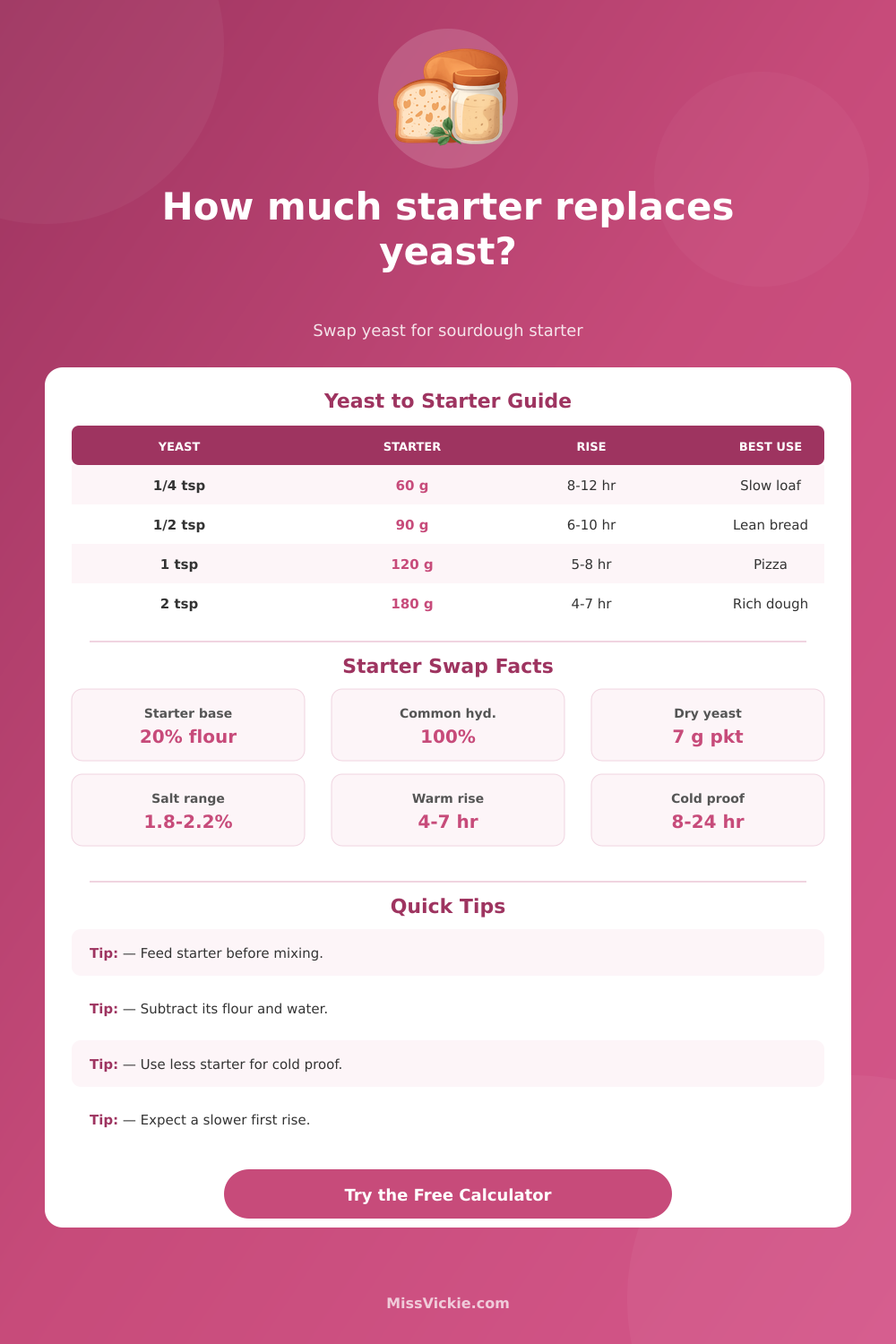
| Original Yeast | Dry Yeast Weight | Starter Flour Target | 100% Starter for 500 g Flour | Best Fit |
|---|---|---|---|---|
| 1/4 tsp instant | 0.8 g | 10% to 14% | 100 g to 140 g | Overnight or cold proof dough |
| 1/2 tsp instant | 1.6 g | 14% to 18% | 140 g to 180 g | Lean loaves and pizza dough |
| 1 tsp instant | 3.1 g | 18% to 24% | 180 g to 240 g | Same-day bread or focaccia |
| 2 1/4 tsp packet | 7 g | 24% to 35% | 240 g to 350 g | Faster sourdough or enriched dough |
| 10 g fresh yeast | 3.3 g dry equivalent | 18% to 25% | 180 g to 250 g | Soft bread, rolls, and buns |
| 20 g fresh yeast | 6.7 g dry equivalent | 24% to 34% | 240 g to 340 g | Rich dough with sugar or fat |
Starter replacement is not a direct one-to-one leavening swap. The useful number is starter flour as a percent of total flour, then the starter's flour and water are subtracted from the original formula.
| Starter Hydration | In 100 g Starter | Flour Contributed | Water Contributed | Formula Effect |
|---|---|---|---|---|
| 50% stiff | 100 g starter | 67 g flour | 33 g water | Removes more flour, less liquid |
| 60% firm | 100 g starter | 63 g flour | 38 g water | Good for bagels and firm loaves |
| 75% low hydration | 100 g starter | 57 g flour | 43 g water | Moderate water correction |
| 100% equal parts | 100 g starter | 50 g flour | 50 g water | Easiest kitchen math |
| 125% liquid | 100 g starter | 44 g flour | 56 g water | Removes extra liquid |
| 150% very liquid | 100 g starter | 40 g flour | 60 g water | Useful for wet batters and focaccia |
| Plan | Starter Flour | Room Temp | Bulk Window | When To Stop Bulk |
|---|---|---|---|---|
| Fast same-day | 28% to 35% | 76 F to 80 F | 3.5 to 6 hr | Dough is airy and up about 50% |
| Normal same-day | 18% to 25% | 72 F to 76 F | 5 to 8 hr | Jiggles, domed edges, visible bubbles |
| Overnight room | 10% to 16% | 68 F to 72 F | 8 to 12 hr | Expanded but not collapsed |
| Cold proof pizza | 8% to 14% | Short warm start | 2 to 4 hr plus cold | Refrigerate after early fermentation |
| Enriched dough | 24% to 35% | 74 F to 78 F | 6 to 10 hr | Soft rise; sugar and fat slow yeast |
| Whole grain blend | 16% to 24% | 70 F to 76 F | 4.5 to 8 hr | Stop sooner if dough feels fragile |
Yeasted recipes rise on a measured dose of concentrated yeast with little added flour or water.
Starter brings yeast, acids, flour, and water, so the original flour and liquid must be reduced.
More starter speeds fermentation and adds acidity; less starter gives a longer, milder schedule.
A liquid starter loosens dough while a stiff starter keeps dough firmer after the swap.
| Dough Style | Original Hydration | Starter Flour Range | Salt Percent | Swap Note |
|---|---|---|---|---|
| Sandwich bread | 58% to 65% | 18% to 28% | 1.8% to 2.1% | Milk, butter, and sugar slow fermentation |
| Country loaf | 68% to 78% | 15% to 24% | 1.9% to 2.2% | Keep some water for bassinage if needed |
| Pizza dough | 60% to 70% | 8% to 22% | 2% to 2.5% | Use less starter for long cold dough |
| Focaccia | 75% to 90% | 18% to 28% | 2% to 2.4% | Liquid starter fits the wetter dough |
| Bagels | 50% to 58% | 20% to 32% | 2% to 2.3% | Firm starter keeps the dough tight |
| Brioche or rolls | 50% to 65% | 24% to 35% | 1.7% to 2% | Egg, sugar, and fat slow the rise |
When you replace commercial yeast with sourdough starter, you are adjusting the recipe’s balance of flour, liquid, and time, because sourdough starter contain flour, water, and yeast. Because sourdough starter contains flour and water, you will have to subtract those ingredient from the original recipe to account for their presence in the sourdough starter. If you dont subtract the flour and water that are contained within the sourdough starter, the texture of you dough will suffer.
The sourdough starter conversion tool will calculate for you the correct balance of ingredient that you will need to make your sourdough starter dough. To do so, you must enter your flour weight, your original amount of yeast, and the style of dough that you would like to make. The flour weight will determine the recipe’s scale, while the amount of yeast will indicate the amount of sourdough starter flour that you will need to replace.
How to Change a Yeast Recipe to Use Sourdough Starter
The dough style is important, as some dough styles, like enriched doughs, contains ingredients like sugar and fat, which will slow the rising of the dough compared than lean doughs. The hydration of your sourdough starter is another important factor. Stiff sourdough starter contains more flour than water by weight, while liquid sourdough starter contains more water than flour by weight.
You will have to account for this hydration level in your recipe. Additionally, you will have to account for the inoculation of the sourdough starter, which is the amount of sourdough starter flour that you use as a percentage of the total flour in the recipe. The inoculation will determine how fast the dough ferment, which the sourdough starter conversion tool will calculate for you based off the dough style and sourdough starter strength.
The choice of temperature and bulk fermentation schedule will also affect sourdough starter fermentation. If you choose to use warmer room temperatures to speed up fermentation, the sourdough starter conversion tool will calculate a shorter bulk rise time than if you plan to ferment your dough in a cooler kitchen or overnight. A lower inoculation will be calculated in these cases to prevent overproofing of your dough.
Additionally, if you plan to use a cold-proof option for your bulk fermentation, the tool will calculate fewer sourdough starter than for dough that does not undergo bulk fermentation in a refrigerator. The strength of your sourdough starter will change the requirement of the recipe. If your sourdough starter ferments quickly and triples in size in under 20 minutes, you will require a lower inoculation percentage in the recipe than if your sourdough starter ferments slow.
The sourdough starter conversion tool will calculate different inoculation percentages if you decide upon different strength level for your sourdough starter. An overripen sourdough starter that smells of vinegar will slow the fermentation of your dough when you bake with that sourdough starter, hence the need to use caution around overripeness of sourdough starter. Feeding the sourdough starter the night prior to baking will help to even out the sourdough starter strength so that it remain the same from batch to batch.
Certain dough styles require more sourdough starter than others. Pizza dough may contain less sourdough starter than other types of sourdough starter dough, since sourdough starter dough will ferment in the refrigerator over time. Bagels may require more sourdough starter than other breads, as the boiling of bagels results in a sourdough starter dough that ferments more slow.
Enriched doughs, which contain ingredients like eggs, milk, and sugar, may require more sourdough starter because these ingredient can slow the action of commercial yeast. The sourdough starter conversion tool will calculate for you the amount of sourdough starter necessary to accommodate these ingredient differences. Another way to determine when to end bulk fermentation is to actualy observe the bulk fermentation process.
While the sourdough starter conversion tool will estimate how long bulk fermentation will take, it is possible for the bulk fermentation time to differ from recipe to recipe. Therefore, you should observe your dough to determine when to end bulk fermentation; when the dough has noticeably risen, and when it feels airy and features bubble throughout the dough. These visual cues are more important than the bulk fermentation timer, since the sourdough starter strength, type of flour, and room temperatures can change daily.
Additionally, it is a good idea to keep notes about the different type of bulk fermentation schedules that you use with sourdough starter. These notes will allow you to gain experience with your sourdough starter, allowing you to adjust the parameters that you enter into the sourdough starter conversion tool as time passes.