Sourdough Starter Per Loaf Calculator
Calculate starter for one loaf or a full bake day by loaf count, flour weight, inoculation, starter hydration, room temperature, bulk time, dough hydration, levain reserve, and loaf size.
Choose a real baking scenario, then tune the flour, starter strength, room temperature, hydration, levain build, and reserve.
Your Sourdough Starter Plan
Starter, flour, water, salt, levain build, and timing will appear here.
Dough Formula
Batch Check
| Bulk goal | Room temp | Starter range | Best use |
|---|---|---|---|
| Slow flavor | 64-68°F | 10-15% | Overnight counter bulk or very flexible shaping window. |
| Balanced bake | 70-76°F | 18-25% | Most country loaves, batards, and mixed flour doughs. |
| Fast schedule | 76-82°F | 25-35% | Same day dough that needs a shorter bulk fermentation. |
| Very warm room | 82-86°F | 8-18% | Small starter amount helps prevent overproofed dough. |
| Starter hydration | Starter texture | Flour in 100 g | Water in 100 g |
|---|---|---|---|
| 60% | Stiff levain | 62.5 g | 37.5 g |
| 80% | Firm spoonable | 55.6 g | 44.4 g |
| 100% | Equal parts | 50 g | 50 g |
| 125% | Loose starter | 44.4 g | 55.6 g |
| Loaf style | Flour per loaf | Starter at 20% | Dough size |
|---|---|---|---|
| Small boule | 350 g | 70 g | 600-650 g |
| Country loaf | 500 g | 100 g | 850-900 g |
| Sandwich pan | 550 g | 110 g | 900-970 g |
| Large miche | 900 g | 180 g | 1500 g+ |
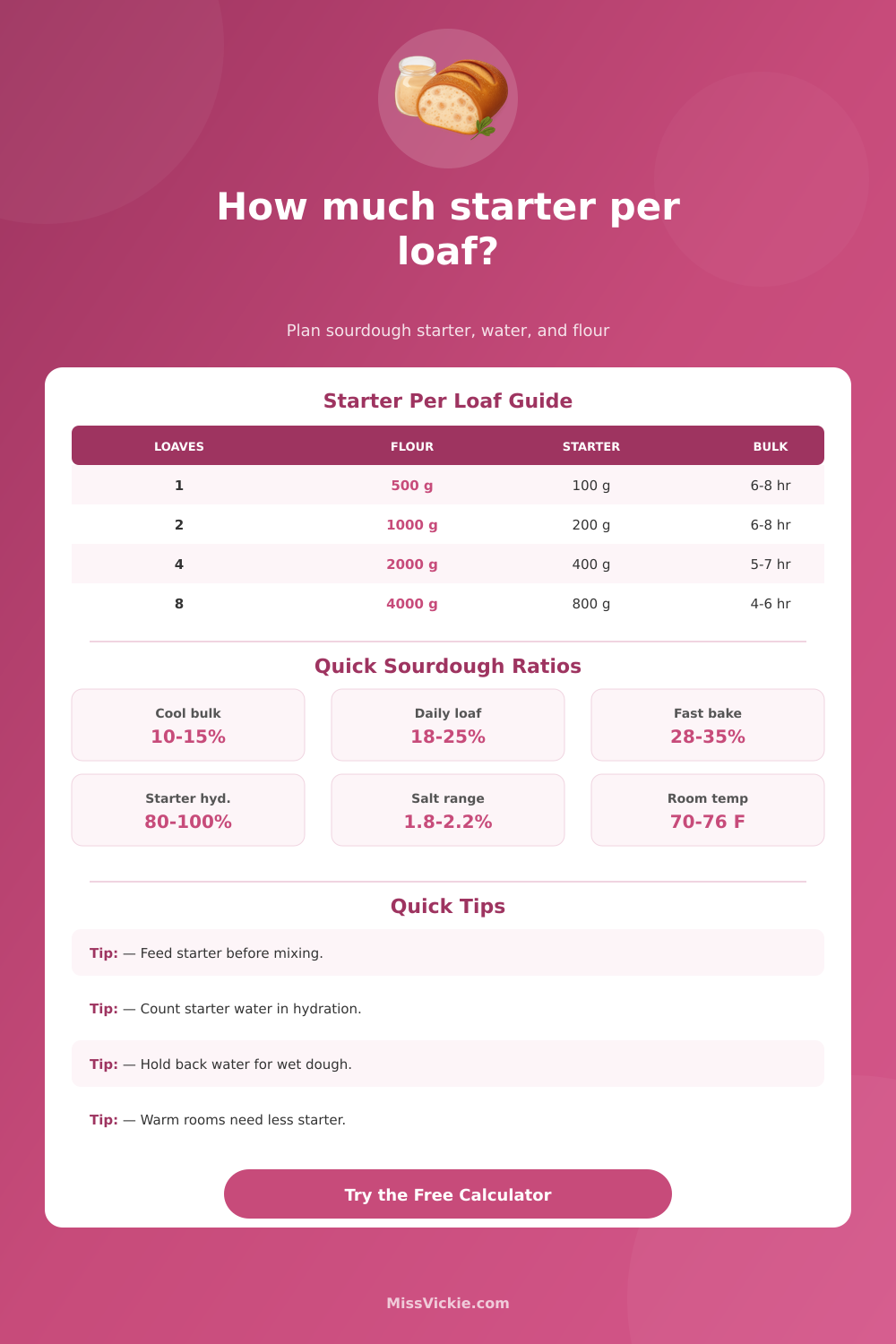
| Loaf count | 500 g flour each | 20% starter | Build with 10% extra |
|---|---|---|---|
| 1 loaf | 500 g flour | 100 g starter | 110 g levain |
| 2 loaves | 1000 g flour | 200 g starter | 220 g levain |
| 4 loaves | 2000 g flour | 400 g starter | 440 g levain |
| 12 loaves | 6000 g flour | 1200 g starter | 1320 g levain |
These baker's percentages treat total flour as 100 percent and count the flour and water already inside the starter.
Cooler room, longer bulk, and a wider shaping window.
Balanced starter amount for most 6 to 8 hour bulk plans.
Good for a lively starter, warm dough, and faster proofing.
Lower starter helps control dough when the room runs hot.
Treat your sourdough starter as just another ingredient, on par with sugar, salt, etc. It’s not. Sourdough starter is actualy a pre-fermented mixture of water and flour, complete with its own hydration level and its own yeast population. By incorporating your starter into dough, you are also incorporating sizable amount of both water and flour into your total formula. Not just leavening power.
This matter: guessing is hit or miss. Assuming a cup of starter is merely something to give you some lift means you’re going to miscalculate hydration each and every time. When you put your exact variables into the calculator, it does the math for you; no need to try to remember how much flour (and water) is in the jar. What it also does is force you to face the fact that at full hydration, a cup of starter contain half flour, by weight. That hidden flour affects your overall dough hydration, which you don’t want to forget to consider.
Why Sourdough Starter Matters for Your Bread
The quiet variable is always room temperature. As temperatures drop, yeast become less active: A ferment at sixty-eight degrees will rise much slower then one at eighty-two degrees. Which means if you’re making a batch at sixty-eight degrees, you’ll want only half as much starter as when making a batch at eighty-two degrees. Conversely, if your kitchen is warm, adding too much starter will cause the dough to overproof while still on the counter. This results in big, wonky bubbles and an overly acidic, sour-tasting bread. It will have a strong acetic acid taste instead of the lactic sweetness you want.
The charts on page detail the variation by ambient temperature, where the more active yeast, the less starter you’ll want. This affects rise time and volume, as well as flavor development. The other factor that’s important to your ability to manage higher levels of active starter is the hydration target. Lower hydrations (e.g., 70%) is forgiving and hold their shape well; they’ll tolerate higher levels of active levain before going slack. Push it up to an 85% hydration, though, and dough gets very sensitive to how much leavening you add. Go overboard with the starter at this level and you’ll end up with a mess of dough that spreads out instead of rising up. It will be virtually impossible to shape.
Using between eighteen and twenty-five percent of total flour weight as inoculated starter is a good sweet spot for most bakers making daily bread. This provides plenty of lift without overwhelming the gluten structure.
Levain reserve is another small point. When you make a batch of starter, you never end up with precisely the amount shown on scale. You get some stuck to side of the container. You take some out to do float tests. Then you set aside some to feed your primary mixture tomorrow. Having a little more than necessary planned will ensure you have enough at “mixing time” without worrying about running out. This allows you to be flexible. If your scale isn’t quite accurate or you want to bake an extra loaf, go ahead. Thinking about how much is going to be wasted before you even begin mixing is just good business, and it helps make things consistent.
This is the bottom line. Sourdough baking isn’t so much about recipes as it is about ratios. When you grasp the amount of water and flour your starter provides, you’re in charge, not the other way around. You know exactly how much water is in your dough, which stops you from guessing if it is too dry or too wet. Too wet?), and transform the frenzy of a hectic morning into a routine you can count on, returning to you the greatest resource in any kitchen: time.