
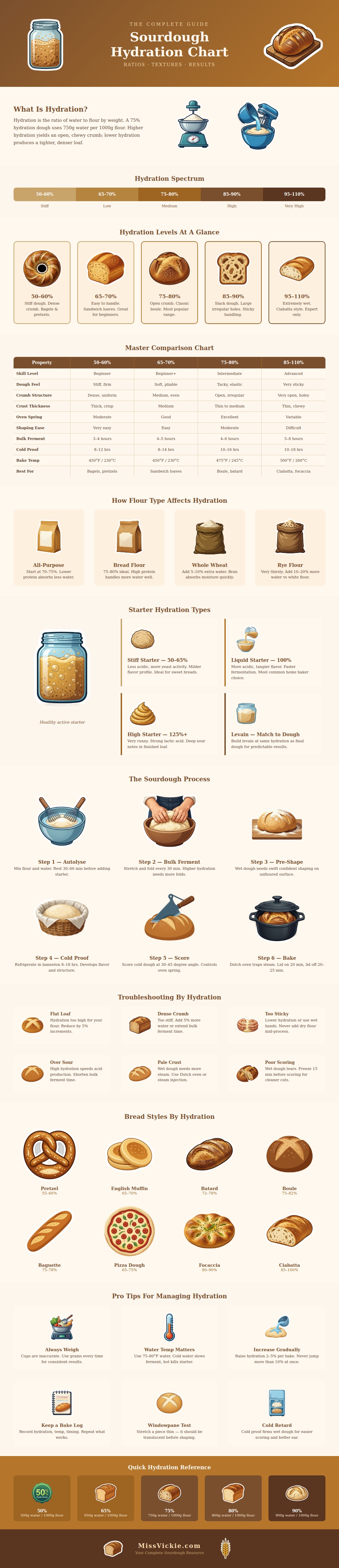
Have you ever added water to flour only to find yourself grasping a soggy goo incapable of forming anything? Or maybe it’s too dry and you’re left with something closer to playdough than bread dough. Those two extremes is hardly a reflection of your ability; rather they reflect one simple thing: hydration ratio. Knowing what your flour can actualy absorb makes all the difference in sourdough baking. It goes from guessing game to geometry.
This can be broken down into practical ranges (see the chart above), but here’s the point: It isn’t about the math so much as the texture. Seventy-five percent hydration would mean using seven-hundred and fifty grams of water per each kilogram of flour. Sounds exacting; and it is, but it’s more important to understand how that water behave within the dough.
Understanding Hydration in Sourdough Baking
Why? It expands into steam during baking, which creates oven spring. It also loosen the gluten network, resulting in an open-crumbed, chewier loaf. Too little water result in a tight structure, ideal for a sturdy pretzel, or something sliced for sandwich. Too much water results in larger holes and a crustier exterior (assuming you have the patience to get it into oven before becoming a sticky mess).
When you’re starting out, most people go too high. They’ve seen some lovely photos of an airy ciabatta with giant irregular hole. And yes, those are wonderful looking loaves, but then you attempt to shape one and they slip all over the counter. Go easy on yourself. Start maybe between sixty-five and seventy percent. This is easy to work with and forgiving if you happen to proof a little too long. It’s soft, but still cooperative. It will allow itself to be folded without ripping or tearing, and it will form into round boule instead of a wrestling match with a slime monster.
That’s where the sweet spot is to really get a sense for the fundamentals. Understand what that does and then gradually work in some more water in little increments. A few percent at a time. Don’t ask your hands to master something new until they know the tension from the last one.
But in addition to what kind of water you use, you’ll also know from which flour to use. White bread flour hold onto water because of its strong gluten. It is a different story with whole wheat. Its bran cuts through the gluten strands and quickly absorbs the water, while leaving the other dough dry. Eighty percent hydration works fine when using white flour, but won’t work if you’re making it with whole wheat unless you add more water. You has to adjust for this difference in how much flour absorb water.
And rye? Even thirstier. It’s practically gluten free, and depends completely on water and starch to bind it together. Don’t take any of this into account, and you’ll wind up with dense, flat bricks of bread that taste like them.
What about hydration of your starter? That is also important, though people do not always consider it. If your starter is very watery, it will be much more active and tangy. If it is stiffer and has less water, the fermentation time will be longer and the flavors will be milder. Ideally your levain hydration should match that of your final dough hydration; this way the baking process becomes more steady and you’re not fighting against conflicting forces in the bowl. You have the variables under control.
Oh, and there is also temperature. Because cold slows down fermentation, you’ll have extra minutes to work with when molding gooey doughs that don’t fall apart. On the other hand, warm accelerates fermentation, good on those chilly winter days, but can spell disaster when you’re fighting against overproofed pizza.
Weigh everything. You might think you measured correctly, but volume measurements mess with hydration and torpedo your effort at the outset. Use a scale. It’s five seconds, it’s hours of grief.
Sourdough is all about balance. Not too much water. It will spread out into a flat loaf. Not too little. It’ll feel dense and heavy. Patience is key. There’s a sweet spot somewhere between loose enough to expand and strong enough to contain gas from gluten. A log.
Note everything: What went right? What didn’t? How did the dough feel in my hands? One day, your hands will know what your eyes cannot see. You begin with a ratio. You finish with bread.