🍞 Sourdough Feeding Ratio Calculator
Calculate exact flour and water amounts for any starter feeding ratio and hydration level
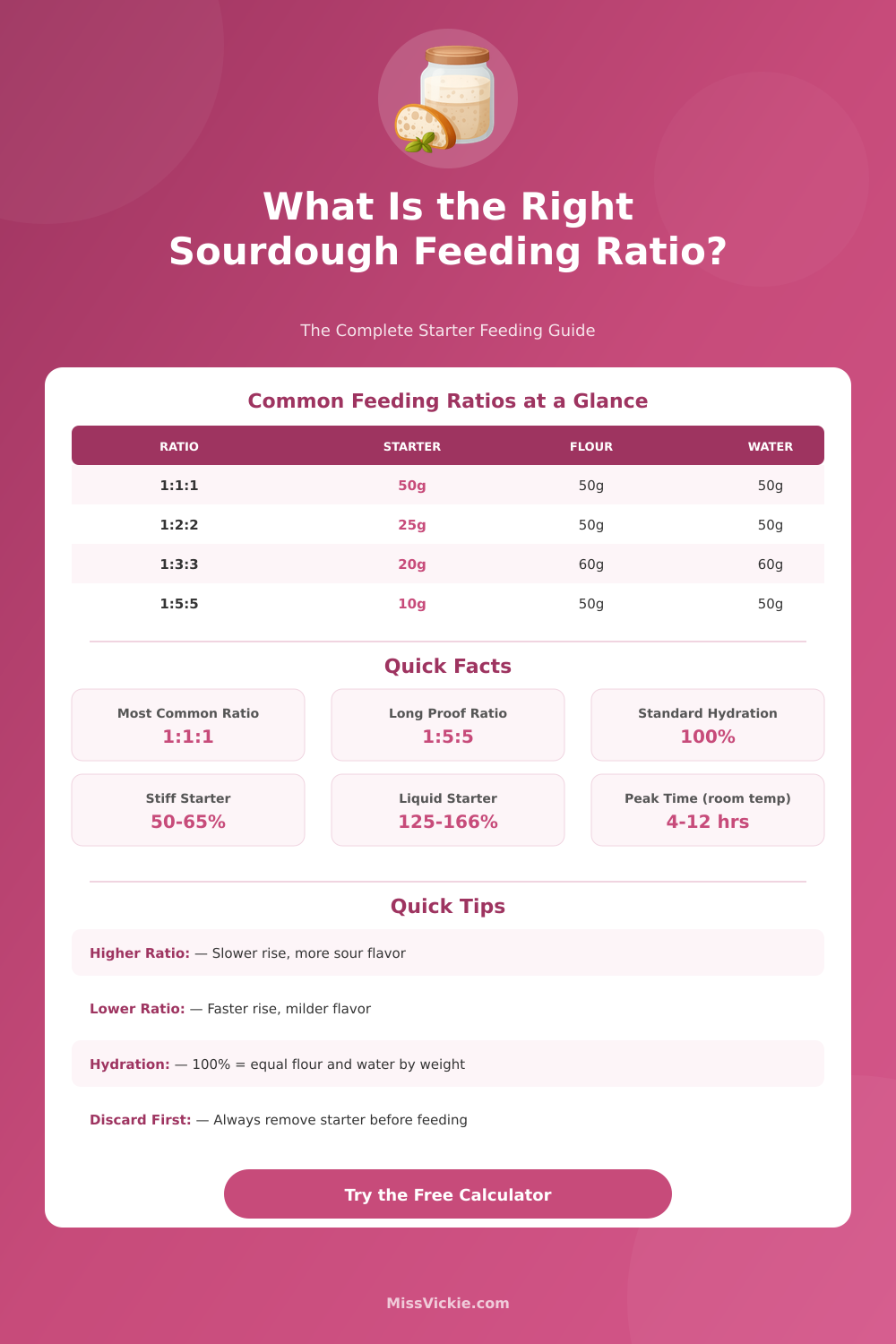
| Ratio (S:F:W) | Starter | Flour | Water | Total | Peak Time (70°F) |
|---|---|---|---|---|---|
| 1:1:1 | 50g | 50g | 50g | 150g | 4–8 hours |
| 1:2:2 | 25g | 50g | 50g | 125g | 6–10 hours |
| 1:3:3 | 17g | 50g | 50g | 117g | 8–12 hours |
| 1:4:4 | 12g | 50g | 50g | 112g | 10–14 hours |
| 1:5:5 | 10g | 50g | 50g | 110g | 10–16 hours |
| 1:10:10 | 5g | 50g | 50g | 105g | 14–24 hours |
| 2:1:1 | 100g | 50g | 50g | 200g | 2–4 hours |
| Hydration | Flour | Water | Consistency | Best For |
|---|---|---|---|---|
| 50% | 50g | 25g | Very stiff, dough-like | Pasta-style bakes |
| 65% | 50g | 32g | Stiff, holds shape | Bagels, pretzels |
| 80% | 50g | 40g | Firm, slightly tacky | Sandwich loaves |
| 100% | 50g | 50g | Thick batter | Classic sourdough |
| 115% | 50g | 58g | Soft, pourable | Pancakes, waffles |
| 125% | 50g | 63g | Loose, flowing | Crackers, flatbreads |
| 166% | 50g | 83g | Very liquid | Crumpets, pizza |
| Temp | 1:1:1 Peak | 1:2:2 Peak | 1:5:5 Peak | Notes |
|---|---|---|---|---|
| 65°F (18°C) | 8–12 hrs | 12–16 hrs | 18–24 hrs | Cold kitchen, slow rise |
| 70°F (21°C) | 6–8 hrs | 8–10 hrs | 12–16 hrs | Ideal room temperature |
| 75°F (24°C) | 4–6 hrs | 6–8 hrs | 10–12 hrs | Warm kitchen |
| 78°F (26°C) | 3–5 hrs | 5–7 hrs | 8–10 hrs | Summer baking |
| 82°F (28°C) | 2–4 hrs | 4–6 hrs | 6–8 hrs | Very warm, monitor closely |
At the core, the sourdough bread is that, that rises naturally without commercial yeast or chemical leaveners like baking powder or baking soda. Instead, it depends on sourdough starter, alive, fermented mix of flour and water, to do the heavy lifting. Those starters are not same for all.
You can prepare your own from scratch buy ready or receive a gift from a baking friend.
Sourdough Bread: What It Is and How to Make It
Naturally happening yeast and lactobacillus involve during the fermentation so that the dough rise. Here the secret: yeast are actually fungi, no bacteria, and both require right provisions to actuate the starter. During fermentation, lactic acid produces, what gives the sourdough its distinctive, tangy taste.
This a bit sour, almost attracting flavor become impossible to resist after you try it.
The fermentation alters the chemistry of the bread. The sourdough culture breaks down glutenin and gliadin. Proteins that occasionally are difficult to digest.
In addition, it attacks phytates, that usually stop the body absorbing minerals correctly. The protein itself become more easily digestebl. That same ferment magic, that creates the delicious tangy, also makes the bread sit better in the belly.
For beginners, strong white bread flour works perfectly. The 1:2:3 method is probably the best entry point, one part sourdough starter, two parts water, three parts flour, everything weighed. Salt is added in around two percent of the flour weight.
So, for 100 grams sourdough starter, take 200 grams water, 300 grams flour and around 6 grams salt.
Sourdough bread does not require to be intense or too hard. There is a version that entirely skips feeding the sourdough starter, kneading and shaping. Just mix everything, leave it rest, lay the wet dough in the pan, wait again and bake.
From that you get an incredibly forgiving, deeply tangy sandwich loaf that tastes great. Or you can use the classical pain au levain method, that gives an oval loaf with tender tangy and real depth.
The best sourdough bread has the wanted contrast… Light, airy crumb inside, crisp golden-brown crust outside. What not to love about baking sourdough bread?
It is genuinely a scientific experiment in your own kitchen. Moreover, it simply tastes great. Sourdough bread was not always a choice.
Before the 1800s it was almost the only way to leaven bread, and rates show that folks baked it since around 10 000 BC.
One slice is a standard home ration of sourdough bread. A big slice in French or Vienna style carries around 261 calories. The bread consists roughly of 76% carbs, 8% fat and 16% protein.
It stays quite carb-heavy and calorie-dense, so moderation matters, especially if you mind the bloodsugar.