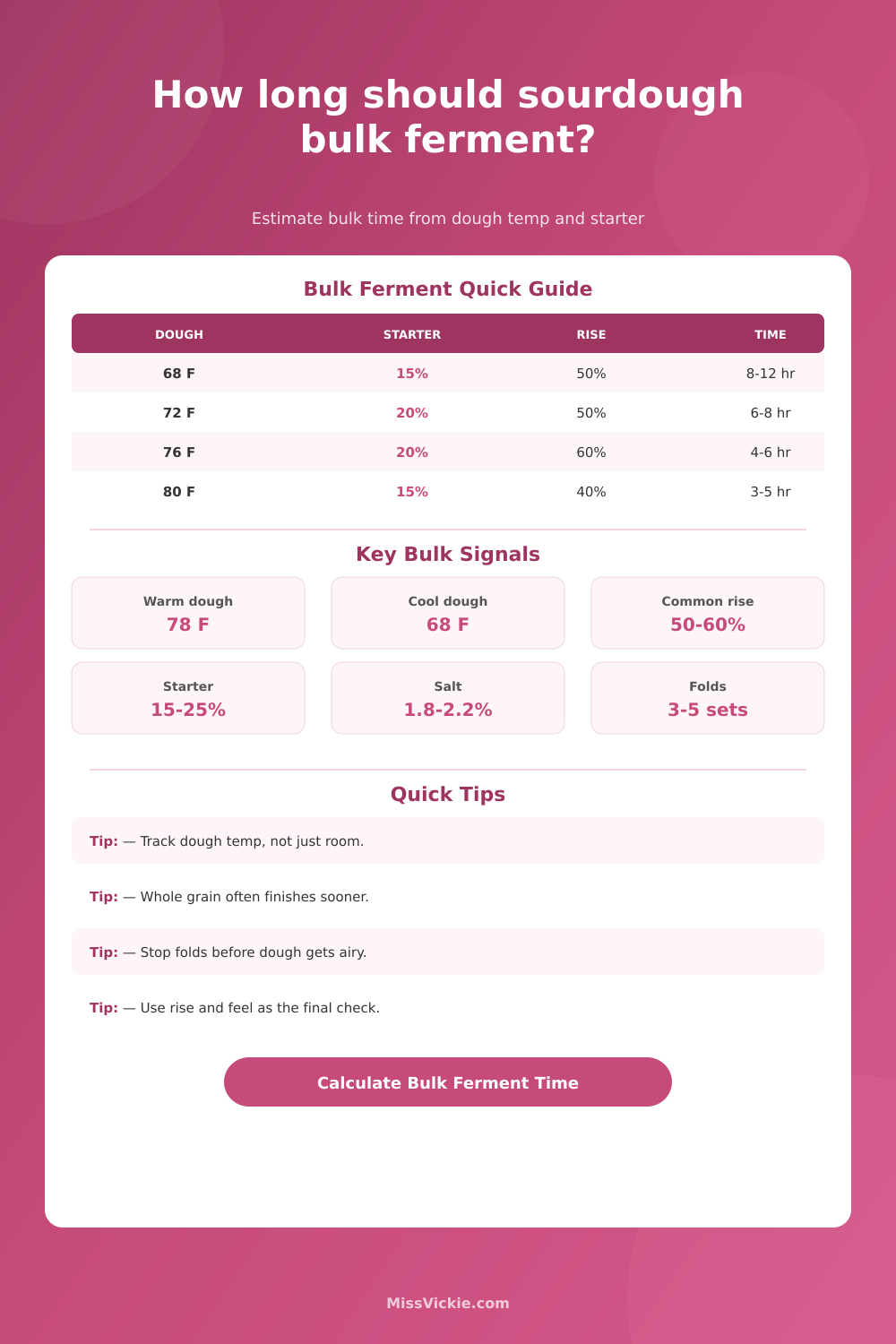
Sourdough Bulk Ferment Time Calculator
Estimate the bulk fermentation window from dough temperature, room temperature, starter percentage, effective inoculation, hydration, flour type, salt, desired rise, and stretch-fold timing.
🍞 Sourdough Bulk Presets
Choose a real dough style, then tune the numbers to match your formula and kitchen conditions.
🌡 Dough Conditions
Estimated Bulk Fermentation Window
Adjust the dough formula and kitchen conditions to estimate when bulk should end.
Formula Breakdown
Timing Breakdown
Stretch-Fold Plan
End-of-Bulk Checks
📊 Current Dough Snapshot
🧪 Fermentation Comparison Grid
Expect a wider window, gentler acidity, and more time before visible rise appears.
Most lean sourdoughs land here for steady gas, strength, and flavor.
Reduce desired rise and watch the dough closely to avoid overproofing before shaping.
More prefermented flour shortens lag time and usually narrows the safe window.
📘 Reference Tables
| Dough Temperature | Typical Bulk Pace | Common Rise Target | Best Use |
|---|---|---|---|
| 65-68 F / 18-20 C | Slow, often 8-12 hours | 60-80% rise | Cool kitchens, workday timing, stronger sour flavor |
| 70-74 F / 21-23 C | Moderate, often 6-8 hours | 50-70% rise | Beginner-friendly bulk with more visual margin |
| 75-78 F / 24-26 C | Balanced, often 4-6 hours | 40-60% rise | Country loaves, open crumb formulas, reliable same-day bulk |
| 79-82 F / 26-28 C | Fast, often 3-5 hours | 30-50% rise | Warm proofing boxes, high whole grain, summer kitchens |
| Starter Added | 100% Starter Inoculation | Bulk Effect | Notes |
|---|---|---|---|
| 10% starter | 5% prefermented flour | Longer, flexible bulk | Useful for warm days or overnight room-temp timing |
| 15% starter | 7.5% prefermented flour | Moderate-slow | Good for whole grain doughs or long flavor development |
| 20% starter | 10% prefermented flour | Standard same-day pace | Common country sourdough baseline |
| 30% starter | 15% prefermented flour | Fast bulk | Watch closely in warm rooms; acidity builds sooner |
| Flour or Dough Style | Fermentation Adjustment | Handling Clue | Bulk Watchpoint |
|---|---|---|---|
| Strong bread flour | Baseline | Holds shape well | Use rise, bubbles, and domed edges together |
| Whole wheat blend | Usually faster | Absorbs more water | Can feel tight early, then loosen quickly |
| Rye-heavy blend | Fast acid and enzyme activity | Less elastic gluten | Avoid waiting for a huge rise |
| Enriched sandwich dough | Usually slower | Softer, smoother dough | Butter, milk, or sugar can delay visible expansion |
| Desired Rise | Best Temperature Range | Dough Feel | Risk if Pushed Further |
|---|---|---|---|
| 30-40% | 78-82 F / 26-28 C | Puffy, lively, still strong | Warm dough can overproof after shaping |
| 45-60% | 72-78 F / 22-26 C | Domed edge, bubbles along sides | Over-bulk if the dough turns slack and sticky |
| 65-80% | 65-72 F / 18-22 C | Expanded, airy, gentle wobble | Cool dough can still need a final feel check |
| 80-100% | Only very cool dough | Large rise and many bubbles | High chance of weak shaping and flat loaves |
These tables estimate fermentation quality, not food safety. Sourdough timing changes with starter health, flour freshness, dough mass, mixing intensity, and container shape.
💡 Bulk Fermentation Tips
Turn your back, turn off the oven, mix some sourdough and go to bed. You has an hour of life ahead of you. But wait: what if your dough peaks when you are brushing your teeth? Bulk fermentation is less unpredictable than earlier stages that rely on mechanical mixing, but it remain the most volatile part of breadmaking. This leaves room for the gnawing thought that something could of gone wrong as soon as your back was turned.
The calculator above can help you trade in that worry for a more reasonable timeframe informed by concrete conditions of your own kitchen, not some generic number plucked from the internet. But here’s where people go wrong: they think that room temp is the controlling factor. It’s not. What’s much more important is the temperature of dough itself, since that incorporates all of the heat retention, or lack thereof, between flour, water, starter, and equipment. Even if your kitchen is warm, a cold bowl will suck down a couple degrees from the mix.
Why Dough Temperature Matters More Than Air
And that’s why this tool lets you input the actual dough temperature right after mixing, and that one number makes an enormous difference in calculation compared to ambient air temperature. Guessing doesn’t help. Use a probe thermometer at the end of mixing. That one number will change everything about rate at which your yeast wakes up and starts chowing on those sugars.
Most folks don’t understand how starter percentage work. More starter doesn’t simply make things happen faster. Higher amounts of starter decreases the lag phase when microbes is adjusting to their new environment. That means a faster bulk, but also shorter safety window prior to overproofing. You’ll be able to see exactly what kind of kickstart you’re getting from your starter size through the calculator’s translation to amount of flour used in the initial fermentation. A younger starter (not at peak strength) will see the math account for a longer fermentation since its microbes aren’t completly active yet.
Another variable (not measured by time) is flour choice. Enzymes in flours such as whole grain and rye make them ferment faster different than refined white flour. If the temperature remains constant, you’ll find that your dough rise faster. The machine doesn’t measure this directly, but it knows you aren’t using a white bread timeline for heavy rye loaf.
In addition, hydration helps here. Dough with more water give bubbles more room to expand. This may make it look like it has risen sooner then it actualy has in terms of gluten development. This is where visual clues come into play. Matured dough just feels right, no algorithm can do it justice. Tap the bowl and listen for that firm but jiggly reply; see that domed edge as well.
The reference tables on the page lay this all out by temperature zones. They show that cooler dough can rise more without collapsing than warmer dough can. There is a balance here between structure and gas production. Stretch folds also control the timing. Every time you fold the dough, you create tension, which means the dough can absorbs more gas before splitting open. Skipping these folds will cause the dough to weaken sooner. That reduces the amount of time you have the dough in bulk.
Depending on your timing and how hydrated your dough is, the calculator recommend a fold schedule so that your final fold occurs when there’s still some life left in the dough. Stop folding when it begins to feel light and resists further manipulation. Once you push it beyond this point, you’ll wreck what you’ve been carefully creating for the last 20 minutes.
So how does it work? Consider it a planning guide, not necessarily a hard and fast countdown timer. With a basic country loaf on a 75 degree F day, maybe four to six hours is about right. But then keep an eye on the dough! Things change during the day. Temperature changes, and your starter could be more active one day than the next. Plan with estimated time, but follow your dough’s lead. Take shape when the dough says it’s ready, not just when the time says so.
The former is logistics; the latter’s the outcome. Getting that balance is where good bakers goes beyond their “lucky” counterparts. You don’t want your bread to merely swell up and collapse in the oven. Let the structure support its own gas. Follow the math for time, but follow your eyes for quality.