Jammy Soft Boiled Egg Time Calculator
Dial in a gel yolk rather than a runny breakfast egg or medium soft boiled egg. Adjust egg size, starting temperature, boiling or steam method, altitude, batch size, ice bath strength, intended use, yolk center viscosity, and carryover.
🥚Jammy Egg Presets
These presets target a glossy gel center: thick enough to slice, softer than medium soft boiled, and not chalky at the yolk edge.
⚙Egg, Method, And Gel Target
Jammy egg timing
Set the inputs above to calculate a gel-yolk target.
Timer Adjustments
Batch Plan
📏Jammy Timing Reference
🌡Boil Vs Steam Gel-Yolk Chart
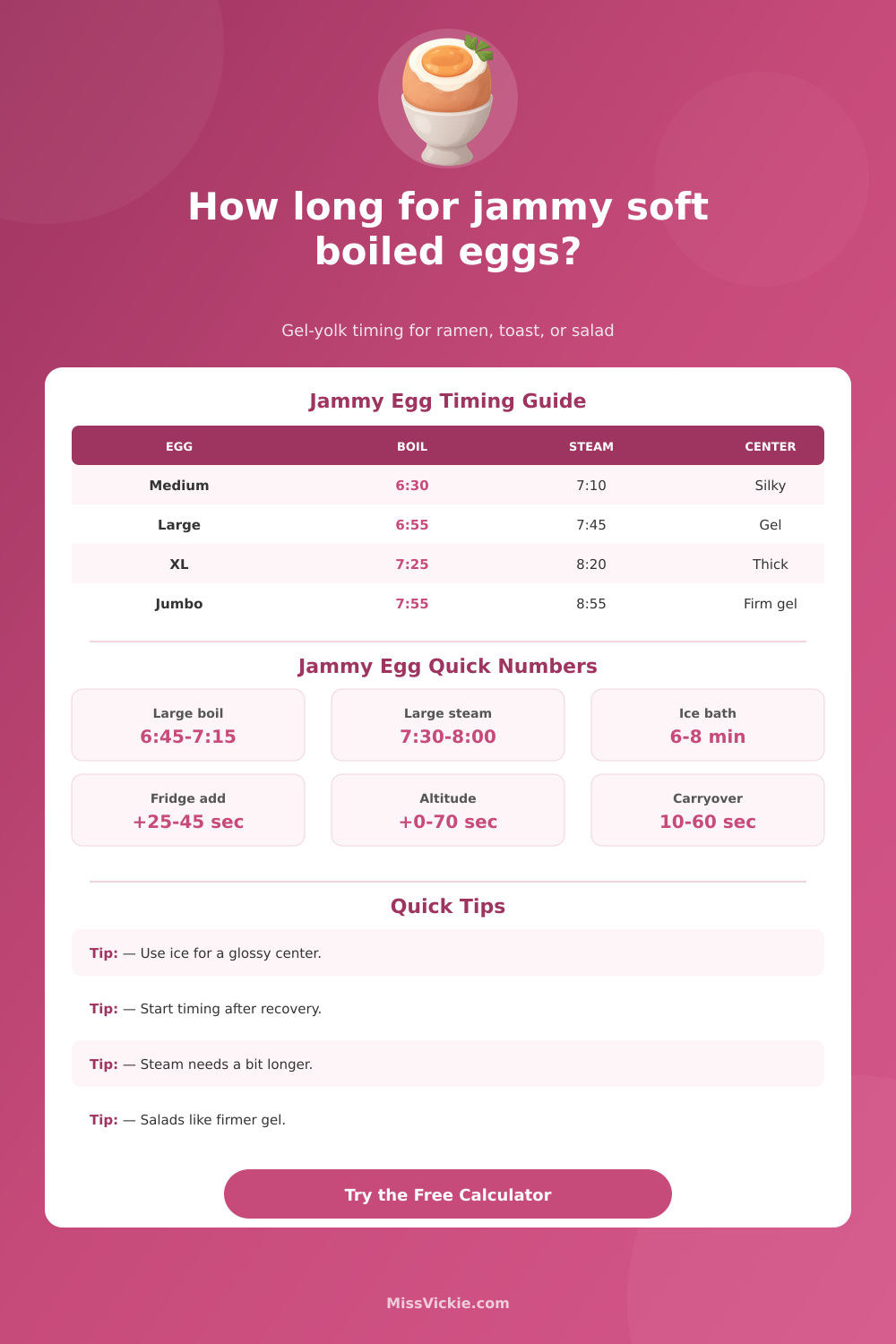
| Egg size | Typical weight | Boiling-water jammy timer | Steam-basket jammy timer | Gel-yolk cue |
|---|---|---|---|---|
| Medium | About 51 g / 1.8 oz | 6:20 to 6:45 | 7:00 to 7:25 | Silky gel, delicate slice |
| Large | About 57 g / 2.0 oz | 6:45 to 7:15 | 7:30 to 8:00 | Classic glossy jam |
| Extra large | About 64 g / 2.25 oz | 7:15 to 7:45 | 8:05 to 8:35 | Thick gel, clean halve |
| Jumbo | About 71 g / 2.5 oz | 7:45 to 8:15 | 8:40 to 9:10 | Firm gel, no chalk |
Timers assume eggs start cold, the pot has recovered heat, and eggs move into a real ice bath. Steam timing starts once full steam returns.
🧪Jammy Vs Medium Soft Boiled
| Yolk stage | Center texture | Large egg boil range | Best use | What to avoid |
|---|---|---|---|---|
| Runny soft boiled | Liquid center, set white | 5:45 to 6:25 | Toast cups or spooning | Too loose for clean slices |
| Jammy soft boiled | Glossy gel center | 6:45 to 7:15 | Ramen, toast, grain bowls | Skipping the ice bath |
| Thick jammy | Dense gel, no run | 7:15 to 7:45 | Salad wedges and lunch boxes | Overcooling before peeling |
| Medium soft boiled | Mostly set yolk, soft core | 8:00 to 8:45 | Snack eggs and firmer plates | Calling it jammy for ramen |
🚫Adjustment Factors That Move The Center
| Factor | Common range | Timer effect | Jammy-yolk effect | Calculator input |
|---|---|---|---|---|
| Egg starting temperature | Room to very cold fridge | -20 to +45 sec | Cold yolks lag behind the white. | Egg starting temperature |
| Cooking method | Boil, simmer, steam, cold start | -10 to +80 sec | Steam is steady but slower than boiling contact. | Cooking method |
| Altitude | Sea level to 12,000 ft | 0 to +75 sec | Cooler boiling water delays gel set. | Kitchen altitude |
| Batch crowding | 2 eggs to full basket | 0 to +50 sec | Crowding slows heat recovery and narrows repeatability. | Egg count and water volume |
| Ice bath strength | Ice, cold tap, short rinse, none | 0 to -55 sec | Weak cooling means the yolk thickens after cooking. | Cooling method |
| Use case | Ramen, toast, salad, prep | -10 to +35 sec | Sliced salads need a more stable gel. | How eggs will be used |
🍴Use-Case Texture Targets
📊Large Egg Nutrition Context
💡Jammy Egg Timing Tips
Soft-cooked eggs are not fully hard-cooked. People who need fully cooked eggs for food-safety reasons should choose a firmer target and verify doneness.
In 30 seconds, it can make the difference between a sad chalky mess of an egg, or a perfect jammy egg. There’s something magical about cracking it open and finding that glossy, gelatinous yolk inside. That yolk smear beautifully into the broth, but still stays together on chopsticks.
But how do we get there? And what makes for a reliably perfect soft boiled egg? Turns out it has nothing to do with intuition, and everything to do with laws of thermal physics. Basically: you’re trying to barely touch the proteins in the yolk, while denaturing the proteins in the white.
The Science Behind the Perfect Soft Boiled Egg
With the calculator above, just plug in starting temperature and size of your egg, and let the calculator handle all the math (no need to guess at any conversions or coefficients). The problem is that most home cooks don’t account for where the eggs originate. Eggs fresh out of a cold fridge will not behave like eggs at room temperature. As the heat travels through shell, the yolk lags behind white. To get to the gel state requires more time, but if you began with cold eggs, cooking too long on the exterior will happen before middle catches up. That’s why it makes that adjustment based off whether or not you started with refrigerator eggs. Add more seconds to the timer so they can catch up. That is what most recipes is missing.
The way you cook it also matters. Steam heats things up faster and more evenly than boiling water do (it’s all about the conduction). A steamer basket will affect rate of heat transfer due to the air gap, so your time is going to be slightly different there. The table on the page clearly lays this out for various sizes. You don’t need to commit any of those numbers to memory. Just know that when you switch from one cooking method to another, you need to switch mindsets. Don’t expect to rely on a boil timer when you’ve got a steamer timer.
Altitude is another silent killer of perfect eggs. As you gain height, water starts to boil at a lower temperature… Which means that the thermal energy hitting your egg are not as intense. That seven minutes that was perfect down at sea level is now a runny mess a mile up. Luckily, the calculator accounts for elevation automatically. Because the boiling point is lower, it adds time to account for that drop in heat intensity. You’ll find that if you move from a valley to the mountains, your old timers will let you down if you don’t account for the drop in heat intensity.
Batch size makes a difference. Putting a dozen eggs in a small pot will kill the boil immediately. As those shells warm up, the water temperature drop like a rock. Then there’s the time it takes to recover the precious heat that was lost. That’s why the tool prompts you for both water volume and batch count. Because the tool guesses at the time needed to regain heat. When you overcrowd the pot, it adds more time. This eliminates thermal shock and prevents undercooking the center of an egg.
Most good eggs go to die peeling. Warm eggs are finicky. They’re also notoriously tricky. Chilling them doesn’t just stop warm food from being hot… It halts the carryover cooking which transforms a gel yolk into a firm one. A setting for how you’ll chill allows the calculator to adjust for that. For example, if you want to serve right away (no chilling), the timer will be shorter. An ice bath adjusts for the sudden drop in temperature and prevents the yolk from hardening any more as it sits in cold water. You should of used an ice bath.
Once you grasp those variables, cooking becomes less of a crap shoot and more of a science. Control the input. Let physics take care of the rest. Chill ’em down, heed the altitude, and go with cold eggs. Get the details right and that glossy center will be all yours.