Soft Boiled Egg Time From Fridge Calculator
Estimate boiling-water-start soft boiled egg timing from true fridge temperature, counter rest minutes, egg size, water volume, batch size, altitude, crack-shock risk, ice bath strength, and runny or jammy yolk target.
Pick a real kitchen scenario, then tune the fridge temperature, counter rest, pot load, and ice bath. This calculator assumes eggs are lowered into already boiling water.
Fridge-cold large eggs
Run the calculator to estimate boil time, cold correction, crack risk, and carryover.
Time Corrections
Kitchen Setup
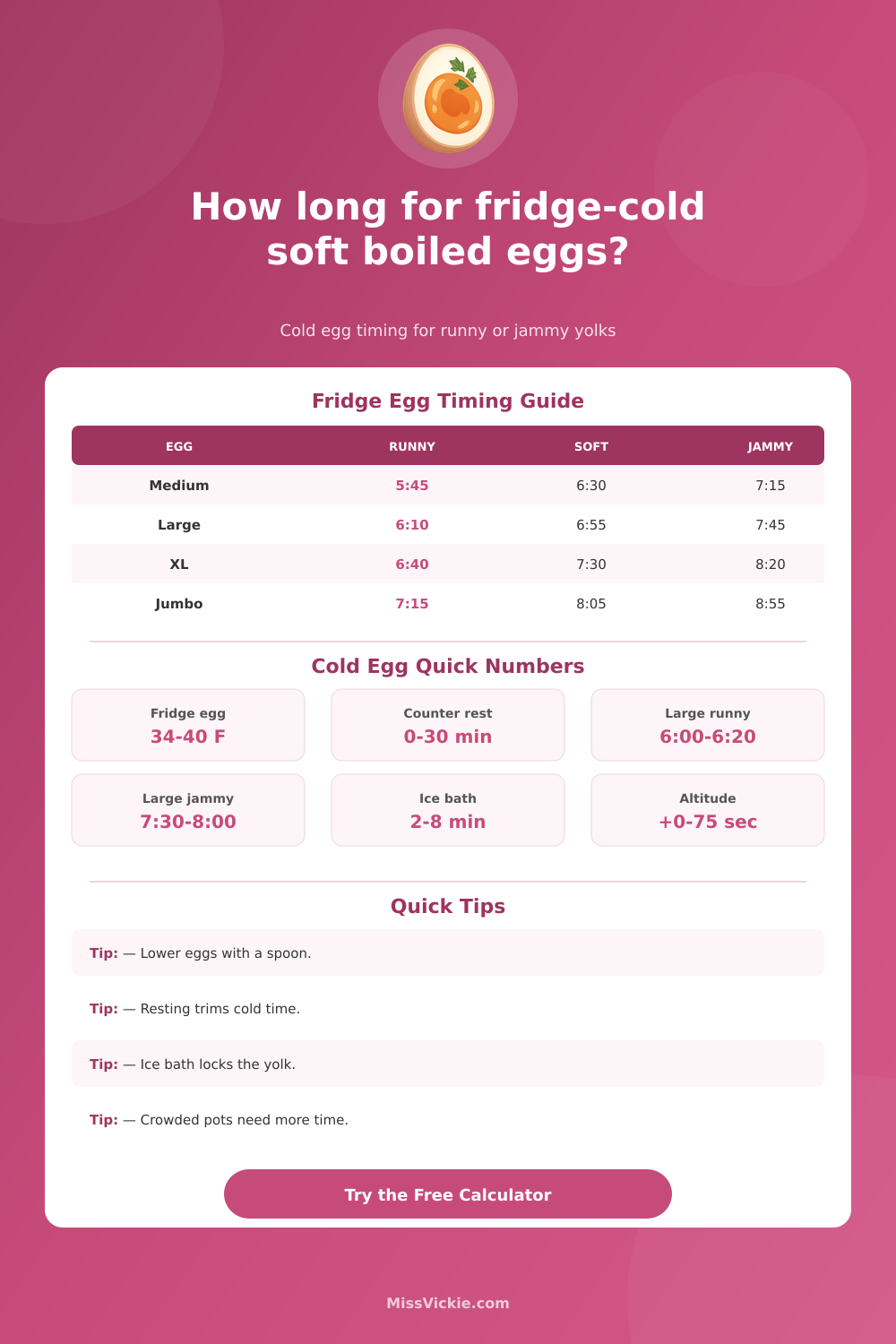
| Egg size | Typical weight | Runny fridge start | Soft yolk fridge start | Jammy fridge start |
|---|---|---|---|---|
| Small chicken egg | 43 g / 1.5 oz | 5:25 to 5:50 | 6:05 to 6:30 | 6:50 to 7:15 |
| Medium chicken egg | 50 g / 1.75 oz | 5:45 to 6:10 | 6:25 to 6:55 | 7:10 to 7:40 |
| Large chicken egg | 57 g / 2 oz | 6:05 to 6:30 | 6:50 to 7:20 | 7:35 to 8:05 |
| Extra large chicken egg | 64 g / 2.25 oz | 6:35 to 7:00 | 7:20 to 7:50 | 8:10 to 8:40 |
| Jumbo chicken egg | 71 g / 2.5 oz | 7:05 to 7:35 | 7:55 to 8:25 | 8:45 to 9:20 |
Table assumes 36°F to 40°F eggs, boiling-water start, low altitude, immediate cooling, and one uncrowded pot load.
| Factor | Low-impact setup | Add time when | Why it matters | Best move |
|---|---|---|---|---|
| Water volume | 2 to 3 eggs per quart | Over 4 eggs per quart | Cold eggs pull heat from the pot. | Use more water or split batches. |
| Boil recovery | Rolling boil before loading | Gentle boil or crowded pot | The timer starts in a cooler pot. | Wait for active simmer to return. |
| Altitude | Below 3,000 ft | Above 3,000 ft | Boiling water is cooler. | Add seconds, not heat. |
| Counter rest | 10 to 20 minutes | No rest from a very cold fridge | Shell shock rises with temperature jump. | Rest briefly or lower slowly. |
| Ice bath | 2 to 8 minutes | Short rinse or no cooling | Carryover keeps thickening the yolk. | Pull earlier or chill harder. |
| Situation | Risk level | Timer effect | Handling cue |
|---|---|---|---|
| Cold eggs gently spooned into boiling water | Low to medium | Use normal cold correction | Lower one by one or use a spider. |
| Very cold eggs dropped into rolling boil | High | Timing may still work | Cracks come from shock and impact, not undercooking. |
| Pin-pricked air end | Lower pressure crack risk | No major time change | Use a clean pin and avoid deep punctures. |
| Thin or hairline shells | High | May leak white | Use basket lower and avoid violent boiling. |
| Cooling method | Typical time | Best for | Carryover result |
|---|---|---|---|
| Immediate ice bath | 2 to 4 minutes | Runny or soft breakfast eggs | Stops the center quickly while still peelable. |
| Long ice bath | 5 to 8 minutes | Jammy peeled eggs | Cleaner peel and firmer edge without hard yolk. |
| Cold tap bath | 3 to 6 minutes | Everyday soft eggs | Moderate carryover; pull slightly earlier. |
| No cooling | Serve immediately | Egg cups and toast dipping | Yolk keeps setting while you plate. |
Soft-cooked eggs may not be appropriate for people who need fully cooked eggs for food-safety reasons. Choose a firmer target when full yolk set is required.
Most folks make common mistake by thinking soft boiled eggs are just about the time. Take one out of fridge, plop it into some water, and wait six minutes. Nope. It’s more complicated then that.
Eggs stored at thirty-eight degrees Fahrenheit has that coldness deeply embedded within their shell well after their exterior has warmed up. When you neglect this temperature gradient, your yolk turn rubbery before the white even sets. This is what most home cook miss. They pay attention to the clock but fail to take notice of heat retention just inches away in the carton.
Why Timing Is Not Enough for Soft Boiled Eggs
I found this calculator to do all of the thinking for me (though it takes into account things like fridge temp vs actualy temp and how long the counter was out). And yes, it knows your five minutes on the counter probably did nothing to warm up the yolk (but at least kept the shell from cracking based off thermal shock).
We are talking about two different battles: doneness and not breaking the shell. You can drop the egg carefully with a spoon so it doesn’t break the shell, but still need a few more seconds in the pot to get the center warmed up. Think of them as different issues, and treat them differently. If not, then you’ll either have broken whites or underdone yolks, and only one is right each time.
And here’s another sneaky way altitude comes into play: Because the boiling point of water decreases as altitude increases (as in, the higher above sea level you are, the lower your water will boil), your water starts off cooler. This means it take longer to conduct and transfer heat. To account for this, the tool automatically adds more seconds to whatever your starting base is so that no matter where you are, the yolk will cook to the desired texture. It’s not much of an adjustment, but it also saves you the heartbreak of having perfectly timed-looking eggs that feel undercooked in center.
People also forget about how important it is to have enough water. When you put cold eggs into a crowded pot filled with only a bit of water, surrounding water cools down immediately. This doesn’t just mean that it’ll take a few extra seconds for the boil to resume. It also means it won’t be able to steadily transfer heat during the rest of the cooking process.
The timer is also something to consider when it comes to the cooling strategy. Even after removing the eggs from the pot, there’s still carryover cooking. That residual heat will continue to firm up the yolk. You’ll lock in a certain level of firmness if you want a jammy egg for ramen, and a long chill will help peel away any remaining shell without tearing the egg apart. And vice versa: If you’re aiming at a dippy runny yolk, you have to halt this cooking process almost immediately.
You do the math depending on whether you intend to peel the egg for future assembly, or consume immediately. And then there’s the issue of consistent egg sizes. A regular-sized chicken egg comes in at about fifty-seven grams, while a jumbo one will weigh as much as seventy-one. Heating that up take more time and therefore more energy.
If you try to poach a mix of big and little eggs together in the same pan, you’ll likely end up with one perfect egg and the other overcooked. Separating them before cooking may sound like an unnecessary step, but it will ensure all your eggs comes out evenly cooked.
Soft boiled eggs are also very easy for your body to use nutritionally speaking. They have set nicely with their white and still maintain a rich, runny yoke. Because of this textural profile, your body can access the fat from the yolk better than if it were an over-cooked hard boiled egg which becomes chalky. Not only does it taste good. Digestibility and nutrient absorption change based off heat.
The bottom line: Know what it is you’re measuring. And no… It’s not the minutes. What you’re doing is controlling heat exchange between two objects at different temperatures in an unstable medium. When you get that part, when you understand how altitude, fridge temperature, and other variables play together, the guessing stops.
You don’t wait until the timer dings to pull out those eggs. You do so when all the parts comes together for the exact texture you want. Suddenly, a stressful morning routine becomes something predictable. It is something you could of relied on.
The next time you grab that egg carton, keep this in mind: The clock tells us only half the story. The rest is a matter of physics, a delicate business done with a spoon and sure hand.