Soft Boiled Egg Steam Time Calculator
Estimate steam-basket timing for runny, soft, or jammy eggs using egg size, egg count, fridge temperature, lid fit, steam intensity, altitude, pot preheat, spacing, ice bath, and planned carryover.
🥚Steam Basket Presets
These presets assume eggs sit above boiling water in a covered steamer basket. They are not cold-water boil times or simmer-in-water charts.
⚙Eggs, Steam, And Finish
Steam timing plan
Load eggs into a fully steaming basket, cover, and time from steam recovery.
Steam-Specific Adjustments
Basket And Finish Details
⏱Steam Basket Baselines
Baseline times assume large chicken eggs, a single loose layer, a fully preheated covered pot, steady steam, sea-level kitchen, and an immediate cooling bath.
📊Egg Size Steam Timing Chart
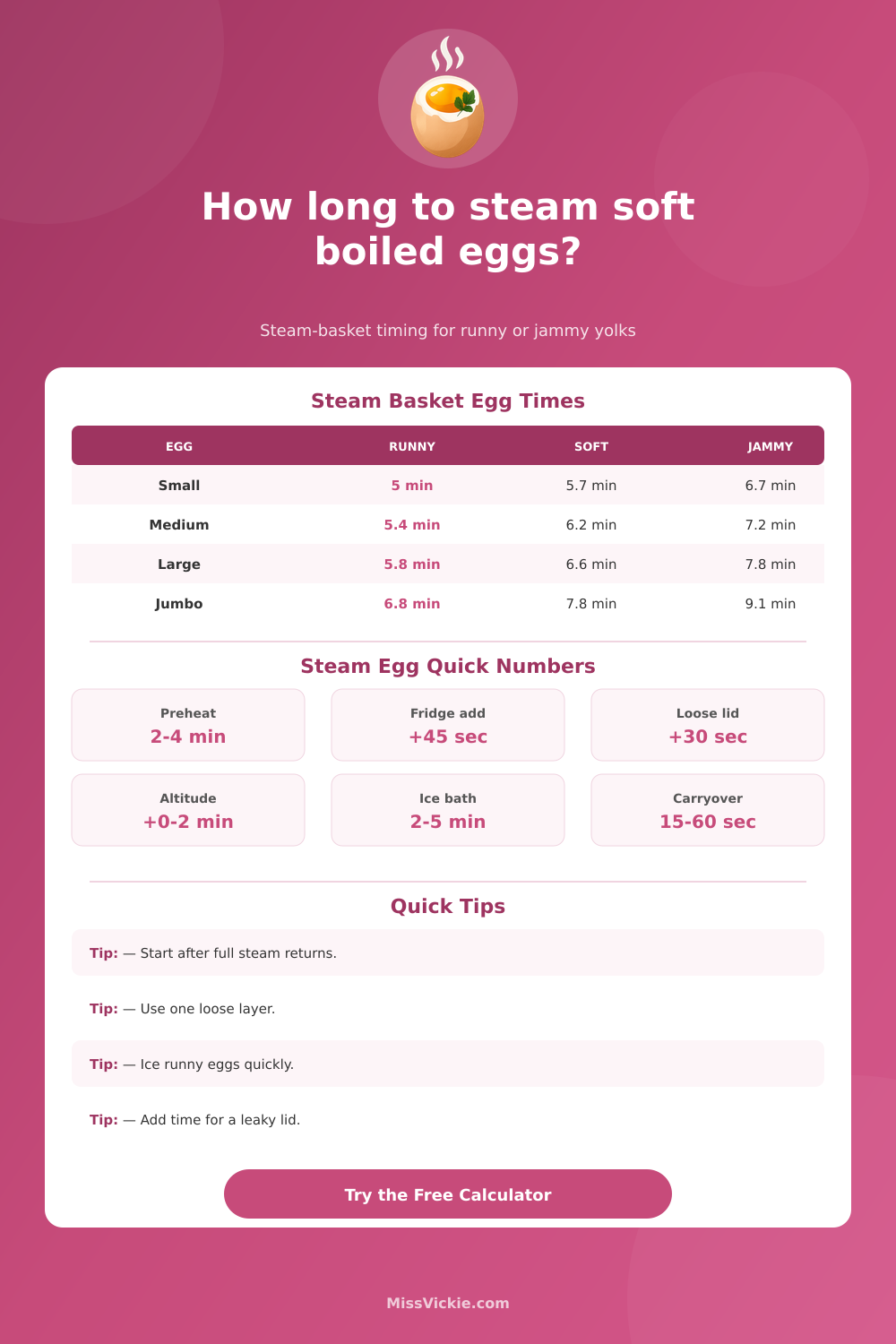
| Egg size | Typical weight | Runny steam baseline | Soft steam baseline | Jammy steam baseline |
|---|---|---|---|---|
| Peewee | About 42 g / 1.5 oz | 4.7 min | 5.3 min | 6.1 min |
| Small | About 50 g / 1.8 oz | 5.0 min | 5.7 min | 6.7 min |
| Medium | About 57 g / 2.0 oz | 5.4 min | 6.2 min | 7.2 min |
| Large | About 64 g / 2.25 oz | 5.8 min | 6.6 min | 7.8 min |
| Extra large | About 73 g / 2.6 oz | 6.3 min | 7.2 min | 8.4 min |
| Jumbo | About 80 g / 2.8 oz | 6.8 min | 7.8 min | 9.1 min |
Use the chart as a starting point, then allow the calculator to adjust for steam loss, load density, altitude, start temperature, and carryover.
🌡Steam Adjustment Reference
Use these steamer-specific adjustments when you are matching the calculator to a real pot, basket, lid, egg temperature, and yolk target.
| Steam factor | Typical setting | Timer adjustment | Runny yolk note | Jammy yolk note |
|---|---|---|---|---|
| Steam intensity | Rolling to intermittent steam | -6 to +51 sec | Weak steam turns runny centers uneven. | Gentle steam can still work if timing is extended. |
| Lid fit | Tight, normal, loose, or vented | 0 to +45 sec | Leaks matter most below 6 minutes. | Add time for visible side plumes. |
| Egg starting temperature | Room to very cold fridge | -21 to +60 sec | Fridge eggs need the calculator's cold-egg buffer. | Very cold eggs may need the full extra minute. |
| Altitude | Sea level to 12,000 ft | 0 to +2 min | High kitchens narrow the runny window. | Expect a slower set above 5,000 ft. |
| Batch spacing | Open layer to stacked basket | 0 to +57 sec | Keep eggs in one loose layer. | Rotate tiers if using a stacked steamer. |
| Ice bath and carryover | Ice bath, rinse, or no cooling | -10 to -55 sec | Ice bath protects liquid centers. | No cooling keeps thickening the yolk. |
| Egg size and target | Small runny to jumbo jammy | 5.0 to 9.1 min base | Use smaller-egg baselines for toast eggs. | Use jumbo or firm-jammy rows for ramen eggs. |
🧊Cooling And Carryover Guide
| Finish method | Best for | Cooling time | Steam-time effect | Texture note |
|---|---|---|---|---|
| Immediate ice bath | Runny or soft yolks | 2 to 5 min | Use full timer | Stops the center quickly and helps peeling. |
| Cold tap bath | Everyday soft eggs | 3 to 6 min | Subtract about 10 sec | Good when ice is unavailable but water is cold. |
| Short rinse | Peeling warm | 30 to 60 sec | Subtract 20 to 30 sec | Yolk keeps thickening while you crack. |
| No cooling | Eat from shell | None | Subtract 35 to 55 sec | Best only when serving immediately. |
🍳Steam Setup Notes
📝Practical Steam Tips
Soft-cooked eggs are not the same as fully hard-cooked eggs. People who need fully cooked eggs for food-safety reasons should choose a firmer target and verify doneness.
That’s because, well, you’ve cracked an egg onto some toast and found that it’s not quite right. It was hard boiled. It’s happened to all of us before. Maybe the kitchen was cooler then normal, maybe the lid didn’t seal properly and let too much steam escape, or maybe you were just going off a phone timer. Making steamed eggs is as much about controlling the transfer of heat into your egg from a changing environment as it is following any sort of recipe. With the calculator above, we’ve controlled those tricky variables so you can quit worrying about what went wrong with yolk, and start thinking about enjoying it instead.
All soft boiled eggs are not created equal. Size definitely do matter with eggs. In fact, there’s almost double the mass between a peewee and a jumbo egg. That means there’s a lot more distance for the heat to travel to cook that egg from the outside in. Boil them at the same time on the same timer and the little one will go past done and the big one will still be half raw inside. To make up for this, the tool takes into account relative size of your eggs and adjusts starting time to match. Small differences, but they make the difference between a runny pool and a chalky disaster.
Why Egg Cooking Can Be Tricky
Finally, we must consider the egg-temperature history. Immediately after removing eggs from fridge, they’ll be around 38 degrees Fahrenheit. Quite a distance to travel in only six minutes. Surprisingly, it takes some time for the yolk to begin setting while cold shells suck up an enormous amount of thermal energy. Unless you account for this cold mass, you will always undercook the middle of steamed eggs if you remove them from fridge and immediately place them into the steamer. Physics doesn’t care how hungry you are; the calculator includes a buffer for fridge-cold starts. Eggs that is room temperature cook more quickly, but very few of us keep our breakfast ingredients out on the counter throughout the day (for good reason).
There are other variables that won’t be seen with the naked eye: how hard your stove burner is running, how much steam is being produced, for example. A full-on rolling boil creates a thick wall of hot steam around the food inside, cooking everything fast and even. A gentler simmer lets wispy tendrils of steam rise up and dissapears when your lid isn’t on tight, lowering the temperature in the pot slightly so things take minutes longer to finish. And, yes, a loose-fitting lid (or one without a seal) will cause your pot to lose heat at a rate higher than what the typical moddern models assume. For this reason, the tool asks whether or not your lid fits well and how powerful your burners are. You can’t fool thermodynamics; they’re going to fight back.
Altitude also matters, especially if you live in the mountains. Because water boils at a lower temp at high altitude, the steam generated during cooking will therefore be cooler as well. For jammy eggs, maybe this won’t matter much, but it can throw off an exact runny aim since the boiling point drops by roughly one degree for every 1000 feet you climb. Luckily, the calculator accounts for altitude; as you go up higher, the boiling point goes down by about a degree per 1000 feet. Maybe you don’t feel the shift in air pressure, but your breakfast certainly will.
Don’t forget about finishing: The carryover cooking really happens with eggs. When you remove egg from the steamer, the outer layer of cooked whites will continue to cook and pass heat until the still-cool center catches up. Then if you leave it sitting for several more minutes on the plate while you peel, you’ll find it’s now overcooked harder than desired. A quick plunge in ice water halts it immediately, preserving the ideal tender softness. Forgetting about the ice bath is like turning off your oven but leaving some bread inside, then leaving it there longer because you didn’t notice. You’re just further baking it (but without knowing).
Consistency matters. The point of the tool is that your pot has oddities. Maybe your stove’s burners are weaker than average. Maybe your eggs aren’t all identical because you buy them at a local farm. Feed those kinds of real world conditions into the tool, and what you end up with is a timer that matches reality in your kitchen rather than some idealized lab environment. It still requires you to wait till there’s steam coming back before you start the clock. But once you do, the math works out.
There’s no such thing as “lucky” when it comes to perfect eggs. It’s all about understanding and giving in to the variables that you have no say over, while taking care of those that you do. There’s nothing quite like that moment when your yolks are just as thin (or as thick) as you had hoped, and the whites are cooked through just so. A quick breakfast becomes something truly satisfying because you feel like you’re getting something from this simple ingredient that you could never get otherwise. Congratulations on a runny egg: you earned it.