Soft Boiled Egg Cooking Time Calculator
Estimate second-by-second soft boiled egg timing for runny, thick, or jammy yolks from egg size, starting temperature, steam or simmer method, altitude, batch count, freshness, shell thickness, serving use, and immediate chilling.
🥚Soft boiled egg presets
Pick a runny or jammy yolk goal, then fine-tune for your egg carton, stove, altitude, and whether the eggs go into ramen, an egg cup, toast, or a lunch bowl.
⚖Altitude units
⏱Eggs, yolk target, and cooking method
🌡Altitude, shell, freshness, and chilling
Soft boiled egg timing estimate
Timing breakdown
This setup has a tight window but should give a runny yolk when chilled promptly.
📋Soft boiled timing cards
Very runny center for egg cups and toast soldiers.
Set white with a loose golden yolk for breakfast.
Glossy yolk that flows slowly over toast or rice.
Spoonable ramen-style center, still not hard-boiled.
📖Large egg reference times
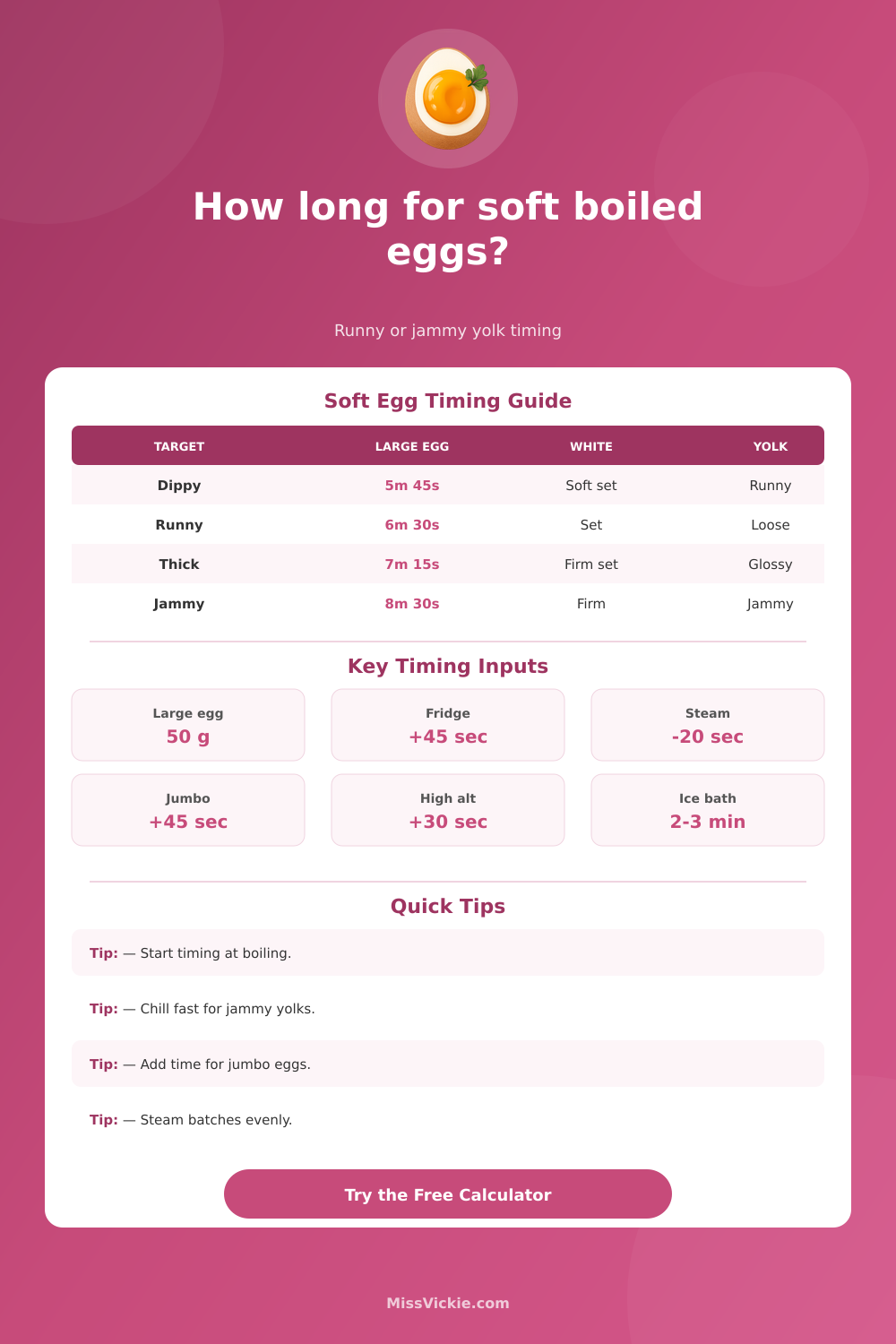
| Yolk target | Simmer from boiling | Steam from boiling | Best use | Immediate chill |
|---|---|---|---|---|
| Dippy, very runny yolk | 5 minutes 30 seconds to 5 minutes 50 seconds | 5 minutes 10 seconds to 5 minutes 35 seconds | Egg cup, toast soldiers | Brief rinse or 1 minute ice bath if peeling |
| Runny yolk, set white | 6 minutes 20 seconds to 6 minutes 45 seconds | 6 minutes to 6 minutes 25 seconds | Breakfast bowl, toast, warm snack | 2 minutes cold water or ice bath |
| Thick runny yolk | 7 minutes to 7 minutes 30 seconds | 6 minutes 40 seconds to 7 minutes 10 seconds | Halved on toast, rice, noodles | 2 to 3 minutes ice bath |
| Loose jammy yolk | 7 minutes 45 seconds to 8 minutes 15 seconds | 7 minutes 25 seconds to 7 minutes 55 seconds | Ramen, soy marinade, lunch bowls | 3 minutes ice bath before peeling |
| Jammy spoonable yolk | 8 minutes 20 seconds to 8 minutes 50 seconds | 8 minutes to 8 minutes 30 seconds | Salads, packed lunch, make-ahead ramen | 3 to 4 minutes ice bath |
🍳Adjustment guide for soft eggs
| Factor | Add or subtract | Why it matters | Soft-boiled note |
|---|---|---|---|
| Small egg | Subtract 20 to 35 seconds | Less mass between shell and yolk center | Easy to overcook past runny |
| Extra-large or jumbo egg | Add 25 to 55 seconds | Yolk center heats more slowly | Useful for jammy ramen eggs |
| Refrigerator-cold egg | Add 35 to 55 seconds | Cold yolk starts farther from set temperature | Most U.S. grocery eggs need this |
| Covered steam method | Subtract 15 to 30 seconds | Steam transfers heat quickly and evenly | Good for 6 to 12 egg batches |
| High altitude | Add 8 to 12 seconds per 1,000 ft | Water boils cooler as altitude rises | Steam also slows slightly |
| No ice bath | Subtract 20 to 45 seconds from cook | Carryover keeps the yolk thickening | Crack and serve immediately |
💡Soft egg timing notes
Start point: For simmer and steam methods, start the timer when eggs go into already boiling water or a fully steaming basket.
Ramen use: Chill immediately, peel gently, then marinate after the yolk texture has stopped cooking.
Egg cup use: A short rinse keeps the egg warm while slowing the carryover enough for a dipping yolk.
Fresh eggs: Very fresh eggs peel best after a longer chill, but that chill can firm the outer yolk slightly.
Instead of guessing how to time an egg based off whether you want it for toast or ramen, managing variables and getting the seconds right in the kitchen give you that perfect soft-boiled egg. Timing makes the difference between one that runs a little and one that doesn’t at all. They use the same chart each time like everyone else. However, they don’t take other factors into account which make it different each time.
Why does this matter? Egg size matters because heat has to travel from shell through the white before it reaches the yolk. To achieve the same loose texture, jumbos requires additional time more than a standard or large egg.
Factors That Change Cooking Time
Similarly, starting temp has a role. Because cold eggs come directly out of refrigerator, their initial temperature will be lower than room-temp eggs; therefore they’ll require added time to warm and get desired yolk texture. Reducing that lag by letting eggs sit for 20 minutes on the counter. Without otherwise altering them, is all the adjustment required.
And then there’s cooking style, where things also change: If you’re cooking multiple egg at the same time, steam distributes heat more uniformly than an equal volume of simmering water. And altitude comes into play (because water doesn’t boil as hot up high), slowing everything down. Even without any other variation in your set-up, a five-thousand-foot elevation require a large tweak from sea-level kitchen.
And then, after you’ve got your egg cooked, it’s up to you how runny you’d like the yolk to be. Decide what you actualy want the yolk to do once it’s cooked; a yolk for toast soldiers can stay looser than one that needs to survive peeling and a quick marinade for ramen. If you’re serving it on toast soldiers, you might want a slightly looser yolk then if you’re saving it for something that will be exposed to air for a long time. Decide how jammy or soft you want the yolk to be.
How fresh the egg is has less to do with its actual cooking time than its tendency for peeling (although very fresh eggs will also cling to their membranes even when properly chilled). The reason: When it’s chilled immediately after cooking, the texture is locked into place. If not, there will be some carryover heat that continues to cook the yolk for an additional minute or two, making a runny yolk thicker than intended. Placing it in an ice bath halts this process immediately. Rinsing briefly in cold water leaves it warmer on the inside (good if you’ll eat it right away) but runs the risk of overcooking should you delay.
The remaining factors are real, if smaller: batch size, and water recovery. When there’s a crowd of eggs in your pot, that will depress the water temp as they go in, starting the clock later than you’d guess. Once you plug those things into the calculator (above) it does the math for you… You don’t have to remember all the variables yourself.
Instead of memorizing how each method and egg size affects the yolk target, you can just use the reference table on this page. The timer is the thing people get hung up on and they lose sight of the other variables post-boil. Shell thickness, crowd size in your batches, skipping the chill, all these things will add up quicker than most realize. But once you understand how they work together it’s not as random anymore and becomes predictable enough for repetition.