Soft Boiled Egg Air Fryer Time Calculator
Estimate air-fryer timing for chicken eggs with runny or jammy yolks, then adjust for egg size, count, wattage, preheat, fridge chill, basket spacing, altitude, ambient temperature, ice bath, and carryover.
1.Start with a soft-yolk scenario
These presets use gentle air-fryer temperatures, not hard-boiled egg timing. Use them as a first-test batch for your specific basket.
2.Enter your air fryer and eggs
Soft egg timing plan
Use the calculator to estimate your first test batch.
Timing breakdown
3.Soft-yolk reference cards
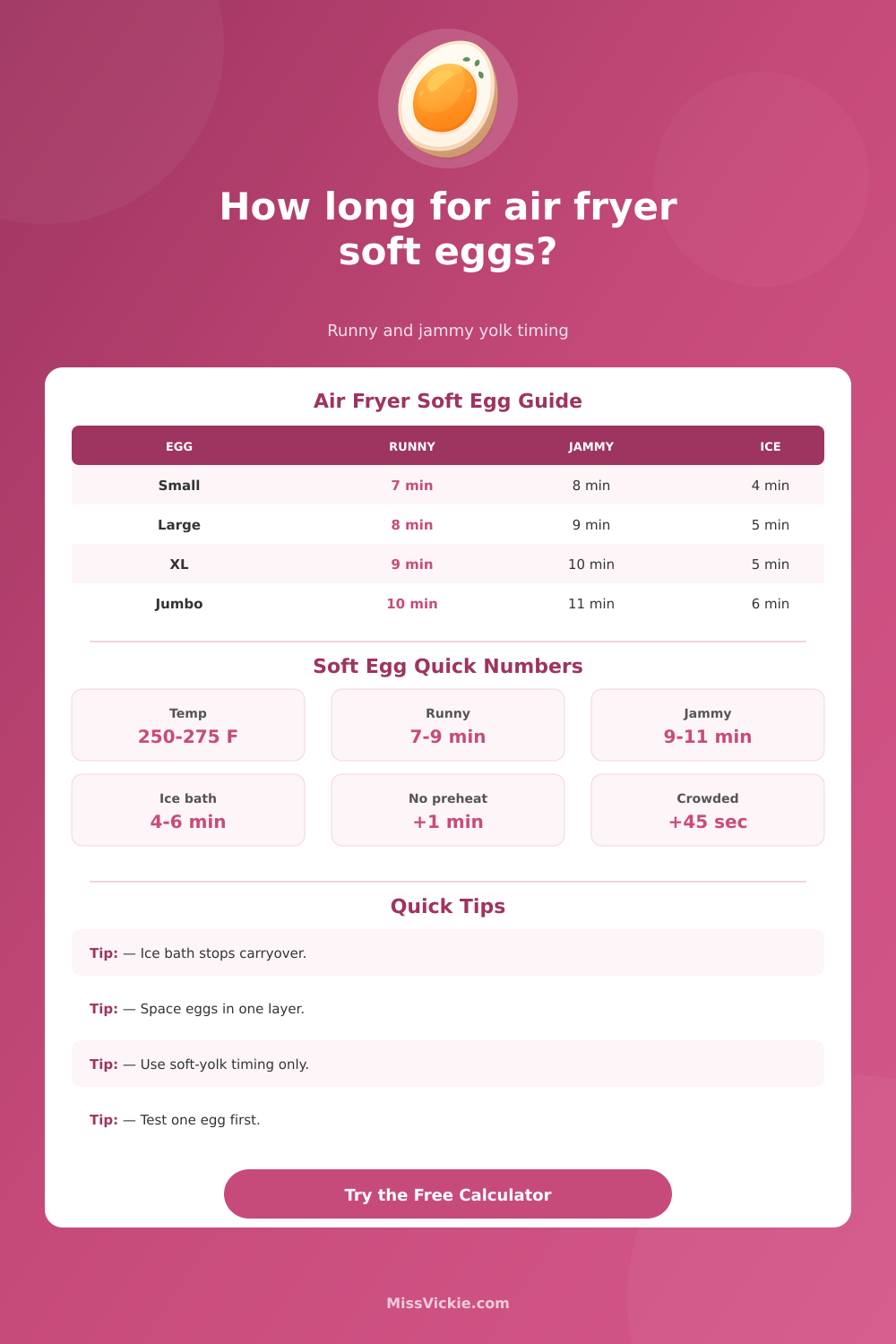
4.Air fryer soft egg timing table
| Egg size | Approx weight | Runny target at 270 F | Jammy target at 270 F | Ice bath |
|---|---|---|---|---|
| Small chicken egg | About 43 g | 6.5-7.5 minutes | 7.5-8.5 minutes | 4 minutes |
| Medium chicken egg | About 50 g | 7-8 minutes | 8-9 minutes | 4-5 minutes |
| Large chicken egg | About 57 g | 7.5-8.5 minutes | 8.75-10 minutes | 5 minutes |
| Extra large chicken egg | About 64 g | 8.25-9.25 minutes | 9.5-10.75 minutes | 5-6 minutes |
| Jumbo chicken egg | About 71 g | 9-10 minutes | 10.25-11.5 minutes | 6 minutes |
5.Adjustment guide
| Condition | Add or subtract | Why it matters | Soft-yolk note |
|---|---|---|---|
| No preheat | Add 45-75 sec | The basket starts cooler and heats the shell slower. | Check early if your fryer preheats quickly. |
| Room temperature eggs | Subtract 30-60 sec | Egg centers start warmer than fridge eggs. | Useful for very runny yolks. |
| Crowded basket | Add 30-75 sec | Airflow drops between shells. | Rotate positions for batches over 8 eggs. |
| Cold water only | Subtract 15-30 sec | The egg keeps cooking longer after removal. | Ice gives the cleanest soft center. |
| High altitude | Add 10-35 sec | Lower air density softens heat transfer slightly. | Smaller than stovetop boil adjustment. |
| Very warm kitchen | Subtract 10-25 sec | Appliance and eggs lose less heat to the room. | Most visible on runny targets. |
6.Air fryer soft egg control tables
Use these tables to sanity-check the calculator when your fryer, basket load, or cooling method is outside the default large-egg test batch.
| Wattage and style | Temp setting | Preheat state | Basket load | Runny large egg | Jammy large egg | Carryover pull |
|---|---|---|---|---|---|---|
| 900 W compact drawer | 255-260 F | Fully preheated | 1-2 eggs, wide gaps | 8-9 minutes | 9.5-10.5 minutes | Pull on time, ice fast |
| 1200 W small basket | 260-265 F | Short preheat | 2-4 eggs, normal gaps | 8-9.25 minutes | 9.5-10.75 minutes | Pull 15 sec early for no ice |
| 1500 W standard basket | 270 F | 3-5 minute preheat | 4-6 eggs, one layer | 7.5-8.5 minutes | 8.75-10 minutes | Ice bath stops carryover |
| 1700 W strong airflow | 270-275 F | Fully preheated | 6-8 eggs, not touching | 7.25-8.25 minutes | 8.5-9.75 minutes | Check first batch at low end |
| 1800 W toaster air fryer | 275 F | Tray preheated | 6-10 eggs, tray spacing | 8.25-9.25 minutes | 9.75-11 minutes | Tray heat can add 20-30 sec |
| Egg start | Egg size shift | Target texture | Ice bath plan | Carryover after pull | Timer move |
|---|---|---|---|---|---|
| Very cold, 34-38 F | Large or XL | Runny center | 5-6 minutes | Low if iced immediately | Add 20-35 sec |
| Fridge cold, 38-42 F | Medium or large | Runny soft boiled | 5 minutes | Medium with cold water only | Use calculator baseline |
| Cool rest, 50-55 F | Large or XL | Thick runny | 5 minutes | Low with ice bath | Subtract 15-30 sec |
| Room temp, 65-70 F | Small or medium | Very runny | 4 minutes | High if left on counter | Subtract 30-60 sec |
| Fridge cold batch | Jumbo eggs | Jammy ramen yolk | 6 minutes | Low after full ice bath | Add 45-75 sec |
| Any start, no ice | Any chicken egg | Runny or jammy | None | High for 2-4 minutes | Pull 30-60 sec early |
7.Nutrition and serving reference
8.Soft egg tips
Air-fryer hard-boiled eggs often run several minutes longer. This calculator intentionally stops in the soft-to-jammy window and treats carryover as a major factor.
Air fryers cycle heat differently. If one egg lands 30 seconds too soft or firm, keep the same settings and shift the next batch by that amount.
Move eggs straight from basket to ice water before peeling. A delayed chill can turn a perfect runny yolk into a thick jammy one.
Eggs touching the basket wall or each other can finish unevenly. For more than 8 large eggs, a second batch is often more predictable.
An air fryer is something you use to create crispy dishes faster. An egg? They’re delicate containers of just-so chemistry, where if you overdo it by thirty seconds, your perfectly done egg becomes rubbery rubber bands instead of creamy custard. So why does this matter? Because time is everything here. Cooking eggs requires knowing exactly when to pull them off; when to stop cooking an egg to ensure you have a soft boiled egg but not a fully-cooked yolk. So unlike anything else in the kitchen, timing are critical.
This online calculator do that math for you, taking into account the variables everyone else forgets, like changing altitudes or wattages on your machine.
Why Timing Matters for Air Fryer Eggs
The first variable is how the shell conducts heat. An air fryer doesn’t boil food; it circulates hot air around it. That make the outside of the egg cook faster then the inside. And if you’re working with fridge-cold eggs, that difference between the inside and outside temperature will be large. You can touch the shell and find it warming, yet there’s still an icy yolk underneath. That’s why initial temp matter so much. A fridge-cold egg require longer to get its middle up to cooking temp without getting the nearby white too-done. A room temp egg hits that sweet spot sooner. Small thing, but enough to shift your timer by almost a minute.
Another thing: What about basket real estate? To cook evenly, air fryers needs airflow. Putting six big eggs tightly together in a tiny basket will create dead zones where no air can reach. This cause the centers to steam rather than roast, which results in texture issues. They’ll either still be raw or overcooked. By spreading them apart, you ensure every surface get equal heat exposure. The solution is that this crowding factor increase your cooking time when the basket is full. No voodoo here; it’s just physics.
Carryover cooking is the silent killer of soft boiled egg. Once you remove an egg from whatever heat it’s been exposed to, it keep cooking for several minutes. Even once the machine is turned off, the inside of the egg will still cook. So if you’re planning to leave your eggs out on the counter or throw them in a lunch box right away, they’ll keep firming up. That means you need to keep that in mind and pull them earlier then expected. The best way to stop that is with an immediate ice bath. It stops the process dead in its tracks. Otherwise, you’re taking a gamble with residual heat that could make your runny yolk jammy by the time you’ve peeled off the shell.
Surprisingly, wattage also matter. Because they’re smaller, 900-watt units takes longer to heat up and hold less heat than their big brother, the eighteen-hundred-watt toaster-oven type. Larger units release more surrounding heat into the area where the eggs is placed, cooking them from all sides at once. Undercooking them is easy if you apply a chart optimized for a strong machine on a weak one. This calculator accounts for that variation so you can stop guessing. It closes the gap between appliance specs and cooking results.
Altitude is another silent variable. Air gets thinner as altitude increases. The thinner air change the rate of heat transfer via the air medium surrounding your food. Less so for dips than boiling water, but it do change the cooking window just enough to matter. A perfect dip here at 5,280 ft could be a disappointment there at sea level. And it’s not worth having an argument over unless you’re picky about consistency.
And lastly, what kind of yolk texture do you really desire? Do you want a runny yolk for dipping onto toast? Or a jammy yolk for use in a salad or ramen? They’re two very specific goals with two very specific levels of protein denaturation. This tool makes it easy to distinguish between them, so that you can avoid shooting for one and ending up with the other unintentonally.
There are no set rules for making a soft boiled egg in your air fryer, but there ought of to be. There is science to it, though. There is laws of physics surrounding how heat moves itself within an egg and its shell. Figure out those laws and all the numbers will make sense. All the guesswork goes away and the control begins. You get a perfectly golden yolk each and every time.