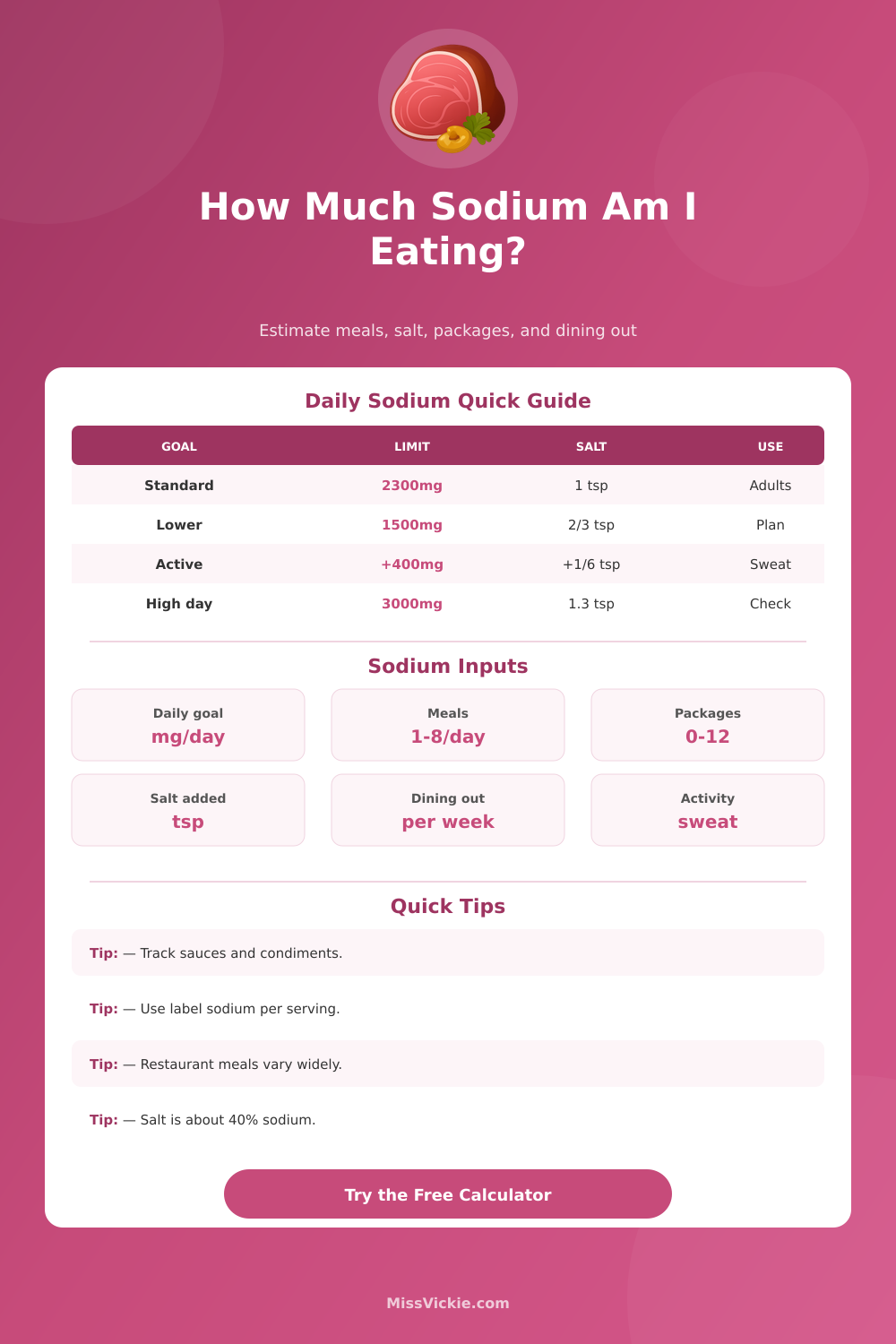
Daily limit, meals, package labels, salt added, servings, sweat, and restaurant meals
Sodium Intake Calculator
Estimate a practical daily sodium total from home meals, packaged foods, salt added during cooking, condiments, food categories, activity, and restaurant meals.
Choose a starting pattern, then replace the defaults with your own package labels, recipe servings, and restaurant estimates.
Daily Sodium Breakdown
Plain fruit, vegetables, grains, and unsalted proteins are usually the lowest sodium starting point.
Everyday staples can add sodium quietly because they appear across several meals.
Prepared soups, beans, entrees, and sides often depend on label serving size.
Dining-out sodium varies widely by sauce, portion, seasoning, and preparation style.
| Planning Reference | Sodium Amount | Approx Table Salt | How To Use It |
|---|---|---|---|
| Standard daily reference | 2300 mg | About 1 tsp salt | Useful as a broad daily comparison point for many adults. |
| Lower daily planning target | 1500 mg | About 2/3 tsp salt | A stricter planning limit some people use under personal guidance. |
| Four-meal split from 2300 mg | 575 mg per meal | About 1/4 tsp salt | Good for comparing breakfast, lunch, dinner, and snacks. |
| Five-meal split from 2300 mg | 460 mg per meal | About 1/5 tsp salt | Helpful for smaller meals or frequent snacks. |
| High-sodium single meal check | 1000 mg or more | About 0.43 tsp salt | Flag meals that may use a large share of the day. |
| Salt Added | Estimated Salt Weight | Estimated Sodium | Serving Note |
|---|---|---|---|
| 1/8 tsp table salt | 0.75 g salt | 290 mg sodium | Small pinch for a single plate or bowl. |
| 1/4 tsp table salt | 1.5 g salt | 580 mg sodium | Often enough to matter in one serving. |
| 1/2 tsp table salt | 3 g salt | 1160 mg sodium | Divide by recipe servings if used in a shared dish. |
| 1 tsp table salt | 6 g salt | 2325 mg sodium | Roughly one standard daily reference limit. |
| 1 tsp Diamond kosher | 2.8 g salt | 1085 mg sodium | Lighter by spoon volume than fine salt. |
| Food Or Ingredient | Typical Serving | Common Sodium Range | Calculator Input To Check |
|---|---|---|---|
| Plain cooked rice, oats, fruit, or vegetables | 1 serving | 0-80 mg | Food category add-on |
| Bread, tortilla, bun, or bagel | 1 piece | 120-500 mg | Packaged food serving |
| Cheese or cottage cheese | 1 oz to 1/2 cup | 180-700 mg | Food category add-on |
| Canned soup or frozen entree | 1 label serving | 600-1200 mg | Average package sodium |
| Soy sauce, dressing, ketchup, or salsa | 1 tbsp or label serving | 90-1000 mg | Condiment servings |
| Dining Pattern | Typical Sodium Range | Why It Changes | Best Calculator Field |
|---|---|---|---|
| Fast casual bowl or sandwich | 900-1800 mg | Bread, sauce, cheese, cured protein, and pickled toppings. | Restaurant sodium per meal |
| Pizza meal | 1200-2500 mg | Crust, cheese, sauce, cured meats, and portion count. | Restaurant meals per week |
| Breakfast plate out | 800-1800 mg | Bacon, sausage, biscuits, hash browns, and salted sides. | Brunch or restaurant preset |
| Home meal prep bowl | 400-900 mg | Seasoning, sauce, canned beans, grains, and cheese. | Home meal and package fields |
| Snack-heavy day | 300-1500 mg | Crackers, chips, dips, jerky, pretzels, and cheese portions. | Packaged and category servings |
The sodium calculator allow people to track the amount of sodium they consume. Sodium is often not visible in the meals that people consumes daily. People dont often realize that they are consuming a significant amount of sodium because sodium is found in many type of foods.
People only realize the amount of sodium that they consume when they use the calculator to determine their total daily sodium consumption. This calculator will show people the total amount of sodium that they consume daily and will inform people whether that amount is higher or low for an average individual. Additionally, the calculator will also show people which food contribute to their high sodium consumption.
Use the Sodium Calculator to Check How Much Salt You Eat
To use the sodium calculator, there is several types of information that you will have to enter. First, you will have to enter the types of food that you consumed daily. Second, you will have to enter the amount of salt that you added to the food that you consumed.
Finally, you will have to enter the number of restaurant meals that you consumed during the week. The amount of sodium that is contained in the food that you consume vary from food to food. Therefore, by entering this information into the calculator, it will provide you with a more accurate measurement of the amount of sodium that you consume daily.
The sodium and salt calculator require people to enter information regarding the amount of salt that they have added to the food that they have consumed. However, salt is not the same than sodium. Table salt, for instance, contains 40% sodium by weight.
Therefore, there will be an error in the sodium consumption if you use table salt but the food also contain sodium. There are other types of salt, and they have different weights than table salt. One such salt is kosher salt, which weigh less than table salt.
One teaspoon of kosher salt will contain less sodium than one teaspoon of table salt. People should of be made aware of the various types of salt to ensure that their added salt to food does not significantly increase their sodium consumption. Many people consume restaurant meals weekly.
These meals contain high amount of sodium. One restaurant meal may contain as much sodium as a person consumes during a whole day of meals at home. The sodium calculator takes into account the number of restaurant meals that people consume during the week because one restaurant meal may skew the weekly sodium consumption.
The calculator spread the sodium consumption from the restaurant meals over the seven days of the week. This way, the sodium consumption from the restaurant meal will not significantly impact the sodium consumption that a person display daily. However, the more restaurant meals that a person consumes each week, the more higher the weekly sodium consumption will impact the persons total sodium consumption.
The activity level that you perform each day will impact the amount of sodium that your body consumes. When you perform physical activity or work in hot environments, your body will lose sodium through your sweat. The sodium calculator will allow you to adjust for the sodium that you lose through your sweat.
While not required when using the calculator, this allows for people to have an allowance for the sodium that they lose through their daily activities. There are various food categories that have more sodium than others. For instance, produce and grains has little or no sodium content.
However, deli meats, soups, and cheeses has significantly more sodium. People can enter the different food categories into the sodium calculator to track how much sodium come from these separate food groups. For example, you can track the sodium from bread, cheese, or snacks separately from the meals that you eat for dinner.
Being able to track these categories will allow people to see what foods contribute to their high level of sodium consumption. To use the sodium calculator, people will have to read the nutrition label of the food that they consume. However, these labels will show the sodium content per serving of the food.
People will have to multiply that number by the number of servings of the food that they consumed. For instance, if there are two servings in a can of soup and you consume the entire can, you will have to enter the amount of sodium that is in two servings of soup into the sodium calculator. The sodium calculator will handle this if you enter the correct number of servings of the food that you consume daily.
The sodium calculator does not require people to have a specific amount of sodium consumption each day. However, it does allow individuals to see if their daily consumption of sodium is high due to one restaurant meal or many meal with a small amount of sodium. Based off these observations, people can make change to the type of food that they consume.
While there is no need to significantly change the meals that you consume daily, there can be small changes that the sodium calculator display with the information.