
Smoking ribs doesn’t have to be a guess. It’s not some mysterious process; it’s a controlled process.
Too many people cooks by luck. This leads them to burn the bark or overcook the meat. They may also under- or over-cook the ribs, making them mushy or tough. To get perfect ribs you need correct conditions that cause the tough collagen to become tender gelatin while preventing the meat from drying out and becoming tough. The visual guide tells you how long and at what temperatures you must do so.
How to Smoke Perfect Ribs
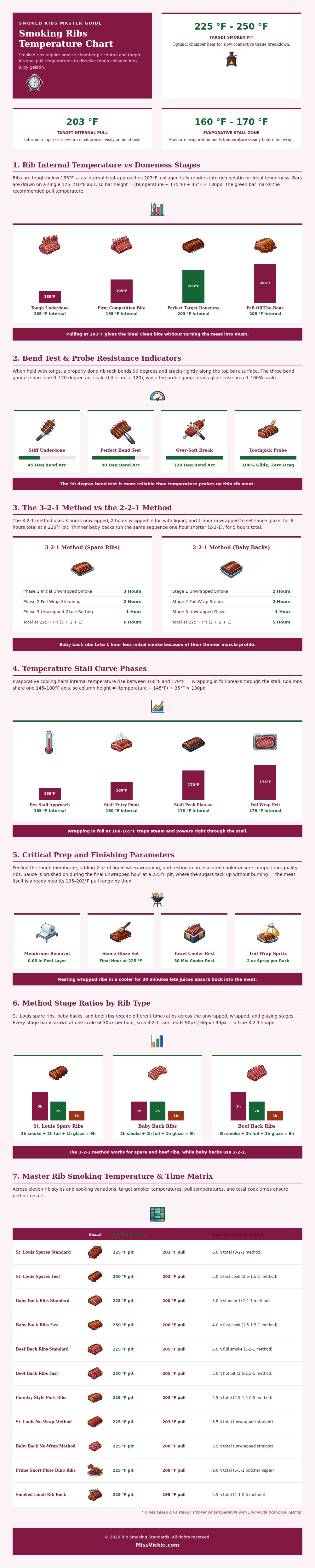
The key here is pit control. Maintain about two hundred and fifty degrees in your smoker. That low-and-slow temperature break down connective tissues gradually. Hurry it, and the outside will burn while inside remains unrendered.
As you can see in the chart, the desired internal temp is above what most assume. People take their ribs off the heat at one hundred forty-five or one hundred fifty degrees when they get hot to the touch. Wrong. Your collagen hasn’t even softened up yet. You’re looking to press beyond that mark until the interior reach an approximate two hundred three-degree temp. That’s the magic number. It’s firm enough to adhere to the bone, but tender enough so that it cleanly separates from it when bitten into.
Getting there won’t always be a direct path. There’s a good chance you’ll encounter the stall. What’s that? It’s when your internal temperature flatlines for an hour or two. Why does that happen? This happens because moisture evaporates off of your meat, cooling it down. According to the graphic, you can overcome this by wrapping the ribs in foil during this stage. This traps steam and overcomes the plateau.
That’s why it’s usually part of the three-two-one method: so you don’t spend the entire day waiting for the temperature to creep up. Wrap the meat, steam the meat, get the heat working for you. Cheating? Nah, just physics.
And don’t forget texture. According to the pictorial walkthrough, one last test is the bend test. Grabbing them by their tongs, pull up on the rack of ribs. They will flex roughly at right angles (or around 90) and top layer of crust may crack a little. Underdone ribs will simply pop back into shape. Too long, and they’ll flop like a soggy towel. For softer pieces such as baby backs, this touch test can be more accurate than the poke alone. With the poke, there shouldn’t be any pressure when you push in. The bend can show how well the meat stick to the bark.
The timing depends on the type of rib. Some aren’t equal: St. Louis spares (above) take longer. They are tougher and have more meat than the leaner baby backs. Adjust accordingly, here’s a chart that details what to do by cut. Six hours for spares? Five for the babies.
Same principle applies, though. Smoke ’em unwrapped to add flavor. Wrap to tenderize. Unwrap to set the sauce. Brush on your glaze during the last hour. The sugars don’t burn and the residual heat sets it.
As important as who cooks the food is how they prepare it. No exception here: You have to remove the membrane from the rack’s underside. This thing is a beast. It acts as a barrier that keeps your seasonings and smoke from reaching the meat, but it only takes about half a minute to peel off. This has a huge impact on the finished product.
Also, don’t forget resting. After your ribs are done cooking, let ‘em rest for a half hour covered in a cooler or towel. This lets the juices spread out. Cut into it right away and you’ll be left with something dry. You should of rested them more.
Ribs aren’t smoked quickly; they’re smoked patiently. They’re smoked precisely. Respect the stall. Control the heat. Trust the science of how collagen breaks down.
When you pull that rack from the smoker, it needs to be perfectly springy. It needs to have a deep mahogany bark. That’s what happens when you treat the smoking of ribs with the respect it demands.
Next time you fire up that smoker, throw away the guesswork. Go with the data. Trust your senses. And savor the reward of really juicy, tender ribs.