🔥 Smoker Build Calculator
Calculate firebox size, cooking chamber volume, vent areas, and steel weight for your custom BBQ smoker
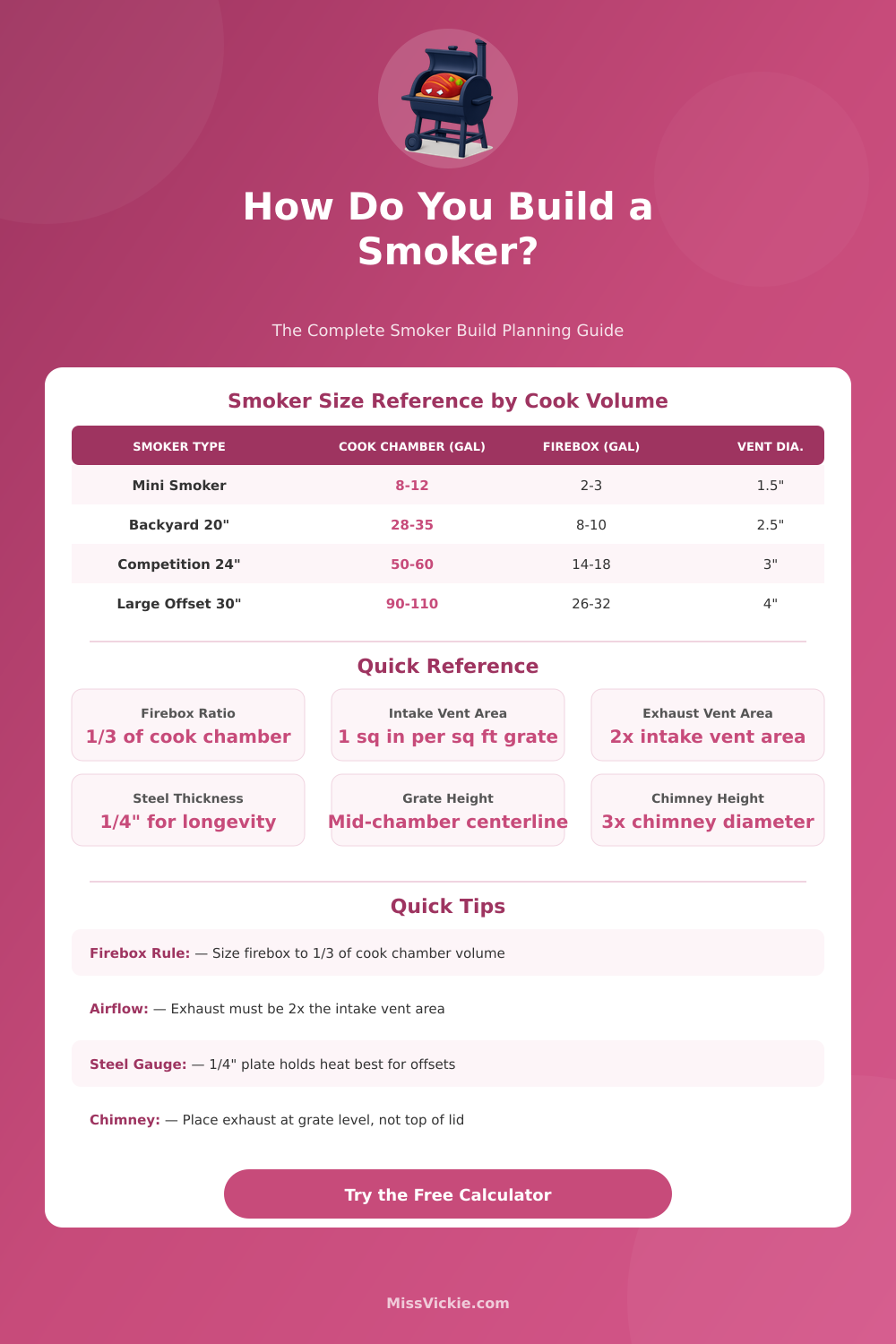
| Pipe Diameter | CC Length | CC Volume | Firebox Size | Intake Vent |
|---|---|---|---|---|
| 16" pipe | 20" | ~2,413 cu in | ~804 cu in | ~1.5 sq in |
| 20" pipe | 24" | ~3,770 cu in | ~1,257 cu in | ~2.4 sq in |
| 24" pipe | 36" | ~8,143 cu in | ~2,714 cu in | ~5.1 sq in |
| 30" pipe | 48" | ~16,965 cu in | ~5,655 cu in | ~10.6 sq in |
| Thickness | Gauge | Weight (lbs/sq ft) | Best For |
|---|---|---|---|
| 1/8" (0.125") | 11 gauge | 5.1 | Budget / lighter builds |
| 3/16" (0.188") | ~7 gauge | 7.65 | Backyard, moderate use |
| 1/4" (0.250") | Plate | 10.2 | Competition / long life |
| 5/16" (0.3125") | Plate | 12.75 | Heavy-duty commercial |
| 3/8" (0.375") | Plate | 15.3 | Extreme / large builds |
| Type | Airflow | Heat Even? | Skill Level | Notes |
|---|---|---|---|---|
| Offset Smoker | Side firebox | Moderate | Intermediate | Classic style, most common |
| Reverse Flow | Baffle plate | Excellent | Intermediate | More even cooking temp |
| UDS (Drum) | Bottom intake | Good | Beginner | Simple, efficient, cheap |
| Cabinet / Vault | Top & bottom | Very Good | Advanced | Versatile, large capacity |
| Grate Area (sq in) | Intake Vent Area | Exhaust Vent Area | Chimney Dia (approx) |
|---|---|---|---|
| 150 sq in | 1.5 sq in | 3.0 sq in | 2" |
| 240 sq in | 2.4 sq in | 4.8 sq in | 2.5" |
| 510 sq in | 5.1 sq in | 10.2 sq in | 3.5" |
| 1,060 sq in | 10.6 sq in | 21.2 sq in | 5" |
Smoker is a special cricket, designed for cooking meat at low temperature and slowly during several hours. Whether dealing about big brisket, thick pork shoulder or good ribs, those devices handle them perfectly. Not only for one use they are, many smokers it is possible to use for direct grilling also so small bits as chicken chests or vegetables do not form problem.
On the market there are various options: models with wooden pellets, units on charcoal powder, rigs with propane and electrical versions. Each of them adds its unique set to the art of outdoor cooking.
How to Choose and Use a Smoker
Pellet smokers stand out by means of their easy usage. One fills the reservoir, switch the button and simply go. You can sleep the whole night, during the machine outside prepare well smoked meat until the morning.
If standing around burning fire whole day sounds like misfortune, then pellet smokers are your solution.
Here the Kamado-type… Another favorite between fans of smoking. It gives wonderful smoky taste, while it spares fuel.
Excellent part is, that one can also grill and bake in very high heats, what pushes them surprisingly versatile. Start with basic model cost around three hundred dollars, what is not too much expense.
The Oklahoma Bronco Joe Drum smoker and Cricket has simple form, that escapes too much trouble. It comes with grate rack and hooks for meat, what is standard gear. One can grill quickly in high heat or lower for slow smoking, the fuel last until fourteen hours without stopping.
Such all-use tools, like the Bronco, the Weber Smokey Mountain or ceramics as Kamado Joe and Big Green Egg, tend to handle almost everything, what you lay on them.
Pitts and Spitts smokers are built too become home treasures. They combine Texas tradition with modern technique, and one does them directly in United States.
When one smokes hamburgers, fatter meat helps to escape drying. For brisket, the amount depends on your purse, of two units for cheap case, if you count every coin, until four until eight units, if you intend to share. One pound of regular brisket is enough for one person as main dish or extend to two, if portions are humble.
The biggest bags of brisket weigh between twelve and fifteen pounds. According to my experience at real dinners, one must plan one and half for one person, because folks commonly ask for seconds.
Time well when you smoke. Sixteen until eighteen pounds of regular brisket require around eighteen hours for good result. Boston butt in the twelve until fifteen pound range?
Plan twelve hours. Do not cut too early, or you will end with poorly cooked meat. For ribs, I found success in around two hundred thirty-five degrees, start with four units of wood.
Normally one uses hickory with ribs, although cherry wood gives more sweet flavor.
Good airflow in the smoker must be watched, so that the flame no flare sharply outside control. Build it well, and it will burn steadily without trouble. Cut the meat to sizes, that matchto your smoker, also do big difference in the final result.