Slow Cooker Liquid Ratio Converter
Convert oven, stovetop, and original recipe liquid amounts into slow cooker targets using food type, weight, cook time, lid loss, sauce thickness, and pot fill level.
Load a common slow cooker meal, then adjust the source method, ingredient weight, sauce thickness, cook time, lid openings, fill level, and pot size.
Liquid Conversion Breakdown
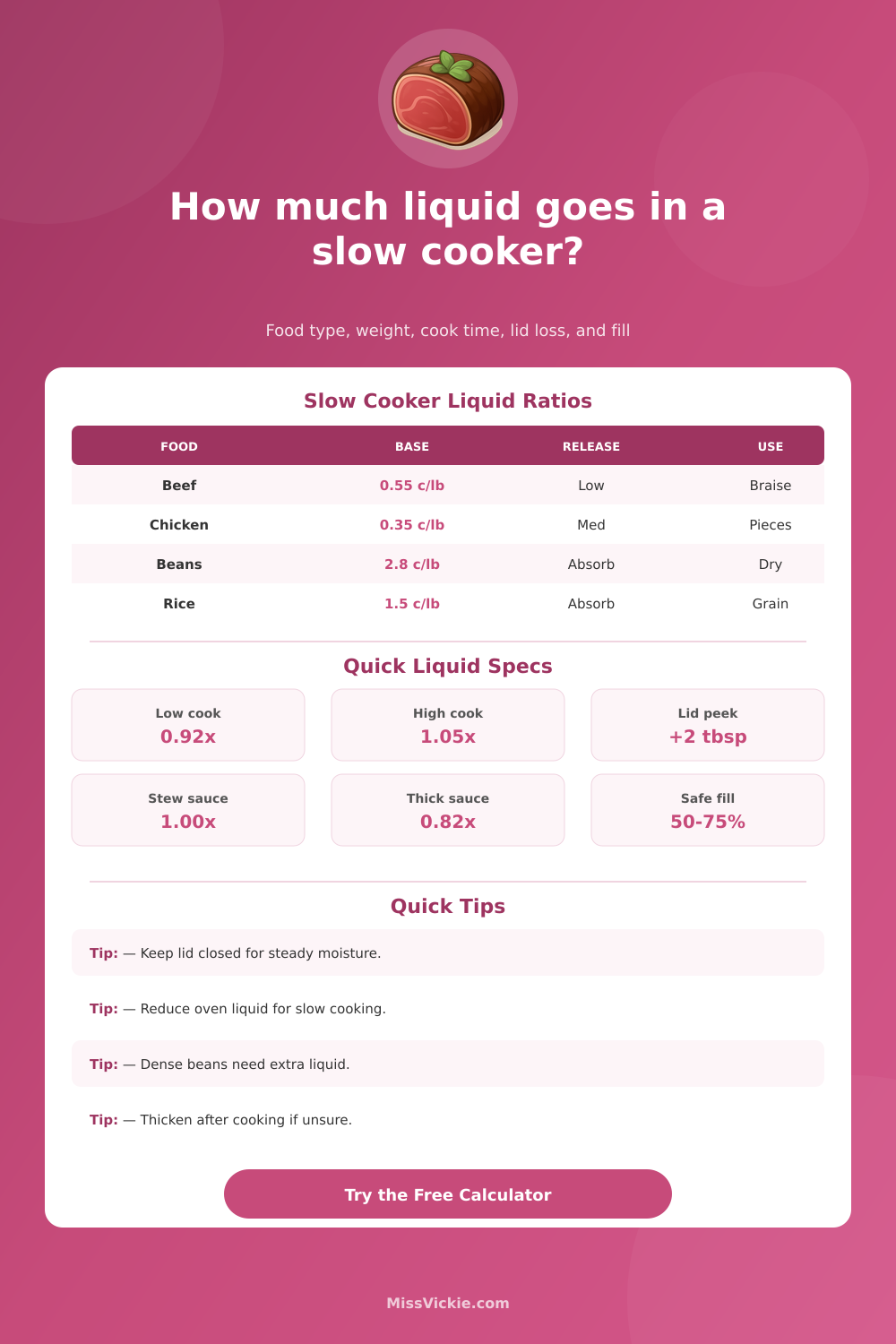
The tables show practical starting points. The calculator then adjusts for your actual weight, source recipe, sauce goal, cook time, lid openings, produce release, and fill level.
| Food Type | Base Liquid | Moisture Behavior | Best Starting Texture |
|---|---|---|---|
| Beef stew meat | 0.55 cup per lb | low release, collagen needs braise | stew sauce or gravy base |
| Pork shoulder | 0.30 cup per lb | fat and juices release slowly | barely sauced, finish with pan juices |
| Chicken pieces | 0.35 cup per lb | moderate release from skin and bones | light sauce or cooking broth |
| Dry beans | 2.80 cups per lb | absorbs heavily before tender | brothy, with room to soften |
| Lentils | 2.20 cups per lb | absorbs but cooks faster than beans | soup or soft stew |
| Rice or grains | 1.50 cups per lb | absorbs liquid into starch | casserole or porridge base |
| Original Method | Slow Cooker Starting Point | Why | Use When |
|---|---|---|---|
| Oven braise | use about 70% of recipe liquid | covered slow cookers lose less steam | pot roast, stew, braised chicken |
| Covered stovetop | use about 75% of recipe liquid | similar moisture, but less active bubbling | soups, beans, saucy meats |
| Open stovetop | use about 55% of recipe liquid | open simmer recipes expect evaporation | tomato sauce, chili, reductions |
| Pressure cooker | use about 110% of recipe liquid | pressure recipes often run very tight | beans, grains, dense roasts |
| Already slow cooker | use recipe liquid as written | method already matches appliance | published slow cooker formulas |
| Adjustment | Liquid Effect | Reason | Practical Cue |
|---|---|---|---|
| Low setting | slightly less loss | gentler simmer and steadier lid seal | good for roasts and beans |
| High setting | small extra buffer | more vigorous bubbling near the edges | use for shorter weeknight cooks |
| Each lid opening | about 2 tablespoons extra | steam escapes and condensation resets | add only if you expect peeking |
| Fill below 50% | add 5% to 12% | more exposed surface relative to food | small batch in a large crock |
| Fill above 80% | hold or reduce liquid | headroom becomes the main limit | avoid overflow and foamy beans |
| Batch Example | Food Weight | Target Liquid | Slow Cooker Note |
|---|---|---|---|
| Pulled pork | 4 lb | 1.0 to 1.5 cups | meat releases plenty of juice |
| Beef stew | 3 lb | 2.0 to 3.0 cups | vegetables and thickener finish the sauce |
| Dry beans | 1 lb | 6.0 to 7.0 cups | keep submerged until tender |
| Chicken thighs | 3 lb | 1.0 to 2.0 cups | bone-in pieces release more liquid |
| Tomato ragu | 4 lb | 2.5 to 3.5 cups | start tighter, thicken uncovered later |
Builds liquid from the main ingredient weight, then adjusts for absorption, release, cook time, and texture goal.
Good for covered braises because the slow cooker traps condensation better than an oven pot.
Works for soups and sauces, but open-simmer recipes need the biggest liquid cut.
Use less liquid for pulled meats and ragu, then thicken or reduce after the food is tender.
Slow cookers work diffrently from oven braises and stovetop pots because slow cookers is designed to trap the steam that cooks the food and return it to the food being cooked. In oven braises or stovetop pots, the steam escape into the air. Because the steam remains in the slow cooker, the amount of liquid that is require in the recipe changes.
The difference in the amount of liquid in slow cookers as compared with stovetop and oven braises can result in the slow cooker recipe having too much liquid or too little liquid in the food. This difference in liquids is most noticeable when translating recipes from different cooking methods. For instance, the amount of broth required in a recipe for a slow cooker pot roast is four cups for an oven braise recipe.
How Much Liquid to Use in a Slow Cooker
Because slow cookers do not allow the liquid to evaporate as does an oven environment, the amount of liquid in the slow cooker will result in too much liquid. On the other hand, a stovetop chili will become watery if cooked in a slow cooker because evaporation is essential in cooking the chili on the stovetop, but is prevented in a slow cooker. In these instances, the cook must adjust the amount of liquid based off the type of food being cooked, the cook time, the amount of moisture that the food will release, and whether the slow cooker lid is opened.
The type of food that is cooked in the slow cooker can have an impact on the amount of liquid in the slow cooker. Foods like beef stew meat will release the juices from the meat as it cooks, but it also needs to be soaked in liquid. Chicken pieces will release some of the liquid from the skin and bones of the chicken.
Pork shoulder will release both fat and moisture slow during the cooking process, so there is no need for much liquid to be added to the slow cooker. Dry beans and rice tend to absorb much of the liquid. In these cases, enough liquid must be added to the slow cooker to soak the dry beans and rice in enough liquid to account for both the amount of liquid they absorb and the amount that will evaporate during the cooking process.
The cook time for slow cookers can impact the amount of liquid in the slow cooker. The longer that the food simmers in the slow cooker, the more time the moisture from the food will be lost to the slow cooker. For instance, cooking chicken thighs for four hours will result in a different amount of liquid than when cooking the thighs for nine hours.
Each time that the lid of the slow cooker is opened, steam leaves the slow cooker. The amount of food that is placed into the slow cooker will affect the amount of liquid in the slow cooker. If a large amount of food is placed into a large slow cooker, the food will lose moisture to the slow cooker.
Furthermore, if the food pushes against the lid of the slow cooker, the expanding food may force some of the cooking liquid out of the slow cooker. Recipes require that the slow cooker be filled between half full and three-quarters full. The cook should consider the thickness of the sauce prior to placing the food into the slow cooker.
For instance, if the desired recipe is a stew that will be eaten with a spoon, the amount of liquid can be balanced to the food. However, if the food is pulled meat, there is no need for much liquid. For beans or oats that must remain under liquid, there will need to be a much more larger amount of liquid added to the slow cooker from the beginning.
Adding extra broth to the slow cooker is a common strategy to deal with insufficient liquid in the slow cooker. However, adding extra broth to the slow cooker is a mistake because it will dilute the flavor of the food. If the liquid from the broth is diluted, thickener agents must be added to balance the flavor of the food.
Adding the correct amount of liquid to the slow cooker from the beginning will eliminate the need to use a thickener agent to adjust the thickness of the liquid in the slow cooker. These rules should be applied when converting a recipe from an oven braise to a slow cooker recipe. Slow cooker recipes will have less liquid than braises because the slow cooker retains the steam and does not allow the liquid to evaporate like an oven does.
A recipe that cooks in a pressure cooker may contain more liquid because the pressure cooker recipe concentrates the flavor of the food. The online calculator automaticly adjust the amount of liquid for these various cooking methods. Even if the measurements for slow cooker recipes are followed exactly as the recipe states, various factors will impact the outcome of the slow cooker recipe.
The moisture content of the vegetables, the freezing of the meat prior to cooking, and the way the lid of the slow cooker seals will impact the amount of liquid in the slow cooker. These factors is some of the reasons that the outcome of the recipe may vary between two individuals who follows the same recipe. The first time that a recipe is cooked, the measurements will serve as a point of departure; however, any adjustment of the amount of liquid will be based upon understanding how each of these factors interact to create the food that is cooked in the slow cooker.
You’ll find that the first time you try it, you should of checked the liquid levels.