Shrimp Marinating Time Calculator
Estimate shrimp marinating time from count size, peeled or shell-on prep, acid strength, salt level, oil ratio, marinade style, refrigerator temperature, cooking deadline, and the maximum texture window.
🍲 Shrimp Marinade Presets
Pick a real shrimp plan, then adjust the acid, salt, oil, shell, fridge temperature, and texture limit before cooking.
⚖ Size, Shell, Marinade, and Fridge Inputs
Shrimp marinade plan
Choose your shrimp and marinade details to calculate timing.
Shrimp and Contact
Marinade and Safety
Timing Notes
📌 Shrimp Timing Quick Grid
Peeled shrimp in lime or lemon-heavy marinade.
Large peeled shrimp with oil, garlic, herbs, and light acid.
Shell slows flavor contact and protects texture.
Keep raw shrimp cold during the full marinade window.
📊 Shrimp Marinade Reference Tables
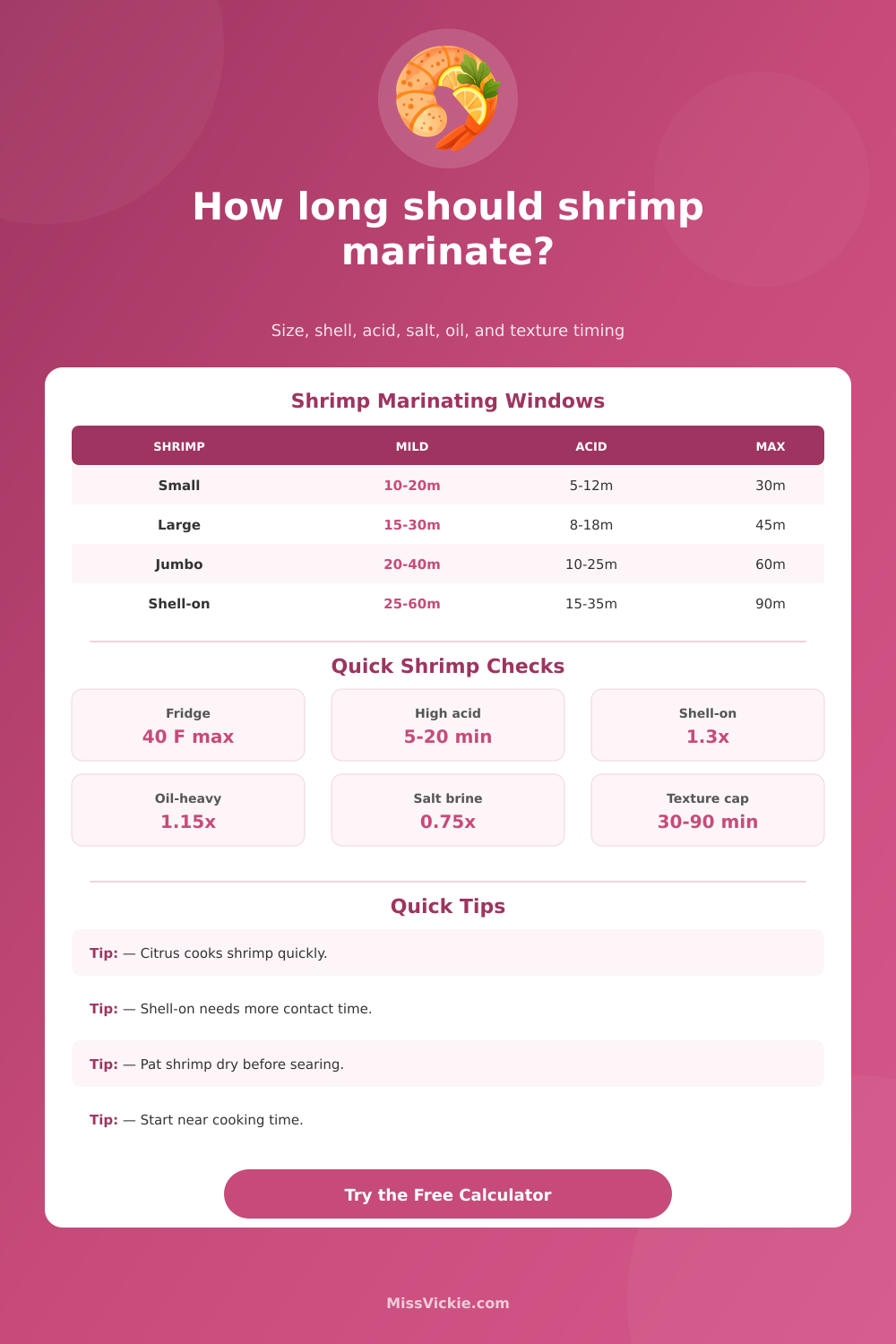
| Shrimp size | Peeled mild marinade | Acid-forward marinade | Shell-on or split shell | Texture warning |
|---|---|---|---|---|
| Salad shrimp 90+ count | 8 to 15 minutes | 3 to 8 minutes | Not common | Turns soft very quickly |
| Small 61-90 count | 10 to 20 minutes | 5 to 12 minutes | 15 to 30 minutes | Watch salt and citrus |
| Medium 41-60 count | 12 to 25 minutes | 6 to 15 minutes | 20 to 40 minutes | Good for tacos and bowls |
| Large 31-40 count | 15 to 30 minutes | 8 to 18 minutes | 25 to 50 minutes | Best all-purpose window |
| Extra large 26-30 count | 18 to 35 minutes | 10 to 22 minutes | 30 to 60 minutes | Good for skewers |
| Jumbo 16-20 count | 20 to 40 minutes | 10 to 25 minutes | 35 to 75 minutes | Handles bolder oil marinades |
| Colossal U-12 count | 25 to 45 minutes | 12 to 28 minutes | 45 to 90 minutes | Turn once for even flavor |
| Marinade style | Typical acid | Salt behavior | Oil effect | Best use |
|---|---|---|---|---|
| Garlic herb oil | Low or none | Gentle seasoning | Protects texture | Skillet, grill, pasta |
| Citrus taco marinade | Medium to high | Fast surface seasoning | Balances lime bite | Tacos and bowls |
| Soy ginger glaze | Low to medium | Salty and quick | Helps browning | Skewers or stir fry |
| Cajun paste | Low | Can be salty | Carries spices | Grill, broil, air fryer |
| Ceviche-style citrus | Very high | Salt firms fast | Usually low oil | Short cure only |
| Cooked shrimp dressing | Low to medium | Seasoned after cooking | Coats chilled shrimp | Cocktail or salad |
| Input factor | Shortens time | Lengthens time | Calculator effect | Kitchen cue |
|---|---|---|---|---|
| Acid | Lime, lemon, strong vinegar | No acid or splash only | Caps upper texture window | Opaque edges mean move fast |
| Salt | Soy, fish sauce, treated shrimp | Light salt added later | Reduces max time | Taste the marinade first |
| Oil | No oil with citrus | Oil-heavy herb paste | Buffers acid contact | Drain excess before searing |
| Shell | Peeled and deveined | Shell-on or split shell | Changes contact factor | Turn shell-on shrimp once |
| Fridge | Above 40°F | 34 to 38°F | Warm fridge forces short cap | Move seafood colder first |
| Batch size | Light coating | Full marinade | Oil guide | Salt caution |
|---|---|---|---|---|
| 8 oz / 225 g | 2 to 3 tbsp | 1/4 cup | 1 to 2 tbsp oil | Use a pinch to 1/4 tsp |
| 1 lb / 450 g | 1/4 cup | 1/3 to 1/2 cup | 2 to 3 tbsp oil | About 1/2 tsp kosher salt |
| 2 lb / 900 g | 1/2 cup | 3/4 cup | 1/4 cup oil | Reduce if using soy sauce |
| 3 lb / 1.4 kg | 3/4 cup | 1 to 1 1/4 cups | 1/3 cup oil | Season in layers |
| 5 lb / 2.3 kg | 1 1/4 cups | 1 3/4 to 2 cups | 1/2 cup oil | Stir halfway for even salt |
🧪 Marinade Style Comparison
Lowest texture risk. Best for garlic, parsley, chili flakes, and quick sauteed shrimp.
Lime and lemon brighten shrimp quickly but can make peeled shrimp rubbery or soft.
Big flavor in a short window. Reduce extra salt and watch sugar near high heat.
Shells slow seasoning and guard texture, making this better for grilling and broiling.
💡 Shrimp Marinating Tips
Timing is an estimate for refrigerated shrimp. If shrimp smells off, feels unusually slimy, or was held warm, discard it rather than extending the marinade.
Because shrimp cooks fast, it’s a different animal from steak: You cannot use beef marinade rules and expect it to work on seafood. Flank steak can soak overnight in sauce with no problem; peeled shrimp would of become mush. Why? Because the delicate proteins breaks down faster when exposed to acid. Use a calculator to figure out proper amount of time so you don’t have to guess how quickly the acid will affect your meat. But first: “You have to know something about the chemistry of marinades.”
Instead of intuition, here’s what matters: Acid is a tenderizer. It breaks down protein (the so-called denaturation) and begins cooking shrimp even before heat is involved. Add some lemon zest or lime juice to your raw shrimp, and that action begin right away. Peeled small shrimp might only tolerate five to twelve minutes in high-acid environment, since the lack of shell means the acid hits muscle directly. Any longer, and they becomes soft, their protein structure dissolve. With shells on, shrimp has more time for marinating because the shell acts as a buffer that slows down acid. Depending on size, shrimp can be marinated for an hour or longer, but the citric acid and salt penetrate more slow because of the shell.
Why Shrimp Cooks Fast
Salt acts like an acid and is aggressive. Sodium is already present in natural sources (think of all those shrimp with added salt) and manufacturers typically adds more to maintain weight and color. Using a salty base (e.g., soy sauce) will decrease your safe zone even further if you don’t compensate by reducing cooking time. That little tweak at the input end keep the outcome from going south.
Fat. Because fat has an insulating effect, it coats the surface of shrimp and delays uptake. Marinating in a rich herb oil is forgiving because lipid barrier protects the flesh from over-seasoning. As long as your refrigerator is nice and cold, you can marinate shrimp for hours in some garlicky butter without any damage.
It’s all about the temperature, as I’ve come to learn. Enzyme activity accelerate (and bacteria multiplies faster) when kept warm, such as on your kitchen counter. To be safe, maintain shrimp below forty degrees Fahrenheit. This also slows down reaction rate of the marinade. Because chemical reactions are accelerated by mild warmth, a refrigerator that runs hotter require shorter soaking time. The calculator accounts for this variability, so you don’t have to guess whether or not your appliance can be trusted for a long soak.
It’s all about balance: maintaining both taste AND texture. How does it taste? But what about the structure? Let’s back up a second: Test acid content of whatever you’re marinating your shrimp in. Is there a lot? Shorten the time and brush the liquid on at the end (a la glazing) instead of soaking. Is it an oil-based or otherwise low-acid mixture? Good news (you’ve got some wiggle room here).
Before you toss them onto pan, dry the shrimps off well, otherwise they’ll steam, not brown. Be patient, but not so much so that you’re waiting hours! Set a timer and follow the limit. Get them in the pan ASAP so they still taste great even if they go slightly over their time limit.
Marinating shrimp isn’t as much about throwing together some ingredients as it is about when to pay attention. With the right tools and tables is used, you’ll learn the perfect window for going from blah to ick. And you’ll discover that learning how shell, salt, and acid work together means less fretting with the timer and more confidence in the process, which yields a better bite and cleaner flavor each and every time.