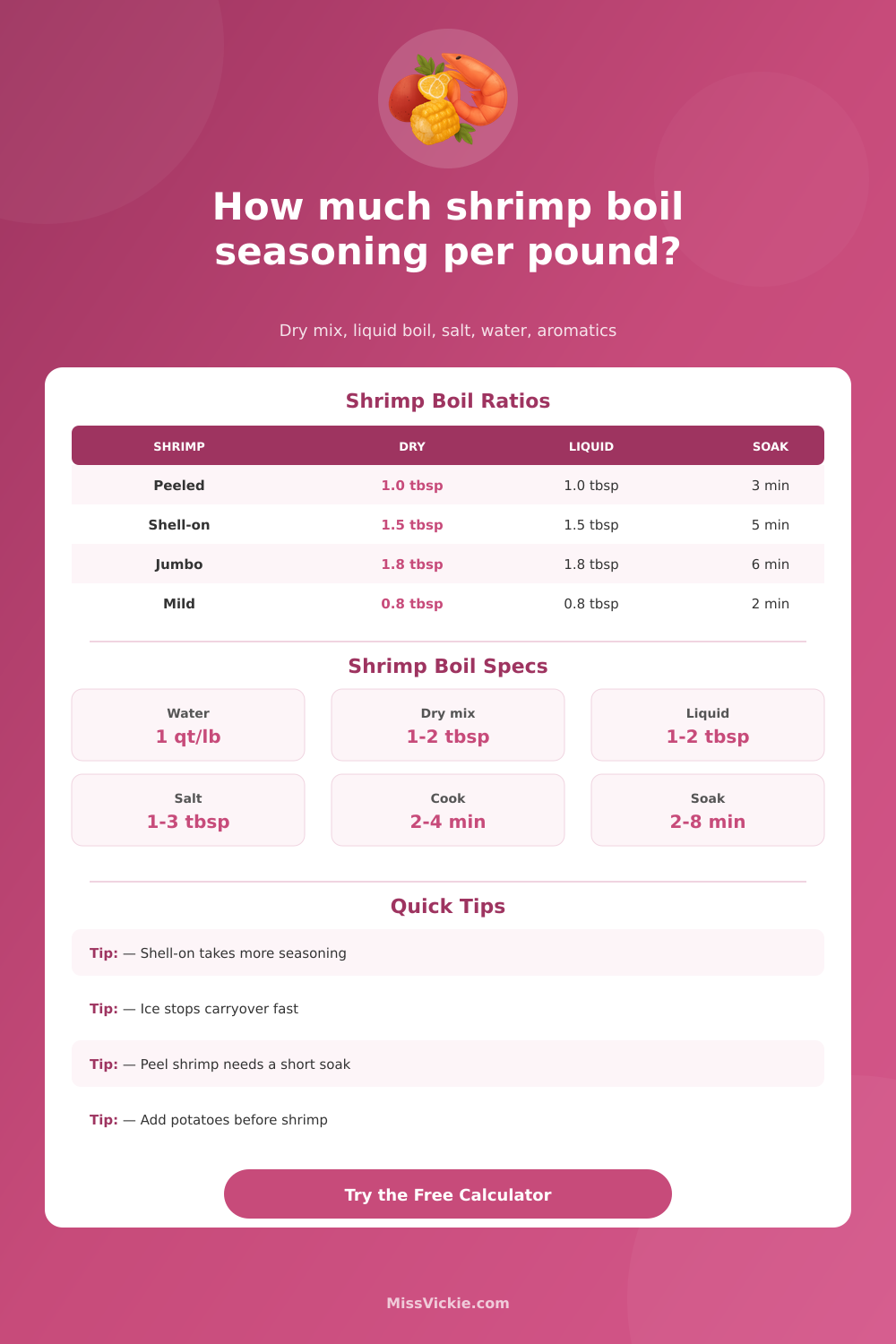
Shrimp boil ratios, salt, aromatics, and chill stop
Shrimp Boil Seasoning Per Pound Calculator
Calculate shrimp boil seasoning by shrimp pounds, shell status, water gallons, dry and liquid boil strength, salt level, aromatics, soak time, shrimp size, add-ins, and ice-stop carryover.
Pick a shrimp-focused boil scenario, then fine-tune shell-on versus peeled shrimp, water, seasoning, salt, aromatics, add-ins, and carryover control.
Your Shrimp Boil Seasoning Plan
Seasoning, salt, water, aromatics, soak, and carryover are calculated from your inputs.
Full Shrimp Boil Breakdown
Use a short soak and less liquid boil because peeled shrimp absorb brine fast.
Shells protect the meat, so seasoning can be stronger without harsh salting.
Large shrimp need a little more spice and a firm ice stop for carryover.
Crawfish soaks longer and uses heavier seasoning; shrimp should stay quick.
| Shrimp prep | Dry seasoning per lb | Liquid boil per lb | Best soak range |
|---|---|---|---|
| Peeled and deveined | 0.75 to 1.1 tbsp | 0.5 to 1 tbsp | 1 to 3 minutes |
| Peeled, tail-on | 0.9 to 1.25 tbsp | 0.75 to 1.25 tbsp | 2 to 4 minutes |
| Shell-on | 1.25 to 1.75 tbsp | 1 to 1.75 tbsp | 4 to 7 minutes |
| Head-on shell-on | 1.5 to 2 tbsp | 1.25 to 2 tbsp | 5 to 8 minutes |
| Shrimp size | Pieces per lb | Cook cue | Carryover risk |
|---|---|---|---|
| 51/60 small | 51 to 60 | 1.5 to 2 min | High if soaked hot |
| 41/50 medium | 41 to 50 | 2 to 2.5 min | Medium high |
| 31/40 large | 31 to 40 | 2.5 to 3 min | Medium |
| 26/30 extra large | 26 to 30 | 3 to 3.5 min | Medium |
| 16/20 jumbo | 16 to 20 | 3.5 to 4 min | Higher |
| U/15 colossal | Under 15 | 4 to 5 min | High |
| Add-ins | Seasoning bump | Timing before shrimp | Why it matters |
|---|---|---|---|
| Shrimp only | No bump | Add shrimp last | Cleanest seasoning target |
| Corn and lemons | 10 percent | 8 to 10 minutes | Corn absorbs salt and spice |
| Potatoes and corn | 18 percent | 15 to 20 minutes | Potatoes dilute the pot |
| Sausage, corn, potatoes | 25 percent | 15 to 25 minutes | Sausage adds salt but bulk absorbs spice |
| Mushrooms, onion, celery | 15 percent | 5 to 8 minutes | Vegetables soak up liquid boil |
| Water ratio | Effect on flavor | When to use | Adjustment |
|---|---|---|---|
| 0.75 qt per lb | Concentrated | Small pot, shrimp only | Reduce salt slightly |
| 1 qt per lb | Balanced | Most shrimp boils | Use calculator base |
| 1.5 qt per lb | Milder | Lots of add-ins | Add 10 percent spice |
| 2 qt per lb | Diluted | Wide stockpot | Add 20 percent spice |
Here’s how it works: It’s a backyard boil. You purchase the shrimp, pick up the lemons and spice the mix. But what if you don’t have enough seasoning? Or what if your seafood ends up tasting boring? In theory, it’s as simple as some math; but in practice, it can be all too easy to screw it up.
Because shrimp only take a few minutes to cook, there’s not much time to add salt once they’re in the water. Unlike crab legs or crawfish, shrimp won’t sit around soaking for several hours. It is all-or-nothing if you guess the wrong amount of seasoning-to-water mixture. Pull the food out fast; before it gets tough. And serve immediately.
How to Make Good Shrimp Boil Food
After plugging in your weight and shell status, the calculator takes care of the rest. You won’t have to guess at any conversions. This is where most folks fall down; they think a shrimp boil is just like a crawfish boil. Crawfish have thick shells to insulate their meat, making it possible to soak them a long time. That also gives seasonings plenty of time to get deep inside the meat over twenty minutes or longer.
Shrimp are delicate creatures. If you purchased peeled and deveined shrimps, their flesh is exposed to salt and spices quickly. What might be a good ratio for a pound of crawfish will create a salty mess with a pound of shrimp in half the time. That’s why shell status input is important.
On the one hand, shells create a barrier between the brine and the meat. Because the hard outer shell prevents so much salt and heat from penetrating the flesh, shell-on shrimp can tolerate a stronger combination of dry seasonings and liquid boil different than shrimp without shells. On the other hand, peel shrimp require a gentler approach. To account for that difference, the tool scales down amount of dry mix to use and cuts back on suggested soak time if you choose a peeled version.
A little change makes all the difference: The resulting texture is completely different. Without considering the shell factor, you’re putting your meal in danger. Other variables trip people up, such as water volume. If there’s not enough water, the shrimp will cook unevenly; only the ones on the bottom will be cooked, while those floating above gets an under-seasoned bath of just steaming water.
Too much water, however, dilutes the seasoning, resulting in a bland broth with steamed vegetables. For most recipes, I’d suggest about a quart of flavorful water per pound of seafood. That allows for a nice concentration of brine to season the meat but still leaves room for it to swim around without being drowned. The calculator takes into account the weight of other add-ins as well as size of your cooking vessel, helping you arrive at that just-right spot.
The other thing about the ingredients: Certain things suck up seasoning more than others. Potatoes and corn are very thirsty ingredients. Before we get the shrimp in the pot, they’ve soaked up a lot of that liquid seasoning. Unless you think about it, all that seasoning would of gone to waste on the vegetables instead of getting to your shrimp.
Dump those tough veggies in first and let ’em cook till they’re tender. This pulls some of the seasoning from the water and moves it into the corn and potatoes. Then toss in the shrimp. It’s a seasoning AND a timing thing. The tool accounts for that when you choose bags with lots of sausage or starches.
Don’t bypass the ice stop. That’s right: Once off the heat, the shrimp is still cooking inside thanks to residual heat. Letting them sit in the warm colander (or worse, back into the still-warm pot) will allow them to continue cooking and get tighter and tougher. An ice bath brings that process to an immediate halt. Your shrimp remain perfectly cooked and their meat stays sweet and snappy instead of dry and chewy, particularly with jumbos, whose mass retains heat longer.
Depending off batch size, the calculator calculates the minimum amount of ice you’ll need. Keep your dinner edible and your prep sane. Perfect texture, bright flavor… never a salty mistake.