Sheet Cake Calculator
Plan a sheet cake by pan dimensions, batter depth, guest count, event slice size, and frosting coverage so the cake fits the pan and the servings fit the crowd.
🍰Sheet Cake Presets
Choose a common home, party, or catering scenario, then fine-tune the pan depth, slice style, batter, and frosting.
📏Pan, Batter, Servings, and Frosting Inputs
Calculation breakdown
📊Planning Snapshot
📋Sheet Pan Serving Reference
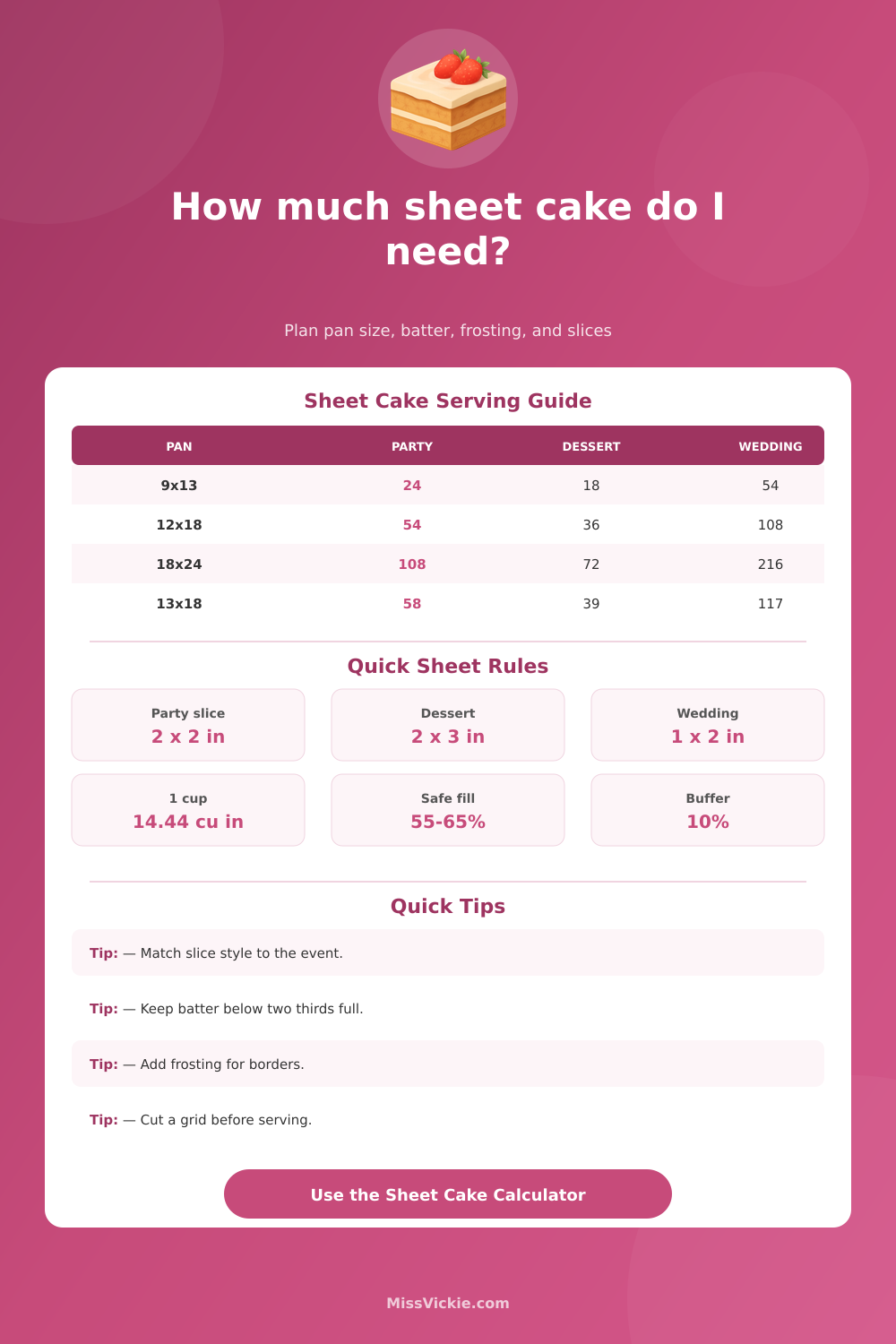
| Pan size | Area | Party 2 x 2 | Dessert 2 x 3 | Wedding 1 x 2 |
|---|---|---|---|---|
| 9 x 13 inch home pan | 117 sq in | 24 servings | 18 servings | 54 servings |
| Quarter sheet 9 x 13 inch | 117 sq in | 24 servings | 18 servings | 54 servings |
| Third sheet 13 x 18 inch | 234 sq in | 58 servings | 39 servings | 117 servings |
| Half sheet 12 x 18 inch | 216 sq in | 54 servings | 36 servings | 108 servings |
| Full sheet 18 x 24 inch | 432 sq in | 108 servings | 72 servings | 216 servings |
🥣Batter Volume and Depth Guide
| Batter type | Suggested fill | Expected rise | Best sheet depth | Watch point |
|---|---|---|---|---|
| Butter or vanilla cake | 58 to 65% | 30 to 40% | 1.2 to 1.6 in baked | Center springs back |
| Chocolate cake | 55 to 62% | 35 to 50% | 1.1 to 1.5 in baked | Moist crumbs on tester |
| Sponge or chiffon | 50 to 58% | 55 to 80% | 1.0 to 1.4 in baked | Extra headroom matters |
| Carrot or mix-in cake | 55 to 60% | 25 to 35% | 1.3 to 1.7 in baked | Heavy center sets late |
| Brownie-style sheet | 45 to 55% | 10 to 20% | 0.8 to 1.2 in baked | Edges firm first |
🧁Frosting Amount Guide
| Coverage style | What it covers | Base estimate | Add for piping | Best use |
|---|---|---|---|---|
| Top only | Single top surface | 1 cup per 50 sq in | Optional 10% | Casual sheet cakes |
| Top plus border | Top and simple edge | 1 cup per 45 sq in | Built in | Birthdays and potlucks |
| Top and sides | Top, sides, and corners | 1 cup per 38 sq in | Add 10 to 15% | Display cakes |
| Two-layer filled | Top, filling, and sides | 1 cup per 28 sq in | Add 15% | Stacked sheet cakes |
| Thin glaze | Light pour or dusting | 1 cup per 95 sq in | Usually none | Snack cakes |
🔍Event Slice Comparison Grid
Party squares
Two inch squares work well when the cake sits beside other food and guests may come back for seconds.
Dessert slices
Two by three inch pieces feel more generous after dinner, so the same pan serves fewer people.
Wedding slices
One by two inch catering pieces are small, tidy, and designed for plated service or a dessert table.
Coffee service
Small rectangular pieces suit morning meetings, school events, and tasting tables where cake is a snack.
Large slices
Three inch squares are better for casual family dessert than a crowded buffet or catered event.
Custom grid
Use custom slice dimensions when a bakery box, platter, or caterer cut guide sets the final shape.
💡Sheet Cake Tips
To plan a sheet cake, you must consider several variable, such as the type of batter for the cake, the size of the slice of cake, and the amount of frosting for the cake. You must determine the number of guests that will be attending the event because the number of guests will dictate the amount of cake that are needed to be baked. A sheet cake isnt the same than a round cake, and sheet cakes require a specific amount of depth for the pan and amount of batter to be pour into the pan.
Using the calculator tool provided in this article will allow you to enter the dimension of the cake pan and the number of guests that will be attending the event. The calculator will use that information to determine the amount of batter and frosting that will be needed to create a sheet cake that will provide each guest with a piece of cake. The type of batter that you will use for the sheet cake is one of the critical variable in baking the cake.
How to Plan a Sheet Cake
Butter cakes will rise at a steady rate, indicating that the cake will require a moderate amount of batter. Chocolate cakes may rise more higher than butter cakes, which means the cake will require a lower percentage of fill for the pan. Sponge cakes will rise quick when baked, so a lower percentage of fill is required for these cakes.
Carrot cakes contain ingredient such as shredded vegetables that add weight to the cake; therefore, the rise of the cake is modest. If there is too little of the batter for a carrot cake, the edge of the cake will dry out before the center is fully baked. If there is too much of the batter, the center of the cake will remain gummy and the edge will be over-browned.
The size of the piece of cake will dictate how many servings of cake may result from one sheet cake. A two-by-two inch square is the most common size for cake piece. A two-by-three inch slice is one of the most common larger size for cake pieces.
A wedding cake slice is smaller, usualy one by two inch, and allows more individual to share one sheet cake. The cake slice size will determine the number of row and the number of columns of cake pieces. The calculator will compare the grid to the number of guests who will attend the event.
A buffer will be created for the guest count to ensure there is enough cake should there be more guest than estimated. A ten percent cake buffer is common for most event but may need to be more pronounced for a wedding. The amount of frosting that you will use will determine how much icing is require for the cake.
If you are to apply the frosting to the sheet cake only, there will be less frosting than for sheet cakes with side. If the sheet cake is to be two layer, there will be more frosting for the middle layer of cake. You will select the frosting prior to adding baking ingredient to the cake batter.
The capacity of the pan limit the amount of cake batter that can be used. The theoretical maximum amount of volume can be calculated by multiplying the length of the pan by the width of the pan and the depth of the pan. That total volume can then be divided by the number of cubic centimeter in a cup of baking batter.
The calculator will use the maximum volume capacity of the pan and apply a percentage of fill to that number. The fill amount cannot be allowed to fill the pan to the rim as this will lead to cake overflow during the baking of the sheet cake. Some of the most common mistake when baking sheet cakes include treating the sheet cake as if it were a round cake, not including a buffer for the number of guests attending the event, and filling the pan to the rim.
Many people are used to filling a loaf pan to the rim of the pan with cake batter. Sheet cake pans will overflow if you pour the batter to the rim of the pan. Other mistake include providing cake slice that are too large in size for the number of guests at the event.
To avoid these mistake, use the calculator to determine the amount of batter and frosting that will be needed to create a sheet cake. You should of run the calculations one more time with a different size of cake slice to determine if the number of guests will require more than one sheet cake to be baked.