Sheet Cake Servings Calculator
Plan sheet cake servings from pan size, slice size, layer count, event type, appetite, border trim, cutting style, and guest count.
1.Pick a sheet cake scenario
Choose a preset, then adjust the pan, slice, and crowd details for your cake table.
2.Enter cake and guest details
Sheet cake plan ready
Adjust the fields to estimate servings and cake count.
Cake math
Serving adjustment
3.Fast serving cards
4.Sheet cake comparison grid
Good for small birthdays, family events, and office snacks.
A useful in-between size when a quarter sheet feels tight.
The common party workhorse for 40 to 70 dessert portions.
Best for large receptions, graduations, and catered events.
5.Reference tables
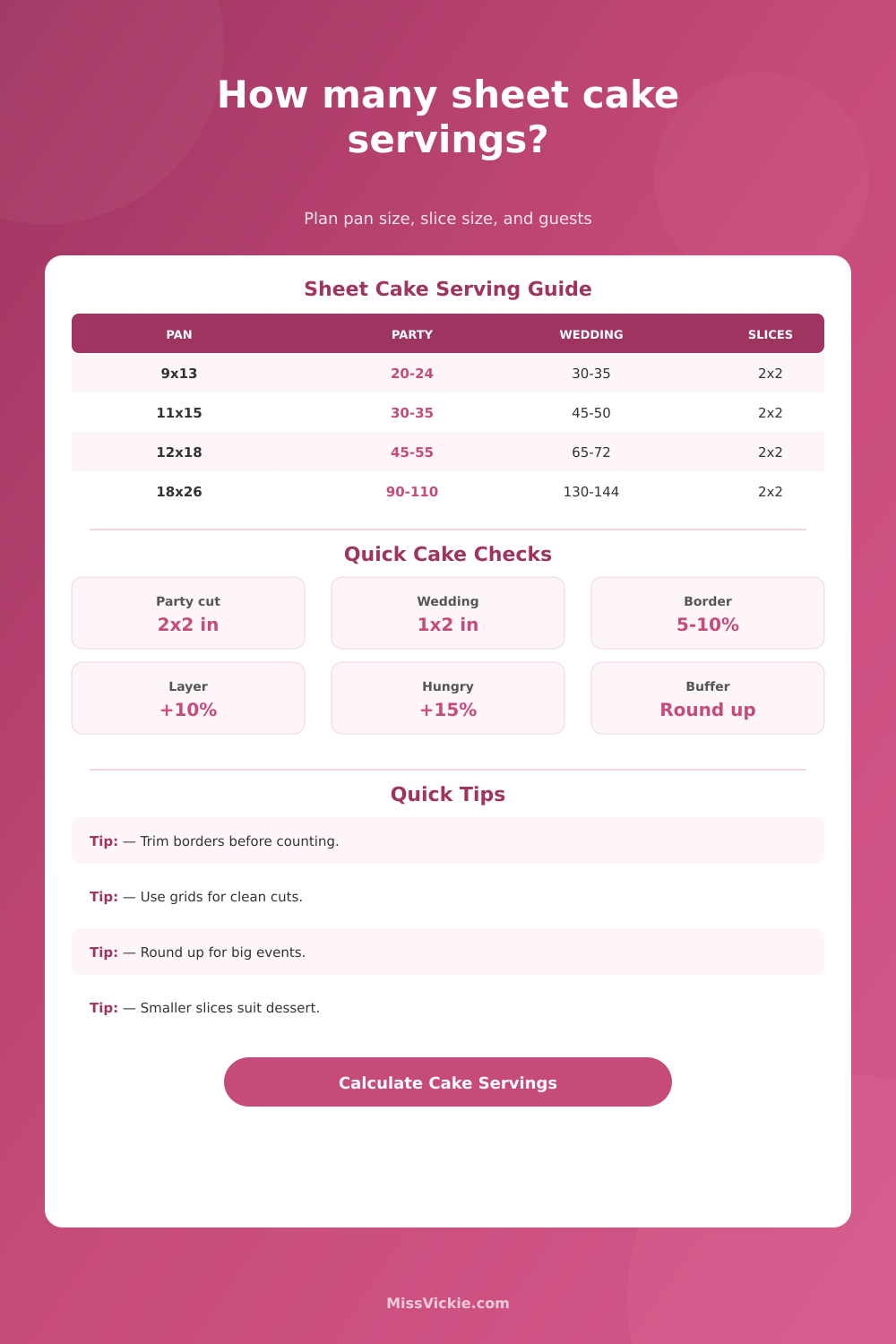
| Pan size | Dimensions | Area | Party 2×2 cuts | Wedding 1×2 cuts |
|---|---|---|---|---|
| Quarter sheet | 9×13 in | 117 sq in | 25 to 28 | 48 to 55 |
| Medium sheet | 11×15 in | 165 sq in | 36 to 39 | 70 to 78 |
| Half sheet | 12×18 in | 216 sq in | 48 to 54 | 92 to 102 |
| Large sheet | 14×20 in | 280 sq in | 62 to 70 | 118 to 132 |
| Full sheet | 18×26 in | 468 sq in | 105 to 117 | 198 to 220 |
| Slice style | Footprint | Best use | Serving feel |
|---|---|---|---|
| Wedding slice | 1×2 in | Plated dessert tables | Small and tidy |
| Dessert slice | 1.5×2 in | After dinner service | Moderate |
| Party slice | 2×2 in | Birthdays and casual events | Standard |
| Large slice | 2×3 in | Cake as main treat | Generous |
| Snack square | 1.5×1.5 in | Office or school trays | Small bite |
| Event type | Portion direction | Why it matters | Planning cue |
|---|---|---|---|
| Birthday party | Baseline | Cake is often a main dessert. | Use party slices. |
| Wedding table | More small cuts | Guests often take plated portions. | Use 1×2 or 1.5×2. |
| Office snack | Slightly smaller | People graze across a workday. | Use snack squares. |
| Buffet after meal | Smaller portions | Guests are already fed. | Use dessert cuts. |
| Open house | Add buffer | Guests arrive in waves. | Round up cakes. |
| Guest count | Quarter sheet | Half sheet | Full sheet | Common choice |
|---|---|---|---|---|
| 20 guests | 1 cake | 1 cake | Too large | Quarter sheet |
| 40 guests | 2 cakes | 1 cake | Too large | Half sheet |
| 75 guests | 3 cakes | 2 cakes | 1 cake | Full sheet |
| 100 guests | 4 cakes | 2 cakes | 1 cake | Full sheet |
| 150 guests | 6 cakes | 3 cakes | 2 cakes | Full sheets |
Bakery sheet dimensions can vary. For catered service, confirm the bakery's finished cake size and whether decorations reduce cut area.
6.Sheet cake planning tips
Then comes the realization: There’s a sheet cake on the table and forty-eight people at your event. And then comes the panic. This is not regular old social anxiety; it’s something any baker has experienced: Will this thing stretch? Is a two-by-two inch square too small for an adult with a belly full of turkey dinner? Geometry are more of an issue here than self-confidence.
A sheet cake appears bigger than it is. But once people start cutting into it, that’s where most people go wrong. Because what they’re judging by, its surface area, shrank by size (height), appetite, and border. The trick with slicing is that a good calculator helps you remove the guesswork by forcing you to pin down exactly what a “slice” means in your own kitchen.
How to Slice Your Cake Correctly
Is this a formal wedding reception with a plated dinner? OK, you’ve got room for smaller cuts.) Or maybe it’s a birthday party, and cake’s the star attraction; in which case the tiny squares won’t cut it; they’ll leave everyone hungry, and a little cranky. That good old party slice (two-by-two inches) will fill them up, and they’ll be happy.
Pick your scenario, then let the above tool do the math. Once you understand why the inputs matter, though, the output becomes meaningful, not just another number on a screen.
Then there’s the hidden waste, the waste that chews up your servings. Unless you’re cool with serving crusty, jagged edges that look like mistakes rather than part of the design, every sheet cake requires a border trim. Even just 5% trim may not seem like much, but it adds up fast in terms of inches lost on a half sheet pan.
The next step is adding layers. Adding another layer doesn’t change the cake’s footprint one bit, but it makes every slice richer and more valuable in the guests’ minds. This slight increase in cake height do a lot of heavy-lifting in terms of guest satisfaction. For this reason, the calculator give you credit for this additional cake volume. This frequently keeps you from having to order an extra pan when you think you’ll need it.
Who is coming in the door? Some people are walking into an office potluck where they’re going to graze between meetings. Consumption is going to be slow and spread out over hours. This requires a bigger buffer.
Other times, you’ll have a group that comes in all at once, like a room full of dessert fanatics who will demolish a half sheet in minutes. You can’t just divide total guests by total slices. Think about how the event will flow. Are people going to grab small pieces if this is buffet style dinner? Is there a wave of people walking in unpredictably, as it would for an open house? In that case, you want to add more margin since you won’t be able to ration the cake well.
The page spells it out plainly with the reference tables: A quarter sheet feeds anywhere from 20-30 people easily, and only then do you move up to the full sheet which is saved for events exceeding the hundred-guest mark. These are benchmarks I needed to know so I wouldn’t underestimate what I need or buy too much.
It’s not just about having sufficient food. It’s about not embarrassing yourself by running out in the middle of the night. It’s also about not spending money on three pounds of cake that ends up in the trash because nobody wanted a second helping.
But as I mentioned, planning is all about expectations management. You don’t want your guests to leave feeling too full; you want them to feel satisfied. How do you accomplish this? That’s the main point. For us, it’s a combination of presentation, serving sizes, and appetite.
If you know how big your slices are going to be, can account for the trim, then everything else sort of slots in. It becomes less a matter of “will there be enough?” and more one of “have I figured out the variables that give me stress at the very end?”
This also goes back to the question of what exactly we’re measuring. The answer is not square inches. It’s more important than they let on that you cut cleanly. With a scored grid, everybody knows exactly how much they’re getting. The one who sits down first gets their fair share, and the one who goes last won’t end up with all the sloppy leftovers.
It also makes sure your math adds up. Slices will run wild otherwise. Your precise guesses fall apart. Believe me, the math sucks, but the consumption shouldn’t.
Let the numbers tell you what to put into the pan, and concentrate on the frosting. If you do it right, everybody gets a fair piece. No one is going to wonder if there was enough for them. And that peace of mind? It was worth every minute of planning.