❄ Shaved Ice Calculator
Plan servings, syrup coverage, melt loss, and ice form for carts, parties, and humid outdoor lines
Use the inputs below to size fluffy ice, layer syrup without oversaturating, and plan for the way block ice, cube ice, and warm weather change the final count.
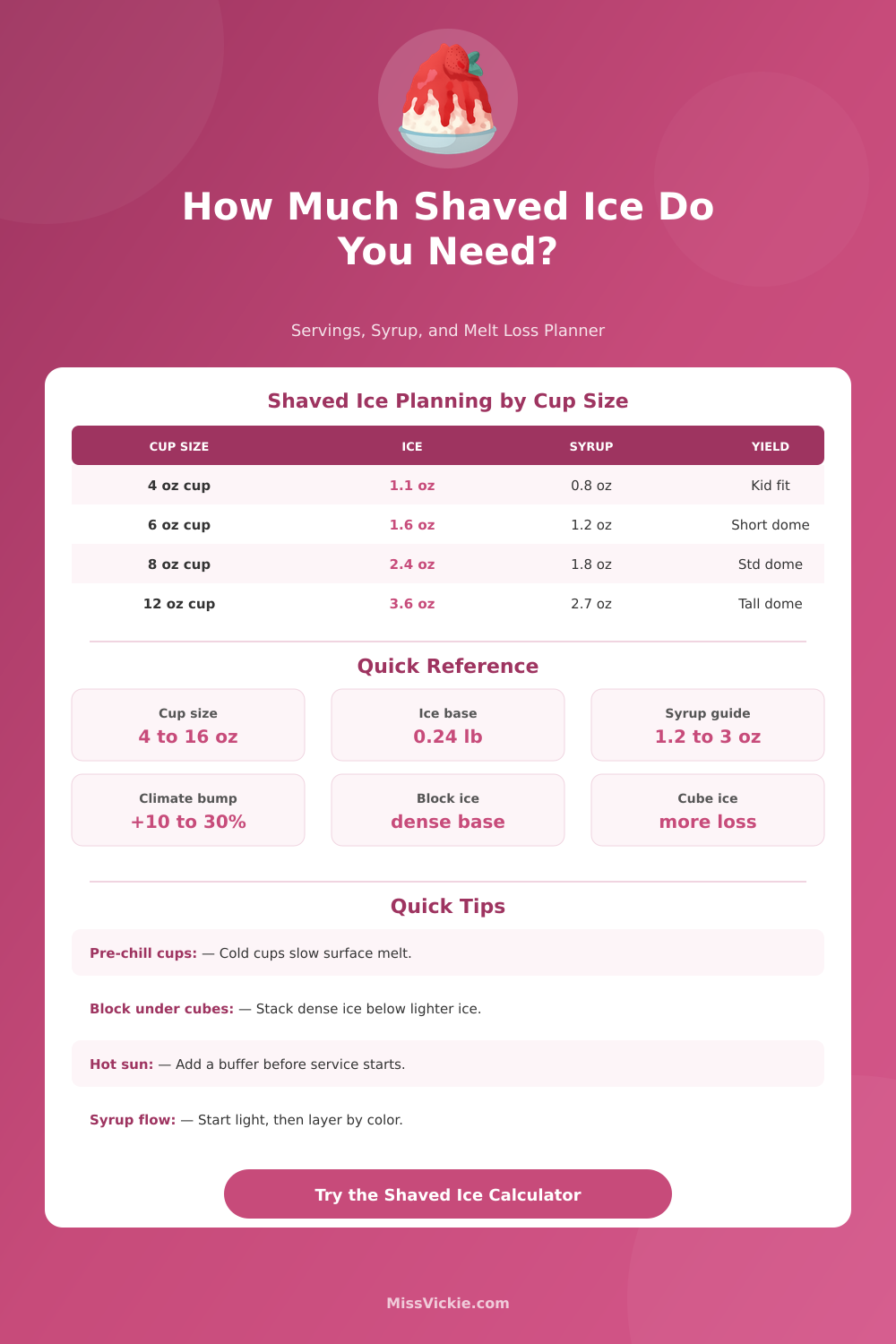
| Cup Size | Serving Shape | Ice Per Cup | Syrup Per Cup |
|---|---|---|---|
| 4 oz | Sample cone | 0.11 lb | 0.8 oz |
| 6 oz | Kid dome | 0.16 lb | 1.2 oz |
| 8 oz | Standard dome | 0.24 lb | 1.8 oz |
| 12 oz | Tall dome | 0.36 lb | 2.7 oz |
| 16 oz | Jumbo tower | 0.48 lb | 3.6 oz |
| Ice Form | Bulk Density | Melt Behavior | Best Use |
|---|---|---|---|
| Block ice | 1.90 lb/qt | Slowest | Long hold, dense base |
| Cube ice | 1.65 lb/qt | Steady | Easy loading, backup stock |
| Crushed ice | 1.45 lb/qt | Quick | Fast service, short lines |
| Flake ice | 1.25 lb/qt | Fastest | Soft finish, immediate prep |
| Setting | Buffer | Notes | Hold Risk |
|---|---|---|---|
| Indoor / cool shade | +0% | Stable line | Low |
| Warm shade | +10% | Watch drizzle | Medium |
| Hot sun | +20% | Pre-chill all cups | High |
| Humid coast | +25% | Plan on surface sweat | High |
| Style | Ice Ratio | Syrup Ratio | Taste Profile |
|---|---|---|---|
| Flat fill | 0.85x | 0.80x | Light finish |
| Standard dome | 1.00x | 1.00x | Balanced service |
| Tall dome | 1.15x | 1.12x | Sweet top layer |
| Tower top | 1.28x | 1.22x | Big festival look |
To manage a shaved ice businesses, understanding the concept of yield management is essential. Yield management is a processes that calculates how much shaved ice and syrup is required to remain profitable. Several variables must be accounted for in calculating how many units of shaved ice and syrup is required.
These variables include the number of guest, cup size, serving style, types of shaved ice, syrup ratio, and the weather. The number of guests are a variable that must be accounted for when calculating yields. However, it is challenging to accurately predict the number of guests as some individuals will order only one cup of shaved ice, while others will purchase several cup of shaved ice.
How to Plan How Much Shaved Ice and Syrup to Make
Cup sizes are also a variable that must be accounted for. For instance, it takes less shaved ice to fill four ounces of shaved ice than it does to fill twelve ounces of shaved ice. The serving styles are also a variable.
For instance, a flat shave use less shaved ice than a dome or a tower of shaved ice. Similarly, if shaved ice is made into a tower, it require a dense base of shaved ice for structural support. The type of shaved ice that is used is a variable.
For instance, block ice shaves into a tight pack and melts more slow because block ice is dense. Flake ice is soft and contain air pockets, but melts quickly because of the high rate of melting of flake ice in high humidity environments. The shop must choose the type of shaved ice that is used based off specific needs of the shaved ice.
For instance, block ice weighs nearly two pound per quart. Flake ice melts quickly and may not be appropriate for shaved ice that will be served in hot environments. Cubes of shaved ice contain air gaps like flake ice but melt at a steadier rate then flake ice.
Crushed shaved ice melts quickly and is best use when there are long lines of customers who want shaved ice. Another variable is the ratios of the syrups that are used. Using too little syrup will make the shaved ice taste blandly.
Using too much syrup will make the cups of shaved ice drown in syrup which waste syrup. Using the correct amount of syrup will produce the best flavor to customers. For instance, two ounce of syrup can be used for an eight-ounce cup of shaved ice.
For a tower of shaved ice, the syrup may be added in increasing amounts from the base of the shaved ice to the top to provide the best taste to the customer. The weather is another variable. Melt loss is the amount of shaved ice that turn into liquid.
The higher the melt loss, the more shaved ice will melt and the more that will be required to provide shaved ice to the customer. The melt loss will increase with high humidity and hot weather. If shaved ice is provided in the shade, there will be less melt loss than if shaved ice is provided in the hot sun.
In the shade, a buffer of shaved ice of twenty percent may be added to the cups. If shaved ice turns into puddles on the surface due to the hot sun, there will be increased melt loss. Using pre-chilled cups or shaved ice based on block ice at the bottom of the cup and flake shaved ice on top will reduce melt loss.
One mistake that you should of avoided is eyeballing the amount of shaved ice and syrup that will be need. Eyeballing the shaved ice and syrup will lead to running out of supplies. Forty guests will not necessarily mean that forty cups of shaved ice can be served.
Using portion tables will allow the shaved ice shop to establish the number of pounds of shaved ice and syrup that is required to serve customers. An 8 ounce cup of shaved ice requires one-quarter pound of shaved ice and a 16 ounce cup requires one-half pound of shaved ice and four ounces of syrup. Another variable to account for is shaved ice machine.
Different machines will shave the shaved ice differently. Some machines may produce shaved ice that is shaved into very fine shavings that pack together well like block ice. Other machines may produce shaved ice that fluff up and takes up more room in the cup than block ice.
The cook will test the machines on a slow day to determine how many pounds of shaved ice are produced per portion of shaved ice. Noting the number of portions of shaved ice made per pound will allow for more accurately yields of shaved ice for customers. If the shaved ice business follows the steps and the processes that is described above, the shop will experience high yields of shaved ice with minimal waste.
For example, shaved ice can be pre-chilled in coolers to slow the melting of shaved ice. Using block ice will help form a structure of shaved ice that will stay together. Accounting for the environment in which shaved ice will be provided can add a buffer of shaved ice to provide for high temperatures of the location.
Following these suggestion, the shaved ice shop will have enough shaved ice and syrup to serve all of there customers.