Flour cups, grams, baking powder, salt, humidity, and storage batches
Baking Powder for Self Rising Flour Calculator
Make self-rising flour from all-purpose or low-protein flour with exact baking powder per cup, salt ratio, flour grams, recipe type, humidity adjustment, and pantry storage guidance.
Pick a baking plan, then adjust the flour amount, flour type, baking powder strength, salt ratio, humidity, recipe type, and storage batch.
Mix Breakdown
| Plain Flour | Baking Powder | Fine Salt | Approx Total Weight | Best Use |
|---|---|---|---|---|
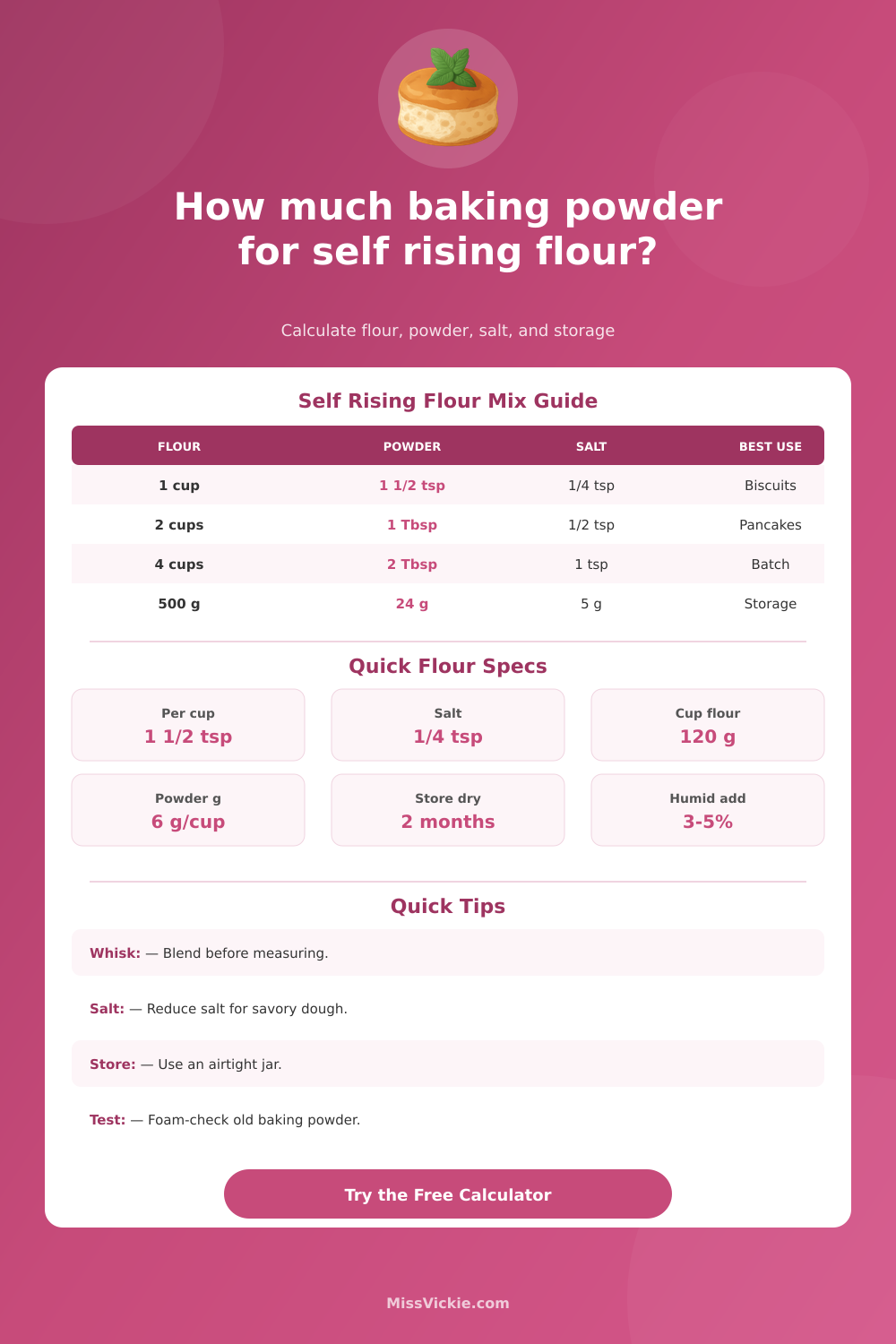
| 1 cup / 120 g | 1 1/2 tsp / 6 g | 1/4 tsp / 1.5 g | 127.5 g | Small recipe swap |
| 2 cups / 240 g | 1 Tbsp / 12 g | 1/2 tsp / 3 g | 255 g | Pancakes, muffins, biscuits |
| 4 cups / 480 g | 2 Tbsp / 24 g | 1 tsp / 6 g | 510 g | Storage jar or family baking |
| 500 g flour | 25 g powder | 6 g fine salt | 531 g | Metric pantry batch |
| 1 kg flour | 50 g powder | 12 g fine salt | 1062 g | Large airtight batch |
The gram estimates use 4 g per teaspoon of baking powder and 6 g per teaspoon of fine table salt.
| Flour Type | Typical Cup Weight | Protein Feel | Self-Rising Result | Recipe Match |
|---|---|---|---|---|
| All-purpose flour | 120 g | Medium | Good all-around substitute | Biscuits, pancakes, muffins |
| Soft wheat flour | 115 g | Lower | Tender, classic Southern-style texture | Biscuits and quick breads |
| Cake flour | 114 g | Low | Very soft crumb, less chew | Cakes, cupcakes, cobbler topping |
| Pastry flour | 118 g | Low-medium | Tender but workable dough | Scones, muffins, dumplings |
| Gluten-free blend | 130 g | Blend-specific | Needs brand testing for lift | Pancakes and muffins first |
| Recipe Type | Powder Bias | Salt Caution | Texture Goal | Handling Tip |
|---|---|---|---|---|
| Biscuits or scones | Standard to slight lift | Watch salted butter | Tall, tender layers | Keep fat cold and cut cleanly |
| Pancakes or waffles | Slight lift | Moderate | Quick griddle rise | Rest batter briefly, not all morning |
| Muffins or quick bread | Standard | Moderate | Even dome without bitterness | Mix only until flour disappears |
| Cornbread | Slight lift | Often salty already | Open crumb and clean slices | Check cornmeal mix for salt first |
| Cake or cupcakes | Gentler lift | Keep balanced | Fine crumb, no chemical taste | Use fresh powder and sift well |
Making self-rising flour at home involve mixing plain flour with baking powder and salt, and making self-rising flour at home allows a person to have more control over the ingredient in the flour. Self-rising flour are a mixture of plain flour, baking powder, and salt, and these three ingredient must be combined in the correct ratio for self-rising flour to function correct in a recipe. Baking powder provide the rise for baked goods, but salt is needed to balance the flavor and structure of the baked goods.
If the ratio of baking powder to salt are incorrect, then baked goods may have a metallic flavor or may fail to rise when baked. The calculator is helpful to those who want to calculate the proper amount of baking powder and salts to add to there plain flour to make self-rising flour. To use this calculator effective, a person must provide information about the amount of plain flour that they have and the type of plain flour that they are using.
How to Make Self-Rising Flour at Home
The type of plain flour impact the self-rising flour because different type of plain flour contain different protein levels. For instance, cake flour contain less protein than all-purpose flour, so the baking powder requirement for cake flour will be different than those needed for all-purpose flour. This calculator allow a person to adjust the gram per cup according to the specific type of flour that a person is using to make the self-rising flour.
Beyond the type of plain flour that will be used in the self-rising flour, two environmental factor will impact the baking strength of self-rising flour: humidity and storage time. The strength of the baking powder will diminish in the presence of high humidity or if the baking powder has been sitting in an environment for a long time. The baking powder calculator take these variables into consideration so that a person can decide whether any extra baking powder should be added to the self-rising flour recipe.
Furthermore, the type of recipe that a person will bake with the self-rising flour will also change the way in which the self-rising flour is used. For example, biscuits requires more rise than pancakes or muffins. The baking powder and salt amount will be adjusted according to the recipe type that the person using the calculator chooses.
Furthermore, the way in which the self-rising flour is mixed will also impact the baking process. It is essential that baking powder and salt is distributed evenly in the plain flour to make self-rising flour. If the baking powder and salt are not evenly distributed, the baked goods may contain bitter spots or flat area.
The baking powder and salt must be whisked or sifted with the plain flour multiple times to ensure that the baking powder and salt are evenly distribute in the flour. The baking powder calculator will remind the person to mix the self-rising flour mixture to ensure that the baking powder and salt are well distributed in the plain flour. Because the person is making their own self-rising flour, they can control the freshness of the baking powder and the amount of salt in the flour.
Therefore, the result of the baking will be more consistent and more controlled if self-rising flour is made at home. Actually, the results of the baking will be more consistent and more controlled if self-rising flour is made at home.