Miss Vickie baking calculator
Self-Raising Flour Calculator
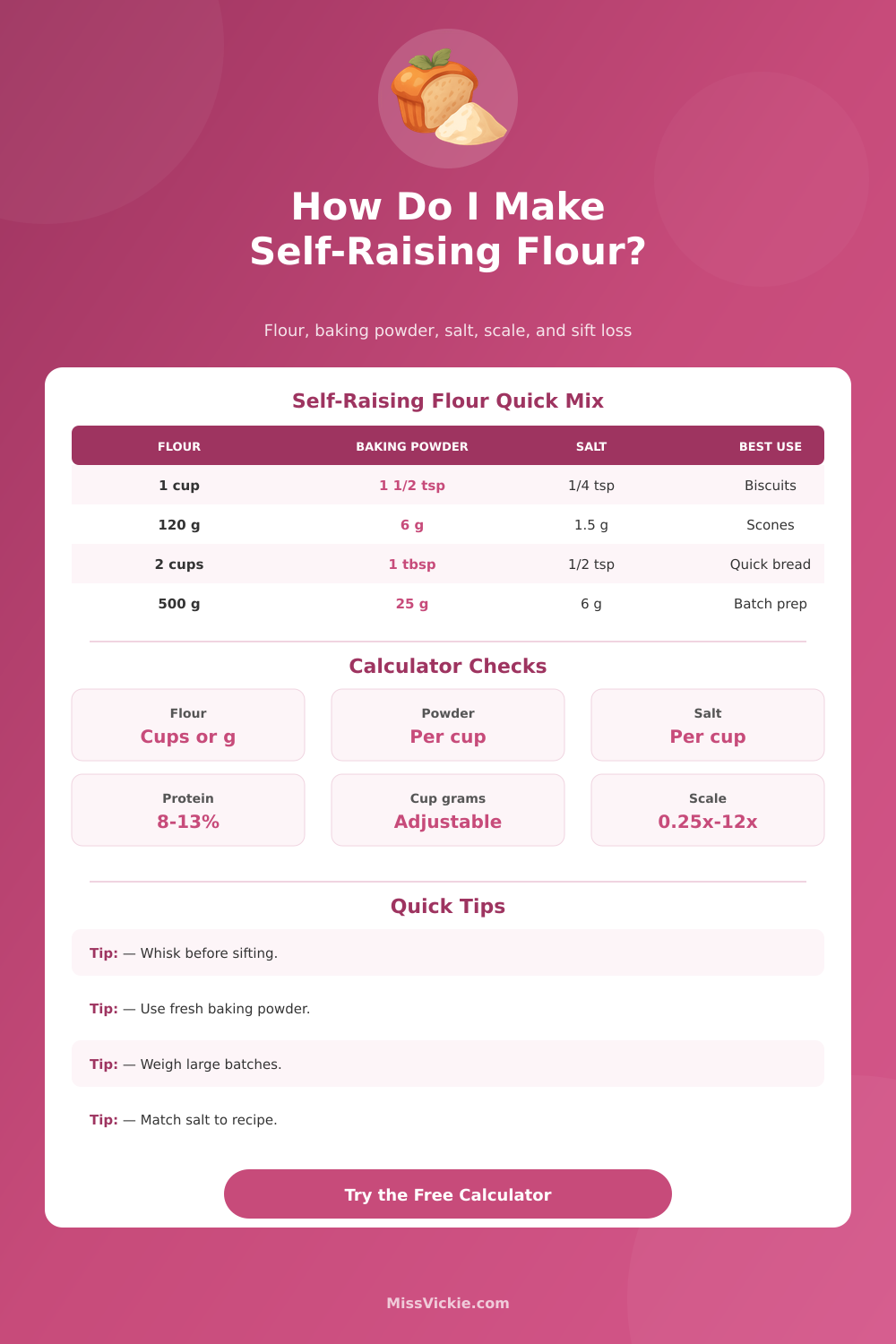
Make self-raising flour from plain or all-purpose flour by entering flour amount, cup weight, baking powder strength, salt level, protein, batch scale, and sifting loss.
Each preset fills the calculator with a practical baking scenario. You can edit every number before calculating.
Plain Flour
The usual base for homemade self-raising flour. It gives control over baking powder, salt, cup weight, and storage.
All-Purpose Flour
A practical US substitute base. Protein varies by brand, so biscuits may be sturdier with higher-protein AP flour.
Commercial Self-Rising
Already blended with leavening and salt. Convenient, but exact salt and baking powder levels are brand dependent.
Cake Flour
Lower protein and softer texture. It can make delicate self-raising cake mixes, but is not ideal for tall biscuits.
Pastry Flour
A middle-ground flour for tender scones, shortcakes, and muffins when plain flour feels too strong.
Bread Flour
High protein creates chew and structure. It is rarely the best base unless a recipe needs extra bite.
The comparison focuses on baking behavior. Brand milling, wheat variety, humidity, and baking powder age can still change the final rise.
Self-raising flour is a mixtures of flour, baking powder, and salt. A calculator can helps you to determine the exact amount of baking powder and salt that you should mix with the flour to make self-raising flour. The calculator allow you to enter the weight of one cup of flour, as well as an amount of baking powder that you would like to use in your recipe.
Based off these inputs, the calculator can show you the total weight of the self-raising flour that will result. The amount of baking powder in self-raising flour will impact how much your baked goods will rise. Baking powder cause baked goods to rise by releasing carbon dioxide gas when it reacts with the liquid in the recipe.
Make self-raising flour with a calculator
When you use more baking powder, you will create more rise in your baked goods. For pancakes, which requires little rise, you may want to use a lower rate of baking powder in the self-raising flour then for biscuits, which requires more rise. The calculator allows you to adjust the rate of baking powder to be used in the recipe, and will display the impact on the total weight of the self-raising flour.
Self-raising flour contains salt as one of its ingredients, but the other ingredients in your recipe influence the amount of salt that should be included in the flour blend. If the recipe contain ingredients like butter or cheese, those ingredients will contain salt, so you may need to use less salt in the self-raising flour blend. The type of salt that you use in the self-raising flour can also alter the amount of salt that needs to be included; fine table salt is more denser than flaky kosher salt.
Consequently, a teaspoon of fine table salt will weigh more than a teaspoon of flaky kosher salt. The protein content of the flour will impact the texture of the baked goods that are made from it; high-protein flour will result in baked goods with more structure than those made from low-protein flour. However, the protein content of the flour does not impact the amount of baking powder or salt that is include in the self-raising flour.
It is necesary for bakers to know the protein content of the type of flour that they will use when they prepare their baked goods. The weight of one cup of flour can impact baking results. Flour that is spooned into the measuring cup will weigh less than flour that you scoop directly from the flour bag.
When using the calculator, it is necessary to enter the number of gram of flour in one cup to the recipe; the calculator will calculate the weight of the baking powder and salt accordingly. Using weights instead of volume measurements will allow the baker to ensure that the baker always creates the self-raising flour blend in the same manner, regardless of the flour that is used. Flour that is sifted to combine the ingredients in self-raising flour can result in a small loss of that flour; some of the flour will remain in the sieve or will fall onto the counter.
For recipes that require large amounts of self-raising flour, it may be necesary to account for this loss of flour when sifting by adding a small percentage of extra flour to the self-raising flour blend. The calculator contains an optional field that allows the baker to add this extra flour to account for flour that may be lost during the sifting process. The scale field in the calculator can be used to prepare batches of self-raising flour beyond the amount indicated in the recipe.
For instance, if the recipe indicates that one cup of flour is to be used, doubling the recipe will require the addition of two cup of flour. The scale field allows for the doubling of the flour, baking powder, and salt; this ensures that the recipes created with self-raising flour will always have the correct amount of baking powder and salt in relation to each other. Before baking with self-raising flour, it is important to check the ingredients list for that recipe to ensure that it does not already contain leavening agent.
If the recipe includes baking powder, adding self-raising flour may result in too much leavening in the baked goods. Additionally, you can use the ingredient calculator to compare the ingredients in the recipe with the ingredients that the self-raising flour will add to prevent the leavening agents from becoming more abundant in the recipe. Freshness of the baking powder can impact the ability of the self-raising flour blend to create the baked goods that are fluffy and full of structure.
If the baking powder become too old, it may lose its strength in activating to produce the carbon dioxide gas that lead to the rise in the baked goods. To test whether the baking powder is still active, the ingredient can be added to hot water; if the baking powder begins to foam, it is still active. If it isnt, then the self-raising flour blend will not work correct in creating baked goods of the required texture.