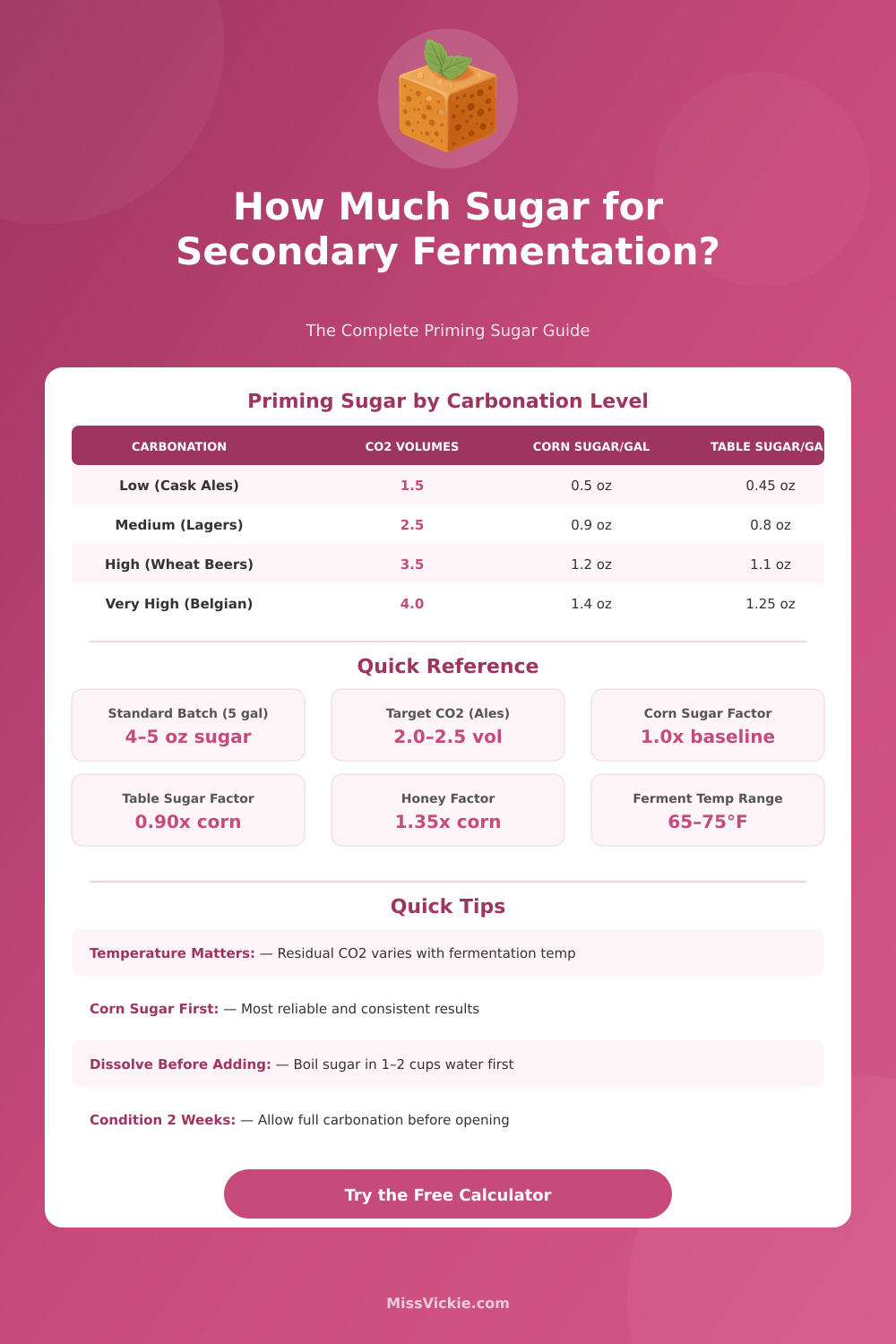
🍺 Secondary Fermentation Sugar Calculator
Calculate the exact amount of priming sugar for perfectly carbonated homebrew
| Sugar Type | Amount (oz) | Amount (g) | Notes |
|---|---|---|---|
| Corn Sugar (Dextrose) | 4.6 oz | 130g | Most consistent; 100% fermentable |
| Table Sugar (Sucrose) | 4.1 oz | 117g | 90% relative to corn sugar |
| Honey | 6.1 oz | 173g | Adds subtle flavor; ~75% fermentable |
| Dry Malt Extract (DME) | 5.7 oz | 162g | Adds malt character; ~80% fermentable |
| Turbinado / Raw Sugar | 4.3 oz | 122g | Slight molasses note; ~95% fermentable |
| Maple Syrup | 6.8 oz | 193g | Seasonal flavor; ~67% fermentable |
| Ferment Temp (°F) | Ferment Temp (°C) | Residual CO2 (vol) | Adjustment |
|---|---|---|---|
| 40°F | 4°C | 1.17 | Needs less priming sugar |
| 50°F | 10°C | 1.00 | Needs less priming sugar |
| 60°F | 16°C | 0.83 | Standard lower range |
| 68°F | 20°C | 0.70 | Most common ale temp |
| 72°F | 22°C | 0.64 | Standard ale range |
| 80°F | 27°C | 0.50 | Higher sugar needed |
| Beer Style | CO2 Volumes | Character | Corn Sugar / 5 gal |
|---|---|---|---|
| Cask Ale / Real Ale | 1.5–1.8 | Very soft, creamy | 2.2–2.8 oz |
| British Bitter / ESB | 1.8–2.2 | Low carbonation | 2.8–3.5 oz |
| Stout / Porter | 2.0–2.4 | Smooth, roasty | 3.2–3.8 oz |
| American Ale / IPA | 2.2–2.7 | Medium fizz | 3.5–4.4 oz |
| Lager / Pilsner | 2.4–2.7 | Crisp, refreshing | 3.8–4.4 oz |
| Saison / Farmhouse | 2.8–3.5 | Lively, peppery | 4.5–5.8 oz |
| Hefeweizen / Wit | 3.0–4.5 | Very effervescent | 4.8–7.5 oz |
| Belgian Tripel / Golden | 3.0–4.0 | Champagne-like | 4.8–6.6 oz |
| Hard Cider | 2.5–4.0 | Light to very fizzy | 4.0–6.6 oz |
| Mead / Wine-Style | 1.0–2.5 | Lightly sparkling | 1.5–4.0 oz |
| Batch Size | Gallons | Liters | Quarts |
|---|---|---|---|
| Mini Batch | 1 gal | 3.79 L | 4 qt |
| Small Batch | 2.5 gal | 9.46 L | 10 qt |
| Standard Batch | 5 gal | 18.93 L | 20 qt |
| Large Batch | 10 gal | 37.85 L | 40 qt |
| Metric Standard | 5.28 gal | 20 L | 21.1 qt |
| Metric Large | 7.93 gal | 30 L | 31.7 qt |
Sugar is a sweet substance that you get mainly from juice of sugarcane and sugar beet. It is also in sorghum and maple sap. You use it a lot as a flavor in foods or as a fermenting agent.
The word sugar covers various kinds that range in sweetness
Sugar: Types, Uses and Health
Natural sugars are in fruits, where they are fructose, and in milk, where they are lactose. One apple has around 11 grams of sugar depending on its size and kind. Plain yogurt can reach 8 grams, but they are not added sugars because they come from milk.
In the kitchen and bakery you have many kinds of sugar to add sweetness to cakes, drinks, steak rubs or fish.
Too much added sugars can cause weight gain, obesity, type 2 diabetes and heart diseases. For women you want no more than 25 grams a day, for men 36 grams. The Dietary Guidelines for Americans say that children under 2 years should not have added sugars.
For older you limit added sugars to less than 10 percent of daily calories. At a 2000-calorie diet that is maximum 48 grams of added suagr.
Dried apricots show how sugar can surprisingly grow. One fresh apricot has only 3 grams, but a serving of four big dried ones holds 21 grams.
Some products called sugar replacements, or artificial sweeteners, give a sweet taste with few calories. Even so during food preparation they cannot give the color, texture and taste that natural sugar provides.
Brown sugar has two main kinds. One has molasses naturally that is not refined. The second is white refined sugar with added molasses.
For light brown you put a spoon of molasses in a cup of white sugar. For dark brown, two spoons in a cup. Use light or dark brown sugar will not alter the result of the recipe.
Sugar is often misunderstood in bread making. You think that it feeds the yeast, but yeast well eats flower. Many breads absolutely do not need sugar.
When you mix it in dough for pretzels, brown sugar can cause lumps even after blending of dry ingredients.
For pulled sugar, cook sugar with 50 grams of glucose syrup until 130 degrees for color, then cook until 168 degrees on high heat. Pulling more than 20 times can cause recrystallization. Sugar must have a silky gloss before you put it under warm lamps until readyforuse.