Seafood Boil Calculator
Plan shrimp, crab, crawfish, corn, potatoes, sausage, seasoning liquid, and pot batches from the number of guests and the seafood mix you want.
🦞Quick seafood boil presets
📝Guest, seafood, sides, and pot inputs
Enter total guests first, then tune appetite, kids, seafood ratios, side portions, seasoning strength, and pot capacity. Ratios are normalized automatically if they do not add to 100.
Seafood boil breakdown
📊Seafood comparison grid
Good for mixed groups because it cooks quickly, peels easily, and works well at 30-60% of the seafood mix.
Plan more raw weight because the shell is heavy. It feels generous, but edible yield is lower than shrimp.
Best for hands-on tables. Whole crawfish need more pounds per guest and are usually the last item people linger over.
Use as a small bonus layer, not the main ratio, unless every guest enjoys shellfish and you can watch timing closely.
🍚Planning reference cards
📒Seafood boil reference tables
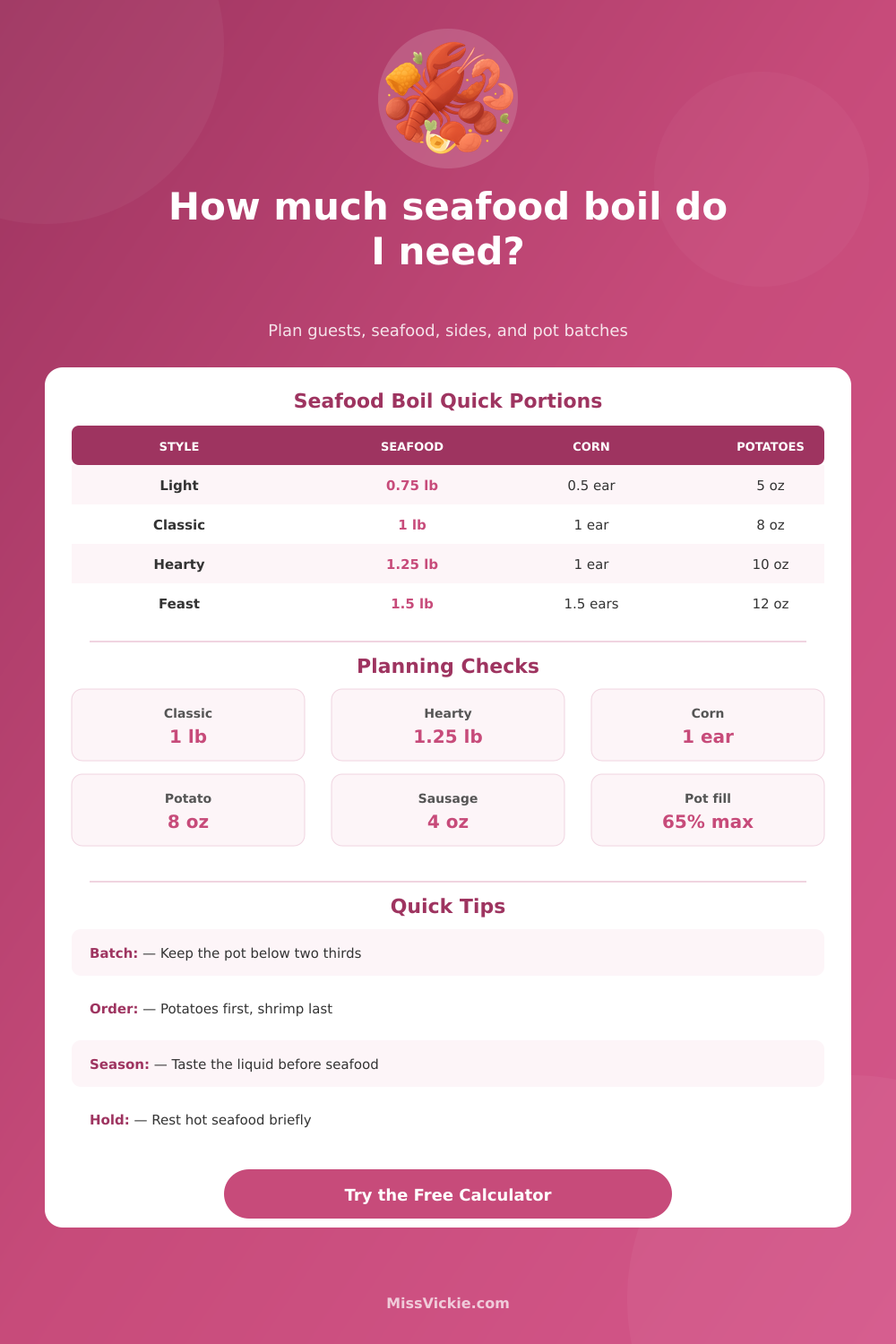
Table 1: Seafood per person
| Appetite | Seafood per adult | Best use | Side note |
|---|---|---|---|
| Light | 0.75 lb / 340 g | Lunch, appetizer table | Use full sides. |
| Classic | 1 lb / 454 g | Main meal boil | Most flexible start. |
| Hearty | 1.25 lb / 567 g | Seafood lovers | Add a buffer. |
| Feast | 1.5 lb / 680 g | Crab or crawfish focus | May need batches. |
Table 2: Shrimp, crab, crawfish mix
| Mix style | Shrimp | Crab | Crawfish |
|---|---|---|---|
| Balanced | 40% | 30% | 30% |
| Shrimp forward | 65% | 20% | 15% |
| Crab heavy | 25% | 60% | 15% |
| Crawfish heavy | 20% | 10% | 70% |
Table 3: Corn, potatoes, sausage
| Side level | Corn | Potatoes | Sausage |
|---|---|---|---|
| Light | 0.5 ear | 5 oz / 140 g | 2 oz / 55 g |
| Classic | 1 ear | 8 oz / 225 g | 4 oz / 115 g |
| Loaded | 1.5 ears | 10 oz / 285 g | 5 oz / 140 g |
| Kids table | 0.5 ear | 4 oz / 115 g | 2 oz / 55 g |
Table 4: Pot and cook order guide
| Pot size | Working fill | Typical batch | Order |
|---|---|---|---|
| 30 qt | 19-20 qt | 10-14 lb food | Potatoes, corn, sausage, seafood |
| 60 qt | 39 qt | 22-30 lb food | Split seafood if needed |
| 80 qt | 52 qt | 32-40 lb food | Good party size |
| 100 qt | 65 qt | 42-52 lb food | Large event batches |
💡Two boil planning tips
To plan a seafood boil, you need to consider several different variable. A seafood boil contain many different components so you have to account for each component. For instance, you must account for the number of guest for the event and how much food each guest will eat.
Additionally, you must account for the size of the cooking pot that will be used for the seafood boil as well as the weight of the seafood and the sides that will be cooked. Using a planning tool help you to calculate each of these different variables for a seafood boil so that you dont have to guess as to the amount and weight of the components that is necessary to prepare the seafood boil. The first decision you must make with a planning tool for a seafood boil is to enter the number of guests for the event.
How to Plan a Seafood Boil
The planning tool will ask for the number of adults and children that will be attending the event. The planning tool assume that a child will eat half of the amount of food of an adult so that the total amount of food is accounted for correctly. Additionally, the planning tool will ask you to choose the appetite level of the guests.
If the appetite level is set to light, each guest will eat three quarters of a pound of seafood. If the level is set to feast, each guest will eat one and a half pound of seafood. The appetite level of the guests will determine the total amount of seafood that are needed to be purchased for the event.
Another decision that the planning tool will ask you is for the type of seafood that will be used in the boil. Common types of seafood for a seafood boil include shrimp, crab legs, and crawfish. Each type of seafood has different weight and amounts of edible meat.
Additionally, shrimp takes longer to peel and cooks more quick than crab legs and crawfish. Crab legs have more shell weight than edible meat while crawfish takes longer to eat so there is more of a need for the weight of the crawfish. The planning tool allows you to select the ratio of each type of seafood to include in the boil so that the tool calculate how many pounds of each type of seafood will be needed.
Another decision that you must make with a planning tool for a seafood boil is the type of sides that will accompany the seafood. Common sides for a seafood boil include corn, potatoes, and sausage. These sides will add to the weight of the meal that is cooked in the pot.
The planning tool accounts for the different weights of the sides so that you do not cook the seafood boil and have no side left for the guests. Additionally, the planning tool will ask for the strength of the seasoning for the seafood boil. If strong seasoning is selected, more seasoning and salt will be added to the pot of water then if the level is set to mild.
Using the same strength of seasoning for each batch of seafood ensure that each batch will taste the same. The size of the cooking pot for the seafood boil will determine how many batches of the boil will be prepared. If the cooking pot is too small for the number of guests, it is possible for the pot to boil over.
Therefore, a planning tool will set the level of the water to sixty-five percent of the size of the cooking pot. The planning tool calculates the total weight of the seafood and sides that will be cooked in the pot. Based off the total weight of the meal, the planning tool will calculate the number of batches of seafood that will be cooked in the cooking pot.
If the total weight of the seafood, sides, and seasoning is to great for the cooking pot, the planning tool will increase the number of batches that are to be cooked. Using the planning tool allows you to make decisions prior to going into the grocery store to purchase the seafood boil ingredients. For instance, if the planning tool indicates that four batches of the seafood boil are required but there is only time to prepare three batches, the amount of sides can be reduced.
Additionally, if the planning tool calculates that the cooking pot will be too small for the number of guests, you can borrow a second pot. Using the planning tool ensures that each batch of seafood will be seasoned to the same amount of seasoning. Additionally, you can use the planning tool to determine the order in which the sides will be cooked.
For instance, the potatoes should be cooked first because they take the longest to cook through to the end. However, the shrimp should be cooked last because they cook more quick. By preparing the seafood in this order, each batch of the seafood boil will taste the same.