Sea salt, meat weight, dry brine, and sodium math
Sea Salt Per Pound of Meat Calculator
Estimate how many grams and teaspoons of sea salt to use per pound of meat, adjusted for crystal size, cut type, surface area, skin, seasoning timing, rest time, and cooking method.
This calculator is focused on sea salt for meat. It treats fine, coarse, and flaky sea salts separately because their teaspoon weights differ from kosher salt and from generic salt converters.
Fine Sea Salt
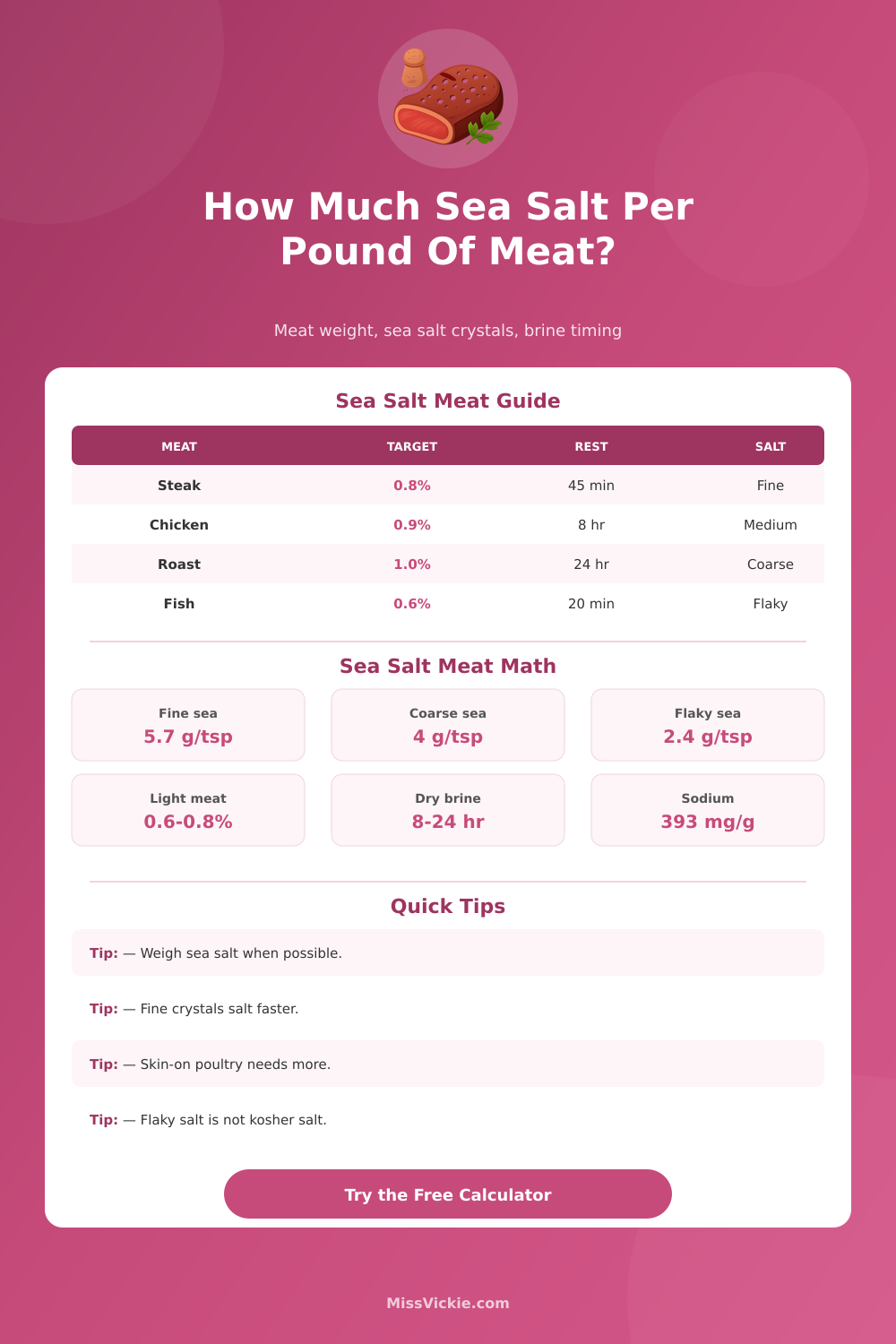
5.7 g / tsp
Dense enough to behave close to table salt by volume. Best for even dry brines when you cannot use a scale.
Medium Sea Salt
4.8 g / tsp
A middle ground for steaks, chops, and poultry parts. Spoon conversions are still brand-dependent.
Coarse Sea Salt
4.0 g / tsp
Large crystals cover unevenly and dissolve more slowly, so rest time matters more than with fine salt.
Flaky Sea Salt
2.4 g / tsp
Light, irregular flakes are excellent for finishing but unreliable for deep seasoning by spoon alone.
| Sea Salt Crystal Size | Approx Grams Per Tsp | Balanced Grams Per Pound | Balanced Tsp Per Pound | Best Meat Use |
|---|---|---|---|---|
| Fine sea salt | 5.7 g | 3.9 g/lb at 0.85% | 0.68 tsp/lb | Ground meat, thin cutlets, quick seasoning, and poultry parts. |
| Medium sea salt | 4.8 g | 3.9 g/lb at 0.85% | 0.81 tsp/lb | Steaks, chops, chicken pieces, and everyday dry brines. |
| Coarse sea salt | 4.0 g | 3.9 g/lb at 0.85% | 0.96 tsp/lb | Roasts, pork shoulder, ribs, and overnight seasoning. |
| Flaky sea salt | 2.4 g | 3.9 g/lb at 0.85% | 1.61 tsp/lb | Finishing bites after cooking; use less for full dry brines. |
| Sel gris or damp sea salt | 4.6 g | 3.9 g/lb at 0.85% | 0.84 tsp/lb | Roasts and poultry when crystals can dissolve for several hours. |
| Cut Type | Common Target | Best Rest Window | Sea Salt Note |
|---|---|---|---|
| Steak or chops | 0.75% to 1.00% | 45 minutes to overnight | Fine or medium sea salt dissolves more evenly than large crystals. |
| Large roasts | 0.90% to 1.20% | 12 to 48 hours | Coarse sea salt can work if it has enough time to dissolve on the surface. |
| Skin-on poultry | 0.85% to 1.10% | 8 to 24 hours | Salt under the skin seasons meat better than salt only on the outside. |
| Fish fillets | 0.45% to 0.70% | 10 to 30 minutes | Fine sea salt is easier to distribute lightly on delicate fish. |
| Ground meat | 0.80% to 1.00% | Mix just before shaping | Mixing salt early can firm the texture, especially for burgers. |
| Ribs and slabs | 0.90% to 1.20% | 4 to 24 hours | Bone and rub ingredients can change how salty the final bite tastes. |
| Target Percent | Grams Per Pound | Fine Sea Salt | Coarse Sea Salt |
|---|---|---|---|
| 0.55% very light | 2.5 g / lb | 0.44 tsp / lb | 0.62 tsp / lb |
| 0.70% light | 3.2 g / lb | 0.56 tsp / lb | 0.79 tsp / lb |
| 0.85% balanced | 3.9 g / lb | 0.68 tsp / lb | 0.96 tsp / lb |
| 1.00% dry brine | 4.5 g / lb | 0.80 tsp / lb | 1.13 tsp / lb |
| 1.20% bold roast | 5.4 g / lb | 0.95 tsp / lb | 1.36 tsp / lb |
| Meat Scenario | Surface Area | Cooking Method | Sodium Estimate | Calculator Adjustment |
|---|---|---|---|---|
| Compact roast | Low exterior for its weight | Oven roast or low smoke | About 1,150 mg retained per lb at 0.85% and 75% retention | Use low surface area, roast cut, and 12 to 48 hours rest. |
| Steak or chop | Normal exterior exposure | Pan sear, grill, or sous vide then sear | About 1,150 mg retained per lb at 0.85% and 75% retention | Use balanced 0.85%, normal surface, and 45 minutes or longer. |
| Chicken pieces | High exterior from multiple pieces | Roast, grill, or air fryer | About 1,220 to 1,500 mg retained per lb when skin-on | Use poultry dry brine, high surface, and skin-on adjustment. |
| Fish fillets | Very high surface exposure | Pan sear, grill, or air fryer | About 650 to 850 mg retained per lb with light salting | Use fish cut, light target, and 10 to 30 minutes rest. |
| Ground meat | Salt mixed through the full batch | Grill, skillet, or roast as patties | About 1,450 mg retained per lb at 0.85% and 95% retention | Use mixed-in mode and avoid long holding before cooking. |
The chemistry of cooking: Protein is different, especially if it’s sea salt, which has varying densities; measuring in volume doesn’t work. You grab the shaker hoping for the best, until you remember that a teaspoon of flaky crystals isn’t the same as a teaspoon of fine. That leads to over-seasoned chicken or underseasoned fish: The calculator do the math for you. No more guessing about what you’re sprinkling into seasonings. Just plug in weight of your meat and crystal type.
There’s one rule that never varies: Salt is expressed as a percentage of weight. For any preparation… Searing scallops, or pork for brine, you want between 0.75- to 1.0-percent sodium chloride, which is pure salt. Recipes call for spoons; that doesn’t work with sea salt. Flaky salt is loose-packed, so it have just two and a half grams per spoonful. Fine salt is packed tight; it contain almost six grams. By volume, you may be applying three times more flaky salt (but fewer gram of sodium).
How to Use Salt Correctly
Salt behave differently at different times. A few minutes is enough to season a thin cutlet. Because it only seasons the surface, the salt will dissolve into a brine on the outside of whatever you’re cooking. Thicker cuts, though, are better off getting some headstart time by being dry-brined several hours or even days before cooking. During this time, the salt extract moisture and changes the proteins, then re-absorbs the liquid so the seasoning can soak deeply into meat. The calculator takes all of this into account: It knows what’s retained over the time period you select.
Salt absorbs differently on birds different than other meats because of their skin. Salt require being worked underneath the skin, into the meat. Alternatively, using a higher total percentage allow you to get enough seasoning on the outside without making the inside too salty. The amount of salt needed for each cut depends on when and where you apply it (and whether the skin is left on), as shown in the reference table below.
Because ground meat gets mixed into the protein structure before cooking, it will retain almost all of the salt. Because there’s not much exposed surface area to shed seasoning during cooking (as with a roast), you can get away with using slightly less total salt. You should of used a bit more if your meat is fatty. To prevent a rubbery texture, blend in your salt just before shaping patty rather than mixing it in too early.
Mastering seasoning is about being exact more then being intuitive. No, you don’t have to weigh each individual grain, but knowing how the mechanism works will make cooking comfortabley possible. Once you know that about a pound of meat require approximately four grams of sea salt to taste right, you’ll stop guessing. It’s a measure, not a guess, and the tool connect the dots between size of your grains and useful decisions. Thinking about salt this way makes sense; it is just a moddern measurement.