Salt, Cure #1, spice, fat, grind, and yield math
Sausage Seasoning Calculator
Calculate fresh or cured sausage seasoning by meat weight, salt percent, spice style, fat ratio, grind size, binder, added liquid, batch yield, and target link size.
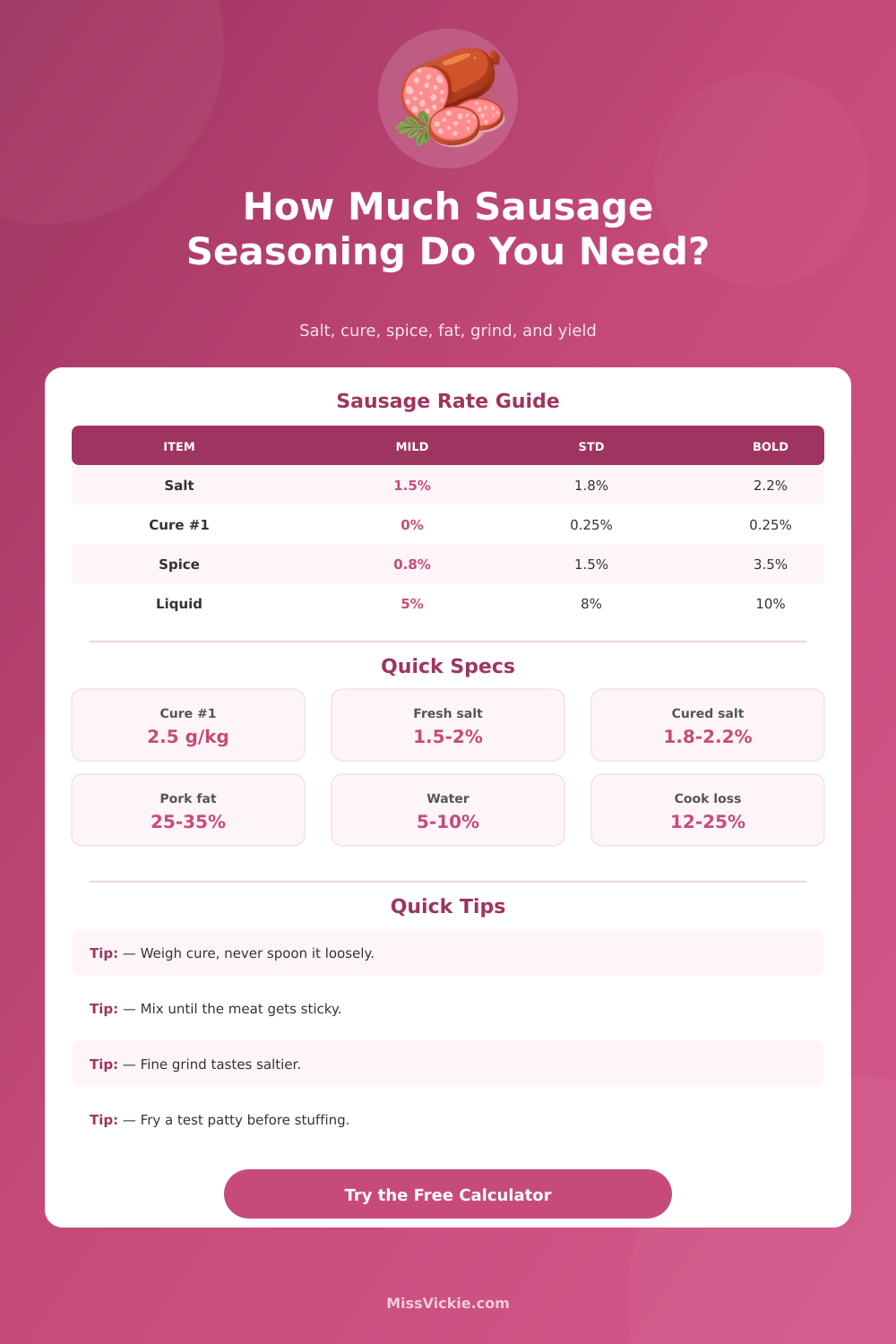
Use total meat plus fat weight as the base. Cure #1 is calculated at 0.25% of meat weight for cooked smoked sausages that call for it; fresh sausage should use no cure.
Seasoning Breakdown
| Style | Salt Range | Spice Range | Typical Fat | Cure | Seasoning Character |
|---|---|---|---|---|---|
| Breakfast Sage | 1.5% to 1.8% | 0.7% to 1.2% | 25% to 35% | No | Sage, black pepper, light sweetness, mild heat |
| Sweet Italian | 1.6% to 1.9% | 1.1% to 1.8% | 25% to 32% | No | Fennel, garlic, parsley, paprika, gentle pepper |
| Hot Italian | 1.7% to 2.0% | 1.6% to 2.4% | 25% to 35% | No | Fennel, chile flakes, paprika, garlic, black pepper |
| Bratwurst | 1.5% to 1.8% | 0.8% to 1.4% | 25% to 30% | No | White pepper, mace, ginger, nutmeg, marjoram |
| Kielbasa | 1.8% to 2.2% | 0.8% to 1.5% | 25% to 35% | Often | Garlic, black pepper, marjoram, smoke-friendly salt |
| Andouille | 1.8% to 2.2% | 2.0% to 3.2% | 25% to 35% | Often | Cayenne, garlic, thyme, paprika, coarse pepper |
| Chorizo | 1.8% to 2.3% | 3.0% to 5.0% | 25% to 40% | Optional | Paprika, chile, garlic, oregano, vinegar |
| Merguez | 1.7% to 2.1% | 2.2% to 3.8% | 20% to 30% | No | Harissa-style chile, cumin, coriander, garlic |
| Batch Weight | 1.6% Salt | 1.8% Salt | 2.0% Salt | Cure #1 At 0.25% | 2% Binder |
|---|---|---|---|---|---|
| 1 lb / 454 g | 7.3 g | 8.2 g | 9.1 g | 1.1 g | 9.1 g |
| 2.5 lb / 1.13 kg | 18.1 g | 20.4 g | 22.7 g | 2.8 g | 22.7 g |
| 5 lb / 2.27 kg | 36.3 g | 40.8 g | 45.4 g | 5.7 g | 45.4 g |
| 10 lb / 4.54 kg | 72.6 g | 81.6 g | 90.7 g | 11.3 g | 90.7 g |
| 25 lb / 11.34 kg | 181.4 g | 204.1 g | 226.8 g | 28.3 g | 226.8 g |
| Mix Or Grind | What It Changes | Suggested Spice Adjustment | Suggested Salt Watchout |
|---|---|---|---|
| Lean under 15% fat | Salt and chile taste sharper | Reduce spice 5% to 10% | Keep salt near 1.5% to 1.7% |
| Classic 25% to 30% fat | Balanced juiciness and seasoning carry | Use style baseline | Most recipes sit well at 1.7% to 2.0% |
| Rich 35% to 40% fat | Fat rounds salt and aromatics | Add 5% to 8% spice | Do not push salt only to chase flavor |
| Fine grind | Seasoning spreads quickly and tastes uniform | Reduce spice 3% to 5% | Salt may feel stronger |
| Coarse grind | Chunks need bolder surface seasoning | Add 5% to 10% spice | Rest longer before stuffing |
| Double grind emulsion | Dense bind, snappy hot dog texture | Reduce coarse herbs | Measure liquid and temperature carefully |
| Raw Batch | 2 oz Links | 3 oz Links | 4 oz Links | 6 oz Links | Cooked Yield At 18% Loss |
|---|---|---|---|---|---|
| 2.5 lb / 1.13 kg | 20 links | 13 links | 10 links | 6 links | 2.05 lb / 930 g |
| 5 lb / 2.27 kg | 40 links | 26 links | 20 links | 13 links | 4.10 lb / 1.86 kg |
| 10 lb / 4.54 kg | 80 links | 53 links | 40 links | 26 links | 8.20 lb / 3.72 kg |
| 25 lb / 11.34 kg | 200 links | 133 links | 100 links | 66 links | 20.50 lb / 9.30 kg |
Seasoning sausage require an understanding of the individual ingredient that contribute to the flavor of the sausage. Each ingredient will have an impact on the final product, from the amount of salt to the type of grind size for the meat. A calculator are one of the first tool that should be used in the sausage making process.
The calculator will allow you to focus on the numbers for the sausage that you are making, rather than having to focus on the math behind the sausage making process. Salt is one of the first ingredients to consider in the seasoning of you sausage. You must balance the amount of salt that you use in your sausage.
Use a Calculator to Season Sausage
If you use too little, the sausage will lack flavor. If you use too much, the sausage will be harsh in flavor after it is cooked. Depending on the type of sausage that you are making, there will be a percentage of salt that you should use.
For fresh sausages, such as breakfast sausages and bratwurst, you should use one and a half to two percent salt by the total weight of the meat that you are using. For cured and smoked sausages, you will need a higher percentage of salt because of the salt in the cure and the effect of smoking on the flavor of the meat. A sausage calculator will allow you to enter the salt percentage that you would like to use so that you can adjust the amount of salt to your personal taste.
Cure is another ingredient that will need to be considered for your sausage. If you are making a fresh sausage, you do not need to use a cure. However, if you are smoking your sausage or if you are planning on holding the sausage link for an extended period of time, you should use Cure Number One.
You should use a quarter of a percent of Cure Number One relative to the total weight of the meat that you are using in your sausage. Some cook will want to use the reduced salt version of Cure Number One so that the total amount of salt in the sausage is not too high. A calculator will allow you to view how much cure you should use by the amount of salt that you will use for your recipe.
The spice intensity for a sausage will determine the amount of spice that should be used. For example, a mild sausage will use a one percent amount of spice by the total weight of the sausage that is created. However, sausages like chorizo or merguez will use three to four times that amount of spice.
The amount of spice that you use will change according to the grind size of the sausage and the fat percentage of the sausage. The finer the grind size for the sausage, the more spice that you will need to achieve the same level of spice in the sausage. The higher the fat percentage for the meat, the less spice that will be needed because the fat will balance the flavor in the sausage.
The fat ratio for the meat and the amount of liquid that is added to the raw mix will impact the texture and how the seasoning travel throughout the meat. Most sausage maker will use a fat percentage between twenty-five and thirty-five percent. If the fat percentage in the ground meat is low, the spice percentage should be adjusted with a calculator so that the flavor of the meat is not too sharp.
Additionally, you can add liquids like ice water, stock, or wine to the raw meats to help the salt and spices distribute even through the meat. Adding liquid will also help the bind of the meat. The more liquid that you add to the raw meat, the more the total weight of the raw mix will change.
The total weight of the raw mix will change the number of link of sausage that can be made from the mixture. Grind size and binders will impact the texture of the final product. Using a coarse grind will allow for the meat to contain distinct piece of fat and meat.
Using a coarse grind will make the sausage seem less uniformly in flavor. You will need to use more spice in your recipe if you use a coarse grind of meat. Using binders such as nonfat dry milk or soy protein will retain moisture in the raw sausage and improve the sliceability of smoked sausages.
A calculator will show the total gram weight of binder that will be used to adjust the recipe for your batch of sausage. One of the first step in the recipe for sausage will be to plan for the yield of your batch of sausage. You will need to determine the raw batch weight, the cook loss that will happen during the cooking process, and the size of the links that you want to produce.
Using these number, a calculator will allow you to determine the total number of links that will be created from your raw batch of sausage and the total weight of the cooked sausage. This information can be helpful if you are making the sausage for an event or want to know the amount of trim that will be created from your batch of raw meat. Another advantage to using a calculator in your batch of sausage is that you will begin to notice pattern in the sausage making process.
For example, you may find that a salt percentage will taste different for different fat percentage in the meat. You may also find that the amount of liquid that is used will change how the meat bind to itself. These observations will allow you to adjust your recipe for different type of meats or types of sausages.
Additionally, the calculator will allow you to focus on making these observations about the sausage making process.