Sauerkraut Fermentation Time Calculator
Estimate sauerkraut timing from cabbage weight, salt percent, room temperature, shred thickness, jar headspace, target tang, current stage, and brine coverage.
🥬Fermentation presets
Choose a batch that resembles your cabbage, jar, kitchen temperature, and flavor goal. Then adjust the inputs for your real ferment.
📝Batch inputs
Your Sauerkraut Fermentation Estimate
Adjust the batch inputs and calculate to see timing, salt, jar fit, and brine notes.
Fermentation breakdown
⚖Batch planning grid
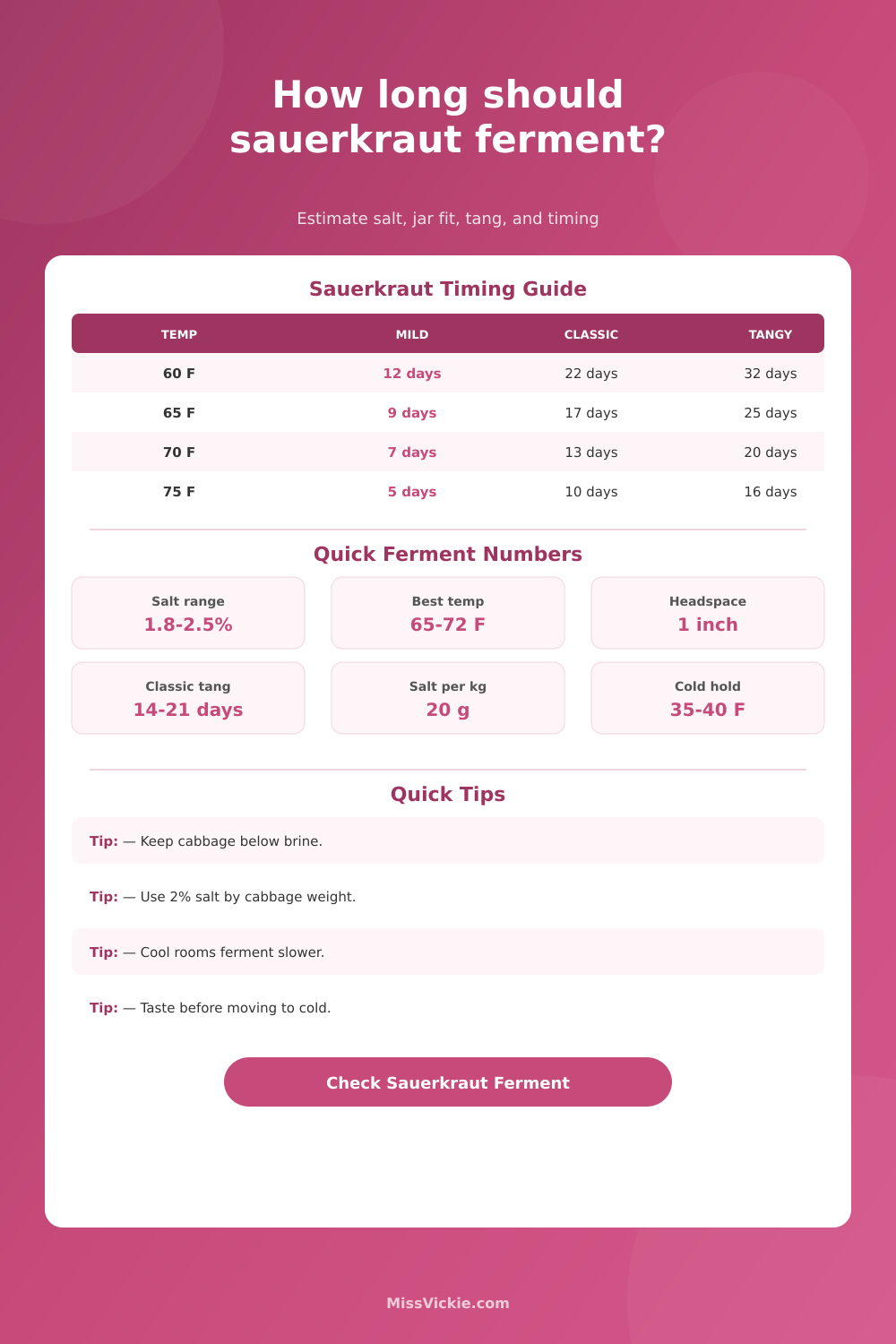
🌡Temperature and tang timing table
| Room temperature | Mild tang | Classic tang | Tangy kraut | Watch closely for |
|---|---|---|---|---|
| 58-60°F / 14-16°C | 11-14 days | 20-26 days | 30-38 days | Slow brine formation and delayed bubbles |
| 61-65°F / 16-18°C | 9-11 days | 16-21 days | 24-31 days | Clean souring with moderate activity |
| 66-72°F / 19-22°C | 6-8 days | 12-16 days | 18-24 days | Best balance of speed and flavor |
| 73-78°F / 23-26°C | 4-6 days | 8-12 days | 14-19 days | Soft texture and faster surface yeast |
| 79°F+ / 26°C+ | 3-5 days | 6-9 days | 10-15 days | Heat stress, mushiness, and off aromas |
🧂Salt percentage reference
| Salt percent | Salt per 1 kg cabbage | Fermentation effect | Texture effect | Best use |
|---|---|---|---|---|
| 1.5-1.7% | 15-17 g | Fast start but less buffer | Softer if warm | Short mild ferments kept cool |
| 1.8-2.2% | 18-22 g | Balanced lactic fermentation | Crisp and juicy | Most quart jars and crocks |
| 2.3-2.7% | 23-27 g | Slightly slower, very stable | Firm, salty bite | Warm rooms or long ferments |
| 2.8-3.2% | 28-32 g | Slow start | Very firm and salty | Hot kitchens or mixed vegetables |
🫙Jar fit and cabbage volume table
| Vessel | Usable packed cabbage | Typical cabbage weight | Salt at 2% | Headspace note |
|---|---|---|---|---|
| Pint / 500 ml jar | 350-420 ml | 0.55-0.75 lb / 250-340 g | 5-7 g | Good for tests, overflow likely if packed high |
| Quart / 950 ml jar | 720-820 ml | 1.3-1.8 lb / 600-820 g | 12-16 g | Leave about 1 inch for active bubbling |
| Half-gallon / 1.9 L jar | 1.45-1.65 L | 2.7-3.6 lb / 1.2-1.6 kg | 24-32 g | Use a weight that covers the surface |
| One-gallon / 3.8 L crock | 2.9-3.3 L | 5.5-7.2 lb / 2.5-3.3 kg | 50-66 g | Best for larger batches and thicker cuts |
📈Fermentation stage reference
| Stage | Typical day | What you may see | Calculator adjustment | Next decision |
|---|---|---|---|---|
| Freshly packed | Day 0-1 | Salt draws juice, cabbage compresses | No completed active days | Check brine after several hours |
| Early bubbles | Day 2-4 | Small bubbles and cloudy brine | About 3 days credited | Burp jars and keep submerged |
| Active souring | Day 5-9 | Tangy aroma and steady bubbling | About 7 days credited | Start tasting mild batches |
| Quiet and sour | Day 12-18 | Fewer bubbles, brighter sourness | About 14 days credited | Chill or keep going for sharper kraut |
🔍Comparison grid
Releases brine fast and usually reaches mild tang sooner.
Balanced timing, reliable brine, and classic sauerkraut texture.
Needs more days for salt penetration and even souring.
Slowest acidification, especially in cool kitchens.
💡Fermentation notes
Wait. Hold up. There’s a mason jar filled with cabbage before you, and you’re waiting on something to happen. Nothing moves. It’s quiet. What gives? Have you ruined it? Is it going to work? Or do you just have poor patience? This is where the sauerkraut fermentation time calculator comes in.
No more guessing games here; we’ve got some good ol’ fashioned science to rely upon. It’s not magic; it’s biology reacting to its surroundings. All you need to do is enter your room temperature and the weight of your cabbage into the calculator, and let it handle the math. You don’t have to try to remember complex decay curves or acidification rates, which spares you a world of headache.
How to Make Sauerkraut Easily
Generally, the primary variable here is temperature (the hotter the microbes get, the faster they work). Kraut made in a sixty-five degree F kitchen will taste different then kraut made in a seventy-eight degree kitchen. It sours faster at warmer temperatures, but it are riskier for getting a mushy texture unless you’re careful. Patience required with cooler rooms…but sometimes rewarded with improved crunch.
Salt percentage gets overlooked until it’s too late. For most home fermenter, that sweet spot is two percent (weight) salt, which maintains enough osmotic pressure to pull water from the cabbage and stave off dangerous bacteria. Go lower than one point eight percent, especially if your room temp is on the warm side, and you’re flirting with spoilage. Go above that and you’ll inhibit lactobacillus strains‘ ability to get started working effectively. The tool shows you how salt interacts with time and will help you visualize that sweet spot.
Besides your taste buds, there are other factors that impact success rate: what size jars you use, and how full they’re filled. When cabbage releases its own juices (which it does), it’ll compact quite a bit. Fill up a jar all the way to the brim, and expect a sticky mess on your counter in twenty-four hours. How do you know if the jar has enough room for bubbling but not so much that there’s air space for mold? The calculator estimates packed volume, allowing you to select a container with enough space. For actively fermenting times, one inch of headspace is usualy plenty.
The thickness of the shred alters its exposed surface area for bacteria to settle. Thick slices will need more time before they are evenly tangy all the way through whereas fine shreds will leach out their brine fast and go sour faster. If you slice it incorrectly, you’re stuck guessing if it’s still in progress, or if it went too far. The chart on the page spells this out, with the multiple on your timeline based off the thickness of the shred.
One thing you shouldn’t compromise on: The brining should be covered. Exposure to air will favor oxygen, not lactic acid bacteria; in other words, it will encourage mold and yeast growth. You want your cabbages kept submerged so they don’t get spoiled on top (and ruin the whole batch). Sealed bags filled with brine or weighted glass stones works well to keep everything under the water’s surface without any extra effort.
How long? That’s objective; what kind of tang suits you is subjective. Two weeks or so at room temperature gives classic deli-style sauerkraut (above). Letting it go longer makes the texture softer and the flavor more developed, sharp as you like. Your best quality control: taste. Numbers can’t measure preference.
And once you understand your inputs, it’s no longer anxiety-inducing, it becomes strategic. It’s not “oh crap” when you see all those bubbles; it’s “yay, I’m doing this right!” From day one, the clock is ticking… But it ticks in details that are within your power to change. By the time finished product reaches that sweet spot between tart and crunchy, you know it was all worthwhle.