Salt To Ice Ratio Ice Cream Maker Converter
Convert bucket size, ice weight, rock salt ratio, batch size, outdoor temperature, and churn time into a practical ice cream maker salt and ice plan.
Load a real ice-and-salt freezer scenario, then adjust bucket size, ice on hand, salt ratio, weather, churn time, and batch volume.
Salt And Ice Breakdown
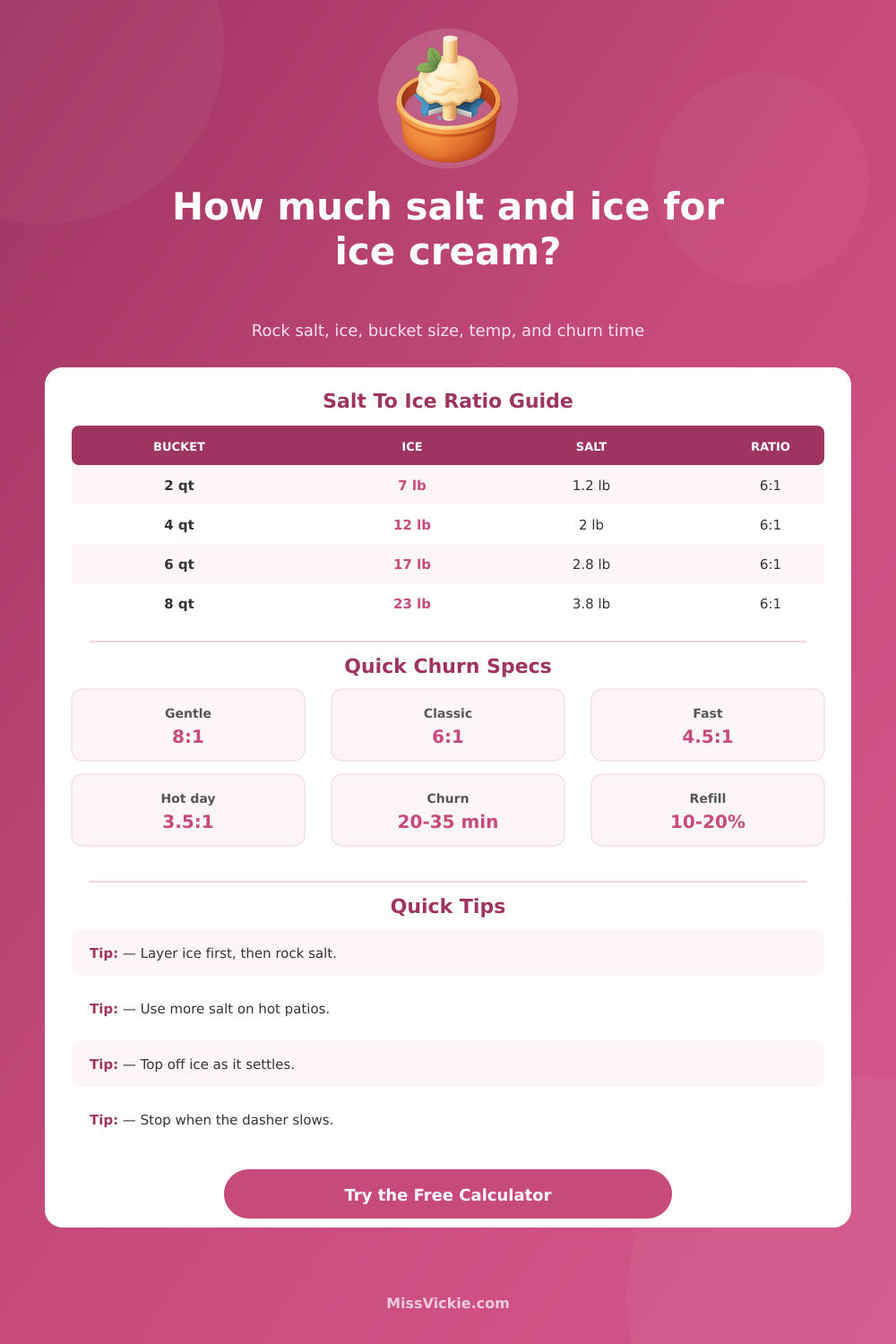
| Bucket Size | Starting Ice | Classic Salt | Good For |
|---|---|---|---|
| 1.5 qt compact | 5 lb / 2.3 kg | 0.8 lb / 1.4 cups | Small test batch |
| 2 qt small | 7 lb / 3.2 kg | 1.2 lb / 2 cups | Family dessert |
| 4 qt classic | 12 lb / 5.4 kg | 2 lb / 3.4 cups | Backyard churn |
| 6 qt family | 17 lb / 7.7 kg | 2.8 lb / 4.8 cups | Large cookout |
| 8 qt party | 23 lb / 10.4 kg | 3.8 lb / 6.5 cups | Party freezer |
| 12 qt event | 34 lb / 15.4 kg | 5.7 lb / 9.7 cups | Event batch |
| Ratio Style | Ice:Salt | Salt Share | Best Use |
|---|---|---|---|
| Gentle freeze | 8:1 | 12.5% | Slow churn, fewer ice crystals |
| Classic churn | 6:1 | 16.7% | Most electric bucket makers |
| Fast freeze | 4.5:1 | 22.2% | Warm air or slow thickening |
| Hot weather | 3.5:1 | 28.6% | Patio heat and large batches |
| Very aggressive | 3:1 | 33.3% | Short rescue use only |
| Light salt | 10:1 | 10% | Extra cold garage setup |
| Outdoor Temp | Salt Adjustment | Ice Reserve | Churn Note |
|---|---|---|---|
| 50-65 F / 10-18 C | Reduce 5% | 5-10% | Easy freeze, watch for overhardening |
| 66-80 F / 19-27 C | Base amount | 10% | Normal backyard conditions |
| 81-90 F / 27-32 C | Add 8% | 15% | Top off once after settling |
| 91-100 F / 33-38 C | Add 15% | 20% | Shade the bucket and refill ice |
| Over 100 F / 38 C | Add 22% | 25% | Use more ice and shorter checks |
| Batch Fill | Canister Status | Salt Move | Texture Risk |
|---|---|---|---|
| Under 60% | Light batch | Use gentle ratio | Can freeze too fast |
| 60-75% | Comfortable fill | Classic ratio works | Balanced overrun |
| 76-85% | Full but safe | Add small reserve | Longer churn |
| 86-90% | Very full | Use fast ratio | Overflow and slow set |
| Over 90% | Overfilled | Reduce mix first | Poor expansion space |
Best default for steady motors, normal chilled mix, and 20 to 35 minute churns.
Slightly gentler freeze keeps the dasher turnable while the mix thickens.
More salt and reserve ice offset warm air, sun exposure, and frequent lid checks.
Rich mixes need more pull from the brine and a longer patient finish.
Making ice cream in a bucket freezer require a balance of salts and ice. The salt and ice creates a brine that will cool the ice cream mix. If the ratio of salt to ice are incorrect, the ice cream mix can become too hardly or remain too soft.
A salt-to-ice ratio ice cream maker converter is a tool that helps determine the correct amount of salt and an amount of ice needed. The converter takes into account many different variables to calculate the ideal ratio. Salt is used because it lower the freezing point of the ice.
How Much Salt and Ice to Use for Bucket Ice Cream
Adding salt to the ice will create a brine that is cold enough to cool the ice cream mixes. If you use too little salt, the brine will not become cold enough to freeze the ice cream mix. If you use to much salt, it will cause the brine to freeze the ice cream mix too aggressively, which will create large crystal of ice in the ice cream mix.
The converter also takes into account the size of the batch of ice cream that are to be made. This can impact the amount of ice and salt need. The smaller the batch, the less ice and salt will be needed as compared to a batch of a larger volume.
The size of the bucket of ice that will be used can also impact the amount of ice and salt. A small two-quart bucket will not require the same amount of ice as a large four-quart bucket. Additionally, the small bucket will require a different amount of salt than a large bucket due to the difference in the surface area of the bucket.
Another factor that must be considered is the percentage of the canister that is to be filled with the ice cream mix. The converter will ask for the percentage of the canister that will be filled with the ice cream mix. This will determine the amount of salt and ice that will be needed.
Another factor is the outdoor temperature. The outdoor temperature will determine the rate at which the ice melt. On a mild day, the standard six-to-one ratio of ice to salt will be sufficient.
On hot days, it is possible that the outdoor temperature will melt the ice too quick. In these cases, you can add either more salt or more ice to the bucket while the churning process. The temperature of the ice cream mix and the canister will also impact the salt and ice ratio.
The ice cream mix, if refrigerated, will be cold already. In these situation, less salt and ice will be required to make the ice cream. If the temperature of the ice cream is closer to room temperature, more salt and ice will be needed.
Another factor that impacts the salt and ice ratio is the desired texture of the ice cream that are to be made. If soft-serve ice cream is desired, a gentler ratio of salt to ice can be used. This allows the dasher to incorporate more air into the mix.
For scoopable ice cream, a stronger brine of salt and ice can be used, as the fat in the ice cream will prevent the freezing of the mix. The converter will also ask for the amount of active ice and reserve ice. The active ice is the amount of ice that will be placed into the bucket.
The reserve ice is the amount of ice that is on hand in case the ice melt in the bucket. Ice melt while the ice cream is being churn. If there is no reserve ice, it is possible to run out of ice prior to the churning of the ice cream being complete.
The type of salt that is to be used is another factor. Rock salt will dissolve at a more predictable rate than table salt. Table salt will dissolve quickly in the ice water, but it is important that the salt is distribute evenly in the ice in the bucket.
If it is not distributed evenly it can create hot spots of salt in the mix. The converter will measure the salt in cup so that the addition of salt does not require a scale. Another factor is the method in which the ice cream will be churned.
If the mixer is hand-cranked it is possible that a gentler ratio of salt to ice will be required. This will make it easier for the ice cream maker to churn the ice cream. Electric mixers do not tire during the churning process.
Therefore, they can handle the stronger brine in warm weather. Another factor that the converter will consider is the length of time that the ice cream mixture will be churned. If the ice cream maker will be using a hand crank, it is important to consider that a portion of the time can be allotted to churn the ice cream.
If using an electric mixer the churn time will be constant. Common mistakes that can be made include using the same ratio of salt to ice for every situation and putting too much ice cream mix into the canister. The ratio can change with the outdoor temperature.
Additionally, the canister should never be filled with more than eighty-five percent of the canister with ice cream mix. If too much ice cream mix is placed into the canister it will make it difficult for the dasher to churn the ice cream. The salt-to-ice ratio ice cream maker converter asks for various factor to determine the salt and ice ratio that will result in ice cream with the desired texture and consistency.
By following the recommendations of the converter and using the steps listed for the creation of the brine the ice cream maker will be able to create their own brand of ice cream.