Optional canned tomato salt, jar size, pack style, and sodium planner
Salt Per Quart Canned Tomatoes Calculator
Calculate optional salt for canned tomatoes by jar count, jar size, salt type, tomato pack style, low-sodium target, servings per jar, and pantry labeling needs.
📌Canned Tomato Salt Presets
Choose a common tomato-canning batch, then adjust the jar size, salt type, sodium target, servings, and pack style. This calculator sizes optional salt only; use a tested canning recipe for acid and processing.
⚖Jar, Salt, Pack Style, And Sodium Inputs
Salt Plan
Your optional canned tomato salt plan will appear here.
Salt And Sodium Breakdown
Canning Reference Checks
Batch Notes
🧂Salt Type Reference
Fine crystals, clear brine, predictable teaspoons.
Plain non-iodized salt is similar by teaspoon.
Morton-style coarse flakes weigh less per spoon.
Large light crystals need more volume for equal salt.
📊Canned Tomato Salt Table
| Jar Size | Quart Equivalent | Reference Salt | Light Salt | Sodium At Reference |
|---|---|---|---|---|
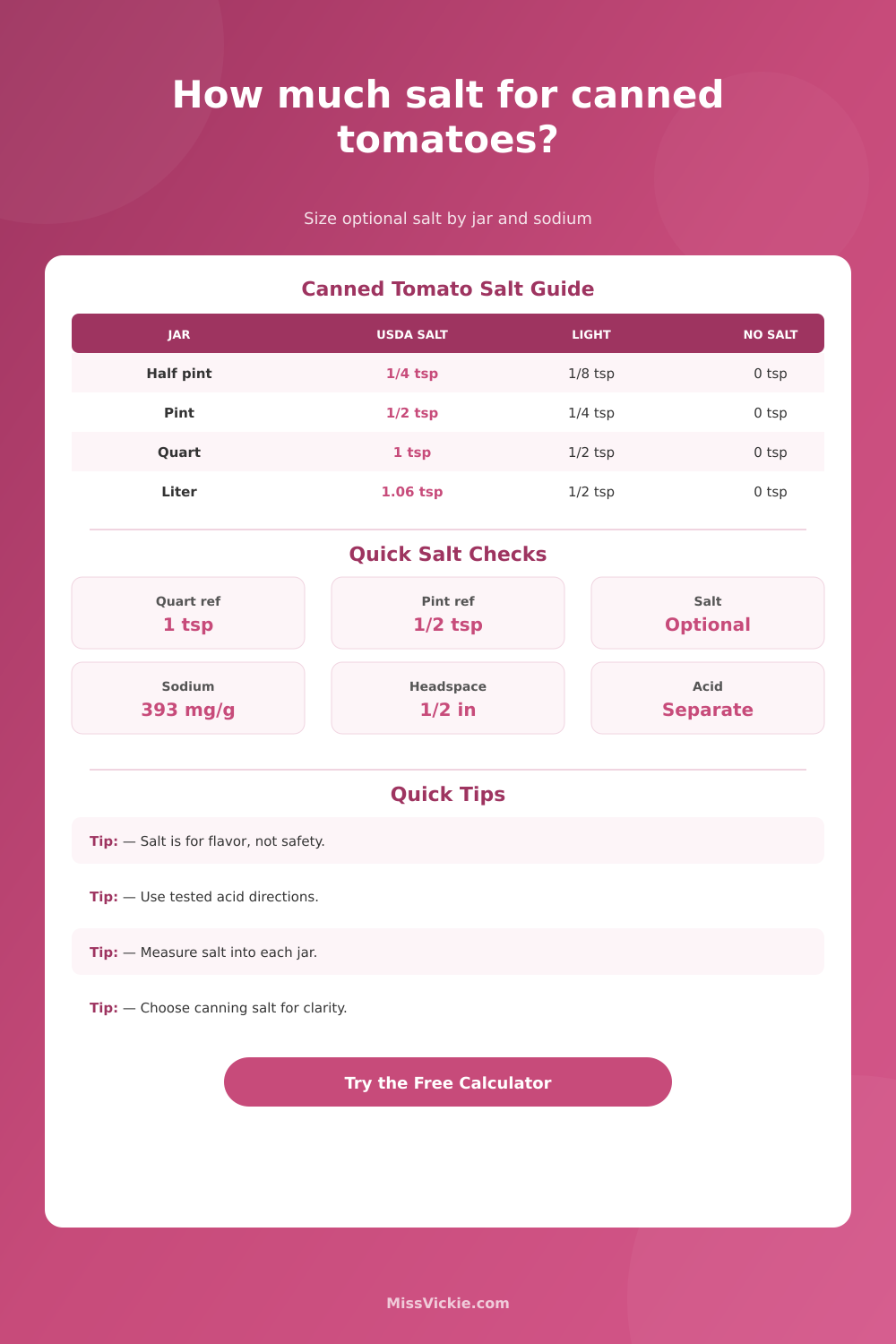
| Half-pint jar | 0.25 qt | 1/4 tsp | 1/8 tsp | About 590 mg per jar |
| Pint jar | 0.5 qt | 1/2 tsp | 1/4 tsp | About 1180 mg per jar |
| Pint-and-a-half jar | 0.75 qt | 3/4 tsp | 3/8 tsp | About 1770 mg per jar |
| Quart jar | 1 qt | 1 tsp | 1/2 tsp | About 2360 mg per jar |
| Metric liter jar | 1.057 qt | 1.06 tsp | 0.53 tsp | About 2495 mg per jar |
Reference salt follows the common home-canning direction of 1 teaspoon per quart or 1/2 teaspoon per pint, if desired. Salt does not replace acidification.
🍅Tomato Pack Style Reference
| Pack Style | Typical Headspace | Serving Estimate | Salt Note | Processing Reminder |
|---|---|---|---|---|
| Whole or halved in water | 1/2 inch | 4 servings per quart | Salt by jar capacity | Use tested water-bath or pressure table |
| Whole or halved in juice | 1/2 inch | 4 servings per quart | Same optional dose | Follow the juice-pack process |
| Raw pack, no added liquid | 1/2 inch | 4 servings per quart | Salt disperses after storage | Often has longer boiling-water time |
| Crushed tomatoes | 1/2 inch | 4 servings per quart | Stir salt in jar gently | Use crushed-tomato process |
| Tomato juice | 1/4 to 1/2 inch | 4 to 8 servings per quart | Sodium per cup can climb fast | Use tomato-juice process |
| Standard tomato sauce | 1/4 to 1/2 inch | 4 to 8 servings per quart | Low salt works well | Use tested sauce process |
📖Common Processing Table Reminder
| Tomato Product | Pint Water Bath | Quart Water Bath | Salt Direction | Important Safety Item |
|---|---|---|---|---|
| Whole or halved in water | 40 min | 45 min | Optional | Add acid as recipe directs |
| Whole or halved, own juice | 85 min | 85 min | Optional | Add acid as recipe directs |
| Crushed tomatoes | 35 min | 45 min | Optional | Add acid as recipe directs |
| Tomato juice | 35 min | 40 min | Optional | Add acid as recipe directs |
| Standard tomato sauce | 35 min | 40 min | Optional | Add acid as recipe directs |
Times shown are quick reference reminders for low-altitude boiling-water processing from tested home-canning style tables. Use the current recipe for exact pack, altitude, pressure, and acid instructions.
💡Salt Planning Tips
Adding salt is optional for canning tomatoes; no one says that it should of added. The acid in the tomatoes will keep the tomatoes safe. Salt only improves the flavor of the tomatoes.
Too much salt and food is inedible. Not enough salt and food is bland. This tool lets you measure just the right amount, it ensures you don’t make a mistake.
How to Use the Salt Calculator
Here’s the normal rule: a teaspoon of salt per quart of tomatoes. For most of us, it is fine. If you’re making whole tomatoes for roasting, use full amount. If you’re making crushed tomatoes for pasta sauce, you might want less. The tool lets you adjust that baseline immediately.
Enter the following information into the tool: number of jars, jar size, and how salty you want your tomatoes. It figure out the total quantity of salt required. It saves time. No more guesswork especially when your hands are hot and wet.
What kind of salt? Fine salt (like canning salt) works well. It dissolves fast. Keeps the liquid part of the jar clear. Same with table salt (but some types also have anti-caking things). Those might cloud the liquid. Flaky salt (such as kosher salt) is too big. A teaspoon of flakey salt weighs significantly less than a teaspoon of fine salt.
So if you are making a recipe that calls for a certain level of saltiness and you measure by volume rather than weight, then your tomatoes would be under-salted (if using flakey salt), because a teaspoon of flakey salt isn’t equal to a tsp. Of fine salt. This adjustment factor takes that into account for you. Select which salt you’re using and it will tell you the right weight.
That allows you to reduce how much sodium goes in there. Naturaly, tomatoes contain sodium. Using added salt bumps it up. If you are on a restricted diet, knowing the overall sodium content is important. How much added sodium is there? That’s what the tool reports by serving.
So it breaks down the added sodium versus the natural. That way, you will label your jars properly. Want a certain number of milligrams per serving? That’s fine. How much salt can I add and still stay within my goal? The tool informs you. It turns a health goal into a numeric goal.
It depends on how you pack the tomatoes. Crushed tomatoes are not whole tomatoes in water. Liquid to solid ratio is different than before. The amount of space in the jar can differ. Salt by quart remains a decent start. Serving size per jar could vary. More servings if tightly packed. Fewer servings if loosely packed.
Define what’s considered a serving. That tells you nutritional content. It shows you tradeoffs.
The altitude changes the canning. At over one thousand feet elevation, you will change your processing times. Adjustments is required in pressure cookers. Altitude does not alter the amount of salt needed. The tool reminds you of this. So it doesn’t mess up the salt calculation. But says you might want to alter the processing time. This avoids confusion. No, adding extra salt is not required based off altitude. You will just process the jar longer.
Others want to make things safer: they can tomatoes with no salt at all. It is safe. They are flat-flavored. Want some salt but not that much? How about a middle ground? The tool gives you reduction options: cut the salt in half (50%), quarter it (25%), or use a tenth (10%). That way you play around, but don’t risk anything.
It’s just a flavor thing. The acid balance isn’t affected.
Label those jars! For long-term storage, or to give some away, it’s nice to have labeled jars. The tool generates a print-out that gives a quick summary: how much of what kind of salt in each jar? How much sodium is in there? This would come in handy for managing food in your pantry, or for making gifts. Go back months later, open a jar, and see at a glance how many salty your tomatoes are.
Control is a thing in canning. It includes the temperature and the seal. And then there’s that last bit of salt. That makes it taste good. Canning isn’t about perfection. Canning is about being purposeful. How much salt are you going to add? How salty is your meal going to be? Add the salt. Then wait. Wait for the seal.