Salt Per Pound of Meat Calculator
Plan dry salting, equilibrium brines, and ground meat seasoning from actual meat weight, cut type, cooking method, salt density, bone-in trim, grind style, rest time, and sodium estimate.
🧂Meat salting presets
Choose a common salting scenario, then adjust the meat pounds, target salt percent, salt type, bone-in adjustment, brine water, and planned rest.
⚖Units
🥩Meat, cut, and cooking plan
🍴Salt type, target, and brine setup
Salt plan results
Meat salting breakdown
Enter a salting plan to compare the target percent, rest time, and cut style.
📌Quick salting cues
Good for fish, thin poultry, or a meal that also has salty sauce.
A balanced dry-salt starting point for steaks, chops, and chicken.
Works for roasts, sausage, smoked meat, or thick pieces needing depth.
Approximate sodium in one gram of pure sodium chloride salt.
📘Target salt percent by meat type
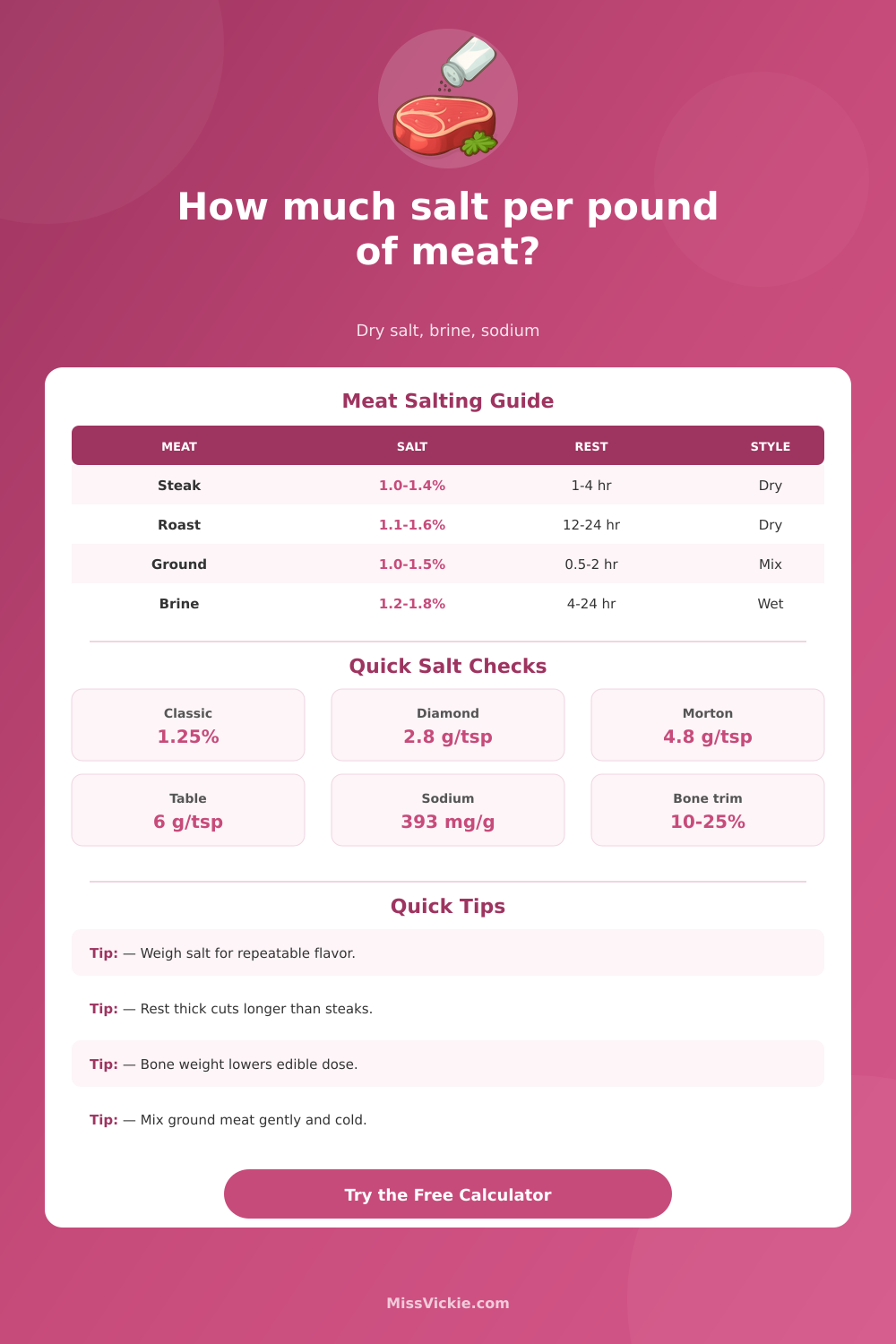
| Meat or cut | Typical target | Best style | Rest note |
|---|---|---|---|
| Steaks and boneless chops | 1.0% to 1.4% of edible meat | Dry surface salt | One to four hours for thin cuts; overnight for thick steaks. |
| Large roasts and brisket flats | 1.1% to 1.6% of trimmed meat | Equilibrium dry salt | Plan at least overnight so the center seasons more evenly. |
| Poultry pieces or turkey breast | 1.0% to 1.5% of edible meat | Dry salt or light brine | Bone-in pieces need a bone percentage adjustment. |
| Ground beef, burgers, meatballs | 1.0% to 1.5% of meat weight | Mix in just before shaping | Long salty rests make a tighter, springier texture. |
| Sausage-style bind | 1.5% to 2.0% of meat and fat | Mixed salt | Keep meat cold and mix until tacky if a bind is wanted. |
| Fish and seafood | 0.7% to 1.1% of edible meat | Short dry salt | Use a short rest because delicate fillets season quickly. |
🥄Salt density reference
| Salt type | Approx grams per teaspoon | Why it matters | Best use |
|---|---|---|---|
| Diamond Crystal kosher | 2.8 g per tsp | Large flakes take more spoon volume for the same grams. | Dry salting by hand; still weigh for precision. |
| Morton kosher | 4.8 g per tsp | Denser than Diamond, so spoon swaps can oversalt. | General cooking when the recipe names this brand. |
| Table salt | 6.0 g per tsp | Fine crystals pack tightly and taste saltier by volume. | Brines, fine seasoning, and gram-based measuring. |
| Fine sea salt | 5.7 g per tsp | Close to table salt but varies by brand and moisture. | Fast-dissolving dry salt or small batches. |
| Coarse sea salt | 4.0 g per tsp | Irregular crystals vary a lot from box to box. | Finishing or weighed meat salting. |
| Pickling salt | 5.9 g per tsp | Fine and additive-free, so it dissolves cleanly. | Clear brines and equilibrium wet salting. |
⏱Rest time and cooking method guide
| Plan | Short rest | Long rest | Calculator adjustment |
|---|---|---|---|
| Dry-salted steak | 45 minutes to 4 hours | Up to overnight for thick cuts | Thickness drives the recommended rest range. |
| Roast or brisket | 6 to 12 hours | 18 to 36 hours | Large cuts get a longer diffusion window. |
| Equilibrium brine | 2 to 8 hours | 12 to 24 hours | Water weight is included in the salt-to-add result. |
| Ground meat | 15 to 60 minutes | Two hours for a firmer bind | Mixed salt is treated as fully distributed. |
| Fish fillets | 10 to 30 minutes | One hour for thick fillets | The balance score warns when the rest is long. |
📊Sodium estimate reference
Approximate sodium in a 150 g cooked serving at one percent retained salt.
Typical sodium for a seasoned 150 g serving before salty sauces.
A stronger seasoning level for roasts, smoked meats, and sausage mixes.
Common in sausage-style mixes, but high for everyday whole cuts.
✅Practical meat salting notes
Dry salt: Sprinkle from high up, cover all sides, and rest uncovered if you want a drier surface for browning.
Brine math: In equilibrium brines, include both meat and water weight so the brine cannot oversalt the meat.
Bone-in cuts: Estimate bone and heavy trim before salting so edible meat receives the intended percent.
Ground meat: Salt close to cooking for tender burgers, or rest longer only when a sausage-like bind is desired.
Small kitchen decisions make a big difference in final dish. Do you get your meat all salted up? Too much salt can cause it to dry out or tighten its texture before you brown it; not enough can leave it bland and flat. Is there such a thing as not knowing if you should add salt? Not really. It’s more: How much and when do you add the salt before beginning the cook?
The trick with salt is knowing how much to use based off what part of the food you actualy eat. If there’s no bone, no heavy trim, then all that seasoning has to be accounted for in the final total. If there’s bone, some of that seasoning is going to land on a part of the animal that will never see your fork. That’s why you need a calculator that know the total weight and adjusts for the bone. This keeps everything focused on meat you’ll actually be eating. Without that, things gets wonky and unevenly flavored.
How to Salt Your Meat Correctly
The weight matter, but so do thickness and cut type. If it’s a thin steak, the salt doesn’t have far to go; it’ll be seasoned through in an hour or two. For something thicker (a bone-in chicken piece or roast), you’ll need to leave it longer maybe overnight, for that same concentration to reach the center. Those two factors, along with your planned cooking method… Help determine the recommended rest window.
High-heat searing loses more moisture then a long, low-heat session. Because of this, each method cause some of the salt you sprinkled on to dissipates. As few people realize, the nature of the salt alters the spoon math even further. A teaspoon of Diamond Crystal flakes isn’t equivalent to a teaspoon of table salt (Diamond Crystal occupy more volume per gram). Instead of guessing about how much salt to add if you’re suddenly out of your preferred brand and can only find a substitute, the calculator use the density of the salt you picked to convert your chosen percentage into both grams and an estimated number of teaspoons.
There’s one more wrinkle to the brine calculations: The water in the brine adds to the salt base. An equilibrium brine measure the salt content by its percentage of total weight (including liquid), rather than just that of the meat itself. This maintain the concentration regardless of how long you let the meat sit in the solution. To avoid overdosing a wet cure, a common error, the tool lets you treat the water weight as optional, adding it only if you select this brine style.
Different story with ground meat: When it’s ground, any salt you mix into it distributes nearly instantly, reducing the required rest time from hours to minutes. Selecting something that will be cooked as a sausage or burger cause the calculator to reduce the suggested waiting period to match, because in practice, seasoning a whole roast is different than seasoning burgers.
The sodium figures are last because they are calculated from retained amounts instead of what was originally weighed on the scale. These figures capture the loss in yield due to cooking. They also capture amount of salt that gets rinsed away or drip-dried off during preparation. Those losses reduce the starting amount of salt to the amount remaining in the final dish. Then, using guesses about retention rates, the numbers changes the final estimate for you to see if the food will be properly seasoned when served.
But what makes a salting plan truly useful is that you can repeat it. Whether you’re cooking for twenty or just four, if you’ve got the right salt density, the right percentage, the correct amount of expected rest and the right weight of the thing you’re going to eat, the same cut will come out every time, whatever else might be changing about the rest of your meal. The seasoning landed exactly where you wanted it to. You should of checked the weight first.