Salt Per Gallon of Water for Turkey Brine Calculator
Calculate wet turkey brine salt from gallons of water, salt brand and grain density, target salinity, turkey weight, brine hours, sugar, aromatics, pre-salted bird status, container displacement, and chilling method.
Choose a real wet-brine setup, then adjust gallons, target percent, salt type, turkey size, time, sugar, container space, and chill plan.
Your Wet Brine Salt Plan
Salt is calculated from water weight, then translated into cups for the selected salt grain.
Salt And Water Breakdown
Turkey, Container, And Safety
| Salt type | Approx grams per cup | 5 percent per gallon | Best use |
|---|---|---|---|
| Diamond Crystal kosher | 135 g | 1.4 cups | Flaky, easy to dissolve, very light by volume |
| Morton kosher | 240 g | 0.79 cup | Denser kosher salt with smaller crystals |
| Fine table salt | 288 g | 0.66 cup | Use less by cup because grains pack tightly |
| Fine sea salt | 270 g | 0.70 cup | Clean flavor and quick dissolving |
| Coarse sea salt | 220 g | 0.86 cup | Dissolve fully before adding turkey |
| Pickling salt | 280 g | 0.68 cup | No anti-caking agents, clear brines |
Cup weights are practical kitchen approximations. For repeatable salinity, weigh the salt in grams.
| Turkey item | Typical weight | Wet brine time | Brine strength |
|---|---|---|---|
| Bone-in turkey breast | 4 to 7 lb | 4 to 8 hr | 3.5 to 5 percent |
| Small whole turkey | 8 to 12 lb | 8 to 12 hr | 4 to 5 percent |
| Holiday whole turkey | 12 to 16 lb | 12 to 18 hr | 4.5 to 5.5 percent |
| Large whole turkey | 17 to 22 lb | 14 to 20 hr | 4 to 5 percent |
| Spatchcock turkey | 10 to 16 lb | 6 to 12 hr | 4 to 5 percent |
| Enhanced or kosher bird | Any size | 4 to 8 hr | 2.5 to 3.5 percent |
| Target percent | Salt per gallon | Flavor level | When to use |
|---|---|---|---|
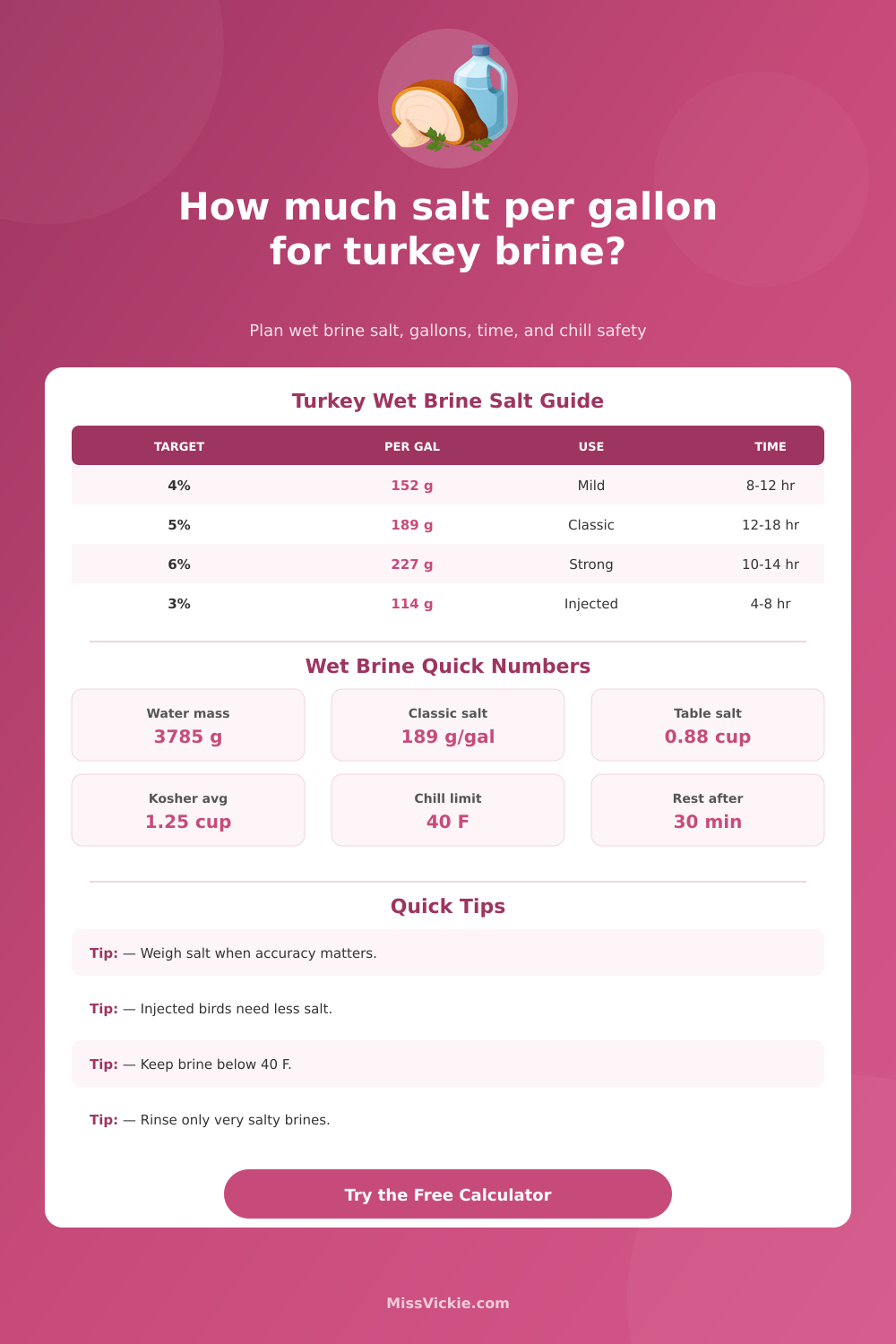
| 2.5 percent | 95 g | Very mild | Injected, kosher, or already seasoned birds |
| 3 percent | 114 g | Mild | Short soak when the turkey label lists sodium solution |
| 4 percent | 152 g | Balanced | Longer wet brines or smaller birds |
| 5 percent | 189 g | Classic | Plain whole turkey with 8 to 18 hours of brining |
| 6 percent | 227 g | Assertive | Short brines, smoking, or large cold-water batches |
| 7 percent | 265 g | Strong | Use only with shorter timing and careful seasoning |
| Method | Capacity note | Temperature check | Calculator warning |
|---|---|---|---|
| Refrigerator bucket | Leave 1 inch headspace | Below 40 F | Best controlled option |
| Brining bag in pot | Less water may cover bird | Below 40 F | Check for leaks and support the bag |
| Ice-packed cooler | Add space for ice packs | Probe brine often | Keep ice replenished |
| Cold porch or garage | Weather can swing fast | Use thermometer | Risky unless temp is stable |
Use the full calculated salt amount when the label does not list added solution.
Reduce salt because broth or sodium solution is already inside the meat.
Use a milder soak since kosher processing seasons the bird before packaging.
Dry brines calculate salt per pound of turkey, not per gallon of water.
The beginning of most all Turkey Day catastrophes is a hunch. Fill a bucket, fill it with water, throw some salt from bag, cross fingers and hope it works out. But hope doesn’t work by osmosis. For moist turkey you’ve got to know how much salt per gallon are needed. And no, that’s not brining the thing. It’s about reaching a certin amount of salt so the proteins relaxes and take on moisture without leaking out while cooking.
Plug in your volume and salt (above) and let the calculator do the math for you. Save yourself from guessing whether Diamond Crystal‘s different then Morton, or table salt.
Why You Need a Brining Calculator
Volume density (a.k.a. “the salt has air pockets”): Salt crystals pack differently depending on their size and shape; a cup of coarse sea salt will be lighter than a cup of flaky kosher salt even though they weigh the same amount. Unless your recipe specifies the kind, this can lead to under- or over-salting: a weak brine won’t do its job, while a brine so salty it’ll keep the turkey till next winter won’t either. Cups don’t cut it, by weight, different salts needs different amounts. Selecting your exact salt from a list lets the device account for that variation. This makes sure the weight percentage remains correct no matter whether your crystals is packed like sardines or as airy as cotton balls. It also removes the variable that causes most peoples at-home efforts to go wrong.
Then there’s the bird itself. Not all turkeys shows up on your kitchen door the same way. Some are already injected with a sodium phosphate solution into their muscle. Some are kosher, meaning they was soaked in brine during processing. If you treat one of those birds as plain meat, you’re going to end up over-salting it big-time. So the calculator takes that into account and reduces the percentage of salt you’ll need if you choose a kosher or enhanced turkey. That way, you don’t accidentally double-brine something that was already treated with seasoning.
Flavor! That’s what you want to add, not cure the thing into jerky. Timing also matters and is directly related to strength. Higher salt concentration mean quicker penetration, but you risk over-salting the meat unless you only leave it for a short time. On the other hand, lower concentration means you must wait longer until the brine has penetrated all the way through to the deepest muscle fibers. The chart on the page spells it out: Four percent is gentle, safe for overnight, but 6 percent is aggressive, intended for shorter soaks. Choose what works best for your timetable. Keep in mind the bird’s size, as a big turkey will require longer to get the brine to penetrate through the center breast flesh compared with a smaller bird.
There are no exceptions for temperature. Submerging raw poultry in liquid (wet brine) offer perfect conditions for bacterial growth, if the temperature rises. And the system will flag any cooling method that fails to maintain a consistent reading under forty degrees Fahrenheit. Ice-filled coolers is good, if you monitor them and top up ice… But so is a chilly garage provided it’s really cold all night. It ain’t food safety 101; it’s food safety 1A, a must for any brining effort.
Salt is one thing; sugar another. Sugar doesn’t alter the osmotic pressure that much, but it balances and browns. Don’t fret if your brine has some sweetener like brown sugar, apple cider, or even citrus peel, it will improve the overall flavor of the salty profile without disrupting the chemisty. The calculator provides spaces for all of those flavorings so you can map out the entire pot, not just the salt.
One last thing: If your brine tastes too salty as it drains out onto the bird, give it another quick rinse. Then pat the bird completely dry before roasting. Wet skin steams rather than crisps. Even with a perfectly moist interior, you’ll end up with a pale and soggy turkey for all your hard work.
It’s about balance. It should be seasoned but still holding juice, not swollen and salted like an ancient artifact. Nip things in the bud, cool ’em down, and rely on physics to do the rest. Your dinner company won’t know what happened, but they’ll tell you it’s different. You could of used better salt, but they won’t care.