Salt by gallon, quart, and salinity percent
Salt Per Gallon for Brine Calculator
Calculate salt per gallon or quart for immersion brines, equilibrium brines, pickle brines, and injection liquid. Choose salt type, target salinity, food weight, sugar, time, temperature, and serving count to estimate both the brine mix and sodium pickup.
Each preset loads a realistic gallon or quart brine with salt type, salinity, food weight, immersion or injection mode, sugar, brine time, and chilling temperature.
Your brine mix is ready.
Salt weight, spoon equivalents, sugar, time, temperature, and sodium estimate update here.
Brine Breakdown
| Salt type | Approx g per tsp | 5% per gallon | Best brine use |
|---|---|---|---|
| Fine table salt | 6.0 g | 31.5 tsp / 10.5 tbsp | Works by weight; easy to oversalt by spoon |
| Pickling salt | 6.0 g | 31.5 tsp / 10.5 tbsp | Clear pickle and vegetable brines |
| Fine sea salt | 5.7 g | 33.2 tsp / 11.1 tbsp | General kitchen brines |
| Morton kosher salt | 4.8 g | 39.4 tsp / 13.1 tbsp | Meat brines when brand is known |
| Coarse sea salt | 4.5 g | 42.1 tsp / 14.0 tbsp | Large crystals; dissolve completely |
| Diamond Crystal kosher | 2.8 g | 67.6 tsp / 22.5 tbsp | Light crystals; safest by weight |
| Food or brine style | Typical salinity | Usual time | Temperature target |
|---|---|---|---|
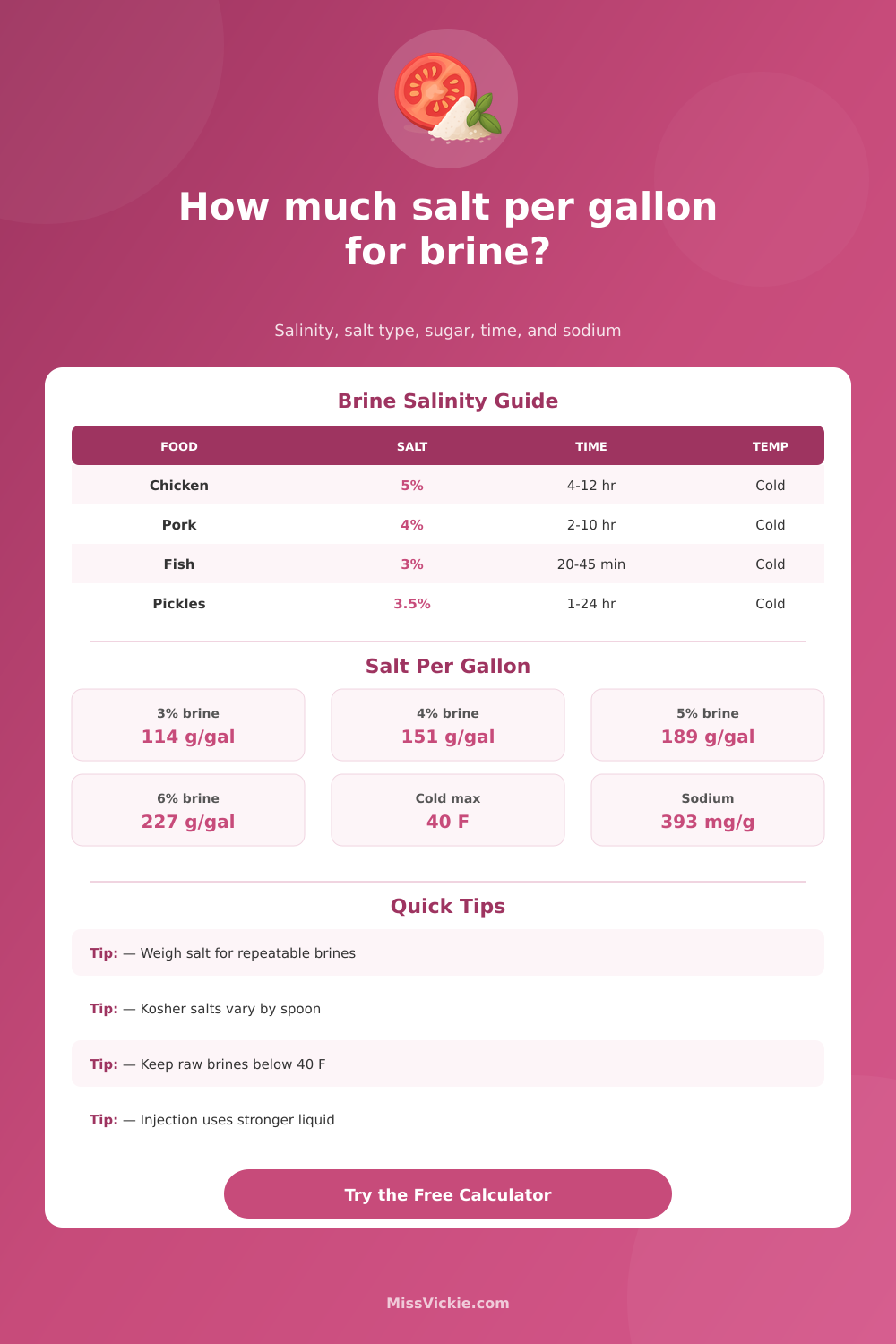
| Chicken pieces | 4.5% to 6% | 4 to 12 hours | 34°F to 40°F |
| Turkey breast or whole poultry | 5% to 6% | 8 to 24 hours | 34°F to 40°F |
| Pork chops or loin | 3.5% to 5% | 2 to 10 hours | 34°F to 40°F |
| Fish and seafood | 2.5% to 4% | 15 to 60 minutes | 32°F to 38°F |
| Vegetables and quick pickles | 2% to 5% | 1 to 24 hours | Cold unless fermenting |
| Injection liquid | 4% to 8% | Injected before resting | Keep chilled |
Best for simple gallon or quart brines where extra liquid surrounds the food.
Uses water plus food weight so the finished food is harder to oversalt.
Good for cucumbers, onions, and quick refrigerator vegetables.
Counts retained liquid, so sodium estimate depends on injection pickup.
Brining is one of those rituals: salt + water + faith. Guess at the ratio. Throw bird in bag and see what happens. Here’s what doesn’t happen: Food isn’t cured by magic. It’s cured by concentration. Because brining is a chemical reaction, chemistry acting like hospitality, it require precision, not intuition. If you get that salt per gallon correct, you’re affecting water movement between protein fiber; this is why a brined roast emerge juicy, while a roast without brine are dry. You’re doing more than flavoring the skin. You’re changing meat from within.
To eliminate the guesswork, we built calculator (above) which does all the math for you. It even converts everything, so you don’t have to think about it, just the food. Most importantly, you’ll input your brand/type of salt. Why? Because a tablespoon of flaky kosher sea salt isn’t as heavy than a tablespoon of fine table salt. It sounds like nothing until you try it. But if you switch brands without changing amount, you could end up with a brine so strong that it preserves your kitchen countertop rather then flavoring your pork chops. To make things totally easy, just weigh your salt. But if you’re spooning it out, the tool accounts for different densities (Diamond Crystal is airy, while Morton’s is dense). This tiny detail save a batch.
How to Brine Meat Correctly
That’s when folks start worrying about salinity percentage. Five percent sounds aggressive as hell for a brine, but it’s really pretty normal for poultry. You’ll use the calculator to match your time with your strength. For example, dense items like a whole chicken or turkey breast can absorbs more brine because they has more mass to soak, unlike delicate item such as shrimp or fish fillets, which require much less brine and shorter soaking times. Why? If you overbrine fish it will turn to rubber; proteins constrict too fast from the high pressure of salty solution. The reference table on this page makes all of this clear by laying out safe zones for you. For instance, you may pickle something super fast at three percent, but using a dry rub to reach brine balance for your pork are a completely different process. Knowing what lane you’re playing on means avoiding culinary disaster.
The next thing is temperature, which most recipes acknowledge about as much as they do love. Your brine should be cold. If possible, keep it under forty degrees Fahrenheit. That’s cool enough to prevent any bacteria from taking hold while they work with the salt. This prevents them from turning your yummy supper into something that might make you sick. Cold water will also take longer to dissolve the salt, make sure you have plenty of time to stir thoroughy till it’s gone, then add whatever else to the liquid you’re going to marinate in. Sugar is optional, but nice. It rounds out the aggressive salt bite, and helps things brown up nicely once you bring out grilling tongs or roasting pan. With this tool, you can adjust the sugar and salt to be as sweet or savory as you like (though I’d recommend keeping those ratios in mind if you’re cooking pork shoulder or ham).
For bigger cuts, equilibrium brining is a game changer. Here’s why: You don’t measure the amount of salt you use relative to the amount of water; rather, you weigh the salt based off the combined weight of meat and water. That way, mathematically speaking, the salt has nowhere else to go once it reaches equilibrium with the meat. No matter how long you leave it in, there’s no excess salt in there. It just won’t absorbs any more. Time no longer matters, and the power is placed back into your hands.
But then there’s injection. That’s another animal altogether. Rather than working from the exterior of the muscle fibers by letting the brine spread slowely over time, you’re forcing it in, and that takes more forceful solutions. Because it isn’t relying on gradual diffusion, the amount of water retained within the meat has an impact on the calculator’s estimate of sodium. It’s a nice tool if you’re watching your intake but don’t want to whip out your nutritional app to count calories.
The thing about brines: They reward focus. With simple physics, they transform ordinary ingredients into something extraordinary. Do things right (measure your salt, check the clock, keep it cold) and let science take care of the hard work. It should of been worth it.