🐟 Protein in Salmon Calculator
Calculate exact protein grams in any salmon serving — by weight, fillet size, or serving type
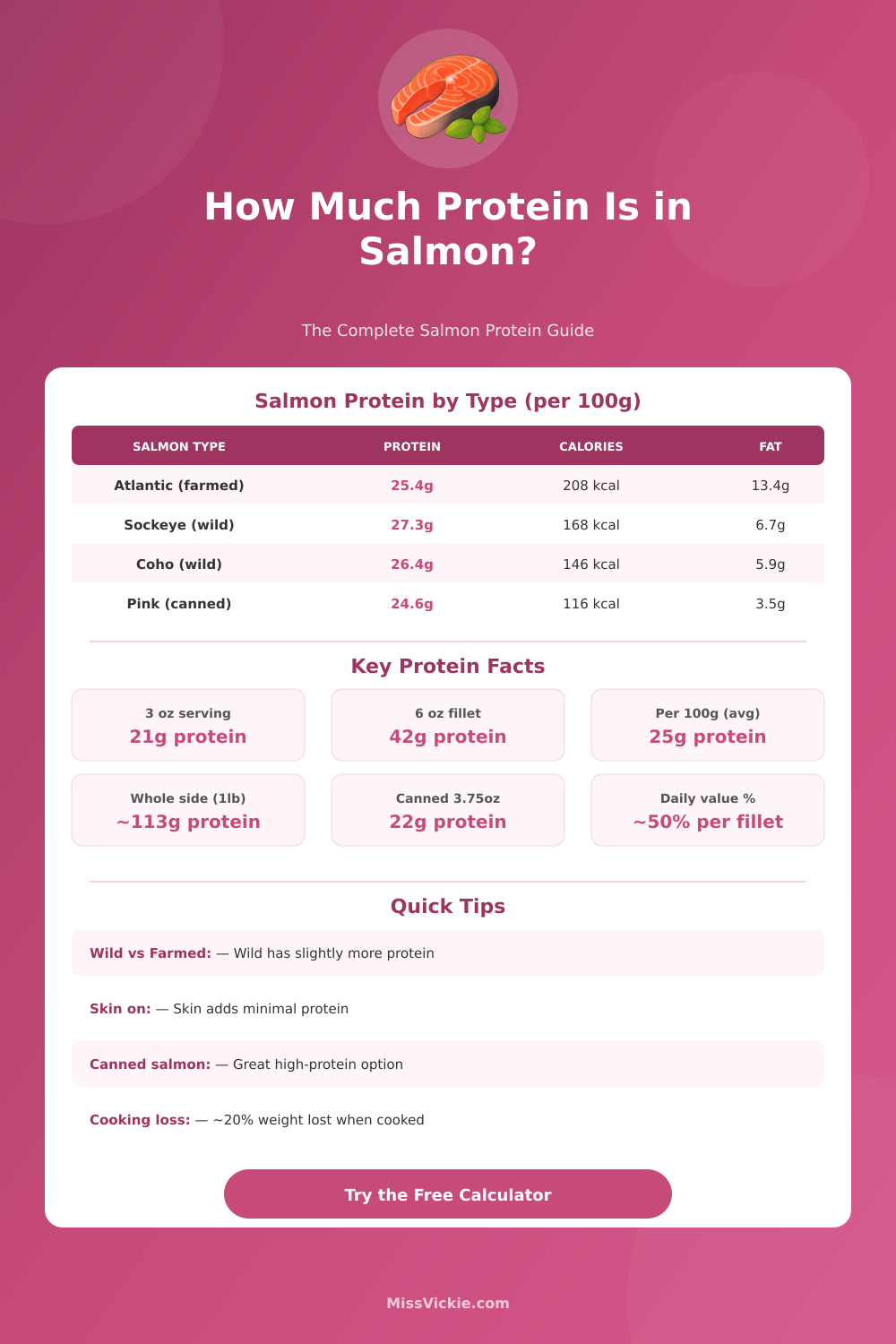
| Salmon Type | Protein (g) | Calories | Total Fat (g) | Omega-3 (g) |
|---|---|---|---|---|
| Atlantic (Farmed) | 25.4 | 208 | 13.4 | 2.30 |
| Atlantic (Wild) | 25.7 | 182 | 10.0 | 1.72 |
| Sockeye (Wild) | 27.3 | 168 | 6.7 | 1.33 |
| Coho (Wild) | 26.4 | 146 | 5.9 | 1.19 |
| Chinook / King (Wild) | 24.3 | 231 | 15.2 | 2.75 |
| Pink (Fresh) | 23.4 | 127 | 3.8 | 1.09 |
| Pink (Canned in Water) | 24.6 | 116 | 3.5 | 0.98 |
| Chum (Keta) | 25.7 | 120 | 3.8 | 0.79 |
| Smoked Salmon | 22.5 | 117 | 4.3 | 0.90 |
| Gravlax / Lox | 18.3 | 117 | 4.0 | 0.80 |
| Serving Size | Weight | Protein (Atlantic) | Protein (Sockeye) |
|---|---|---|---|
| Small portion | 85g / 3 oz | 21.6g | 23.2g |
| Standard fillet | 140g / 5 oz | 35.6g | 38.2g |
| Large fillet | 170g / 6 oz | 43.2g | 46.4g |
| Extra large fillet | 227g / 8 oz | 57.7g | 62.0g |
| Half pound | 227g / 8 oz | 57.7g | 62.0g |
| 1 lb side | 454g / 16 oz | 115.3g | 124.0g |
| Canned (small can) | 106g / 3.75 oz | 22.3g | 26.1g |
| Sushi slice (1 piece) | 30g / 1 oz | 7.6g | 8.2g |
| Person / Goal | Daily Protein Need | Covered by 6oz Fillet | Servings to Meet Goal |
|---|---|---|---|
| Sedentary adult (150 lb) | 54g | 80% | ~1.3 fillets |
| Active adult (150 lb) | 82g | 53% | ~2 fillets |
| Athlete (180 lb) | 130g+ | 33% | ~3 fillets |
| General RDA (0.36g/lb) | 55–65g | 66–79% | ~1.5 fillets |
| High-protein diet (0.7g/lb) | 100–140g | 31–43% | ~2.5–3 fillets |
Salmon belongs to the family of Salmonidae and it falls under the genera Salmon and Oncorhynchus. This fish comes from the rivers that flow in the North Atlantic and North Pacific basins. In the same family find themselves also trout, whitefish, grayling and charr.
The Pacific Salmon owns a difficult life cycle that stores periods in freshwater and in saltwater. It exists in little freshwater flows and rivers, later migrates to coastal estuaries and ultimately in the ocean.
Salmon: Types, Health Benefits and Cooking Tips
Both captive Salmon and organically raised Salmon can be good options. Organic farming affects more positively the quality of the fish than regular farming. Organic Salmon must be kept in deeper waters with more intense flows.
Wild Pacific Salmon usually has lower levels of pollution and a thinner nutritional profile. Farmed Atlantic Salmon commonly carries more fat and can have more pollution, but it also is rich in omega-3 acids. Atlantic Salmon has around 13 percent of fat, while pink Salmon have only about 5 percent.
If one eats Salmon two or three times a week, that can help protect against diseases like heart attack, stroke, heartbeat issues, high blood pressure and high triglycerides. Fat fish like Salmon, mackerel, sardines and anchovies all are rich in omega-3 fatty acids. One pound of Salmon gives around 1.5 grams of those omega-3 acids, that matter for heart health, brain activity and lowering of inflammation.
Salmon delivers prime Protein, that one can harvest and grow in a lasting mode.
The standard portion of cooked Salmon is around 3 to 4 ounces. Some parts go to six ounces for one person or even eight ounces for those with big appetite or for planned leftovers. One pound of Salmon is enough for four people.
Buying whole Salmon has more sense than buying cuts, because it lasts more long because of less handling and less air contact. Frozen Salmon indeed beats fresh in some ways. When one freezes Salmon just after capture, it preserves its nutrients and stays almost that fresh.
Even Salmon of same species can have different taste according too the place of origin. Not always cheap Salmon means lower quality.
The mode of cooking is very important. Popular methods are grilling, air frying, cooking in a pan, starting in a cold pan, roasting on a rack and baking. The main target is crisp skin with moist, soft meat.
If one lays spices before cooking, they enter during the process. The biggest mistake is overdoing. The fish is ready when pushing with a fork the flakes divide, but stay together.
Unlike trout, the bones of Salmon are big and easily removed by running fingers over the cut and pulling with tweezers. A simple recipe can prepare in only tenminutes in the oven, giving tasty and soft results.