MissVickie salmon marinade math
Salmon Marinating Time Calculator
Estimate a salmon marinade window from fillet thickness, acid, soy or salt, oil, sugar, refrigerator temperature, texture goal, and your latest safe start time.
🎛Salmon Presets
Choose a real salmon scenario, then adjust thickness, acidity, sugar, fridge temperature, and your max marinating window.
⚖Salmon And Marinade Inputs
Marinade plan for salmon
Adjust the inputs and calculate.
Salmon Factors
Marinade Factors
Timing Notes
📌Salmon Marinade Timing Grid
Use for tail pieces, cubes, and high-acid citrus contact.
Best for lemon herb, garlic, dill, and balanced oil marinades.
Works for soy ginger, miso, teriyaki, and skin-on grilling.
Reserve longer timing for low-acid, low-salt oil-based marinades.
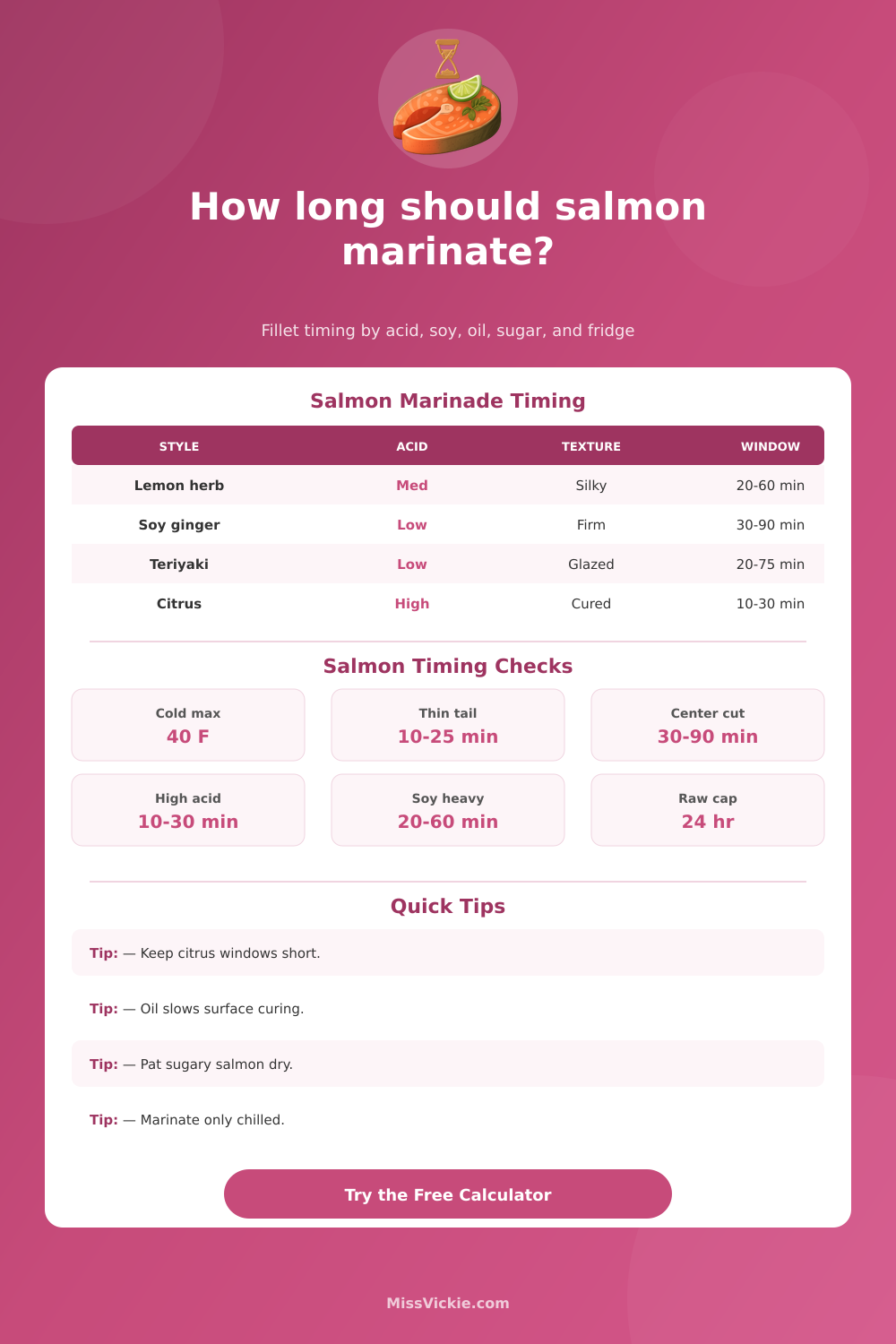
These are quality windows, not room-temperature holding times. The calculator narrows them for acid, salt, sugar, thickness, and fridge temperature.
📊Reference Tables
| Salmon Shape | Typical Thickness | Low Acid Window | Medium Acid Window | High Acid Window |
|---|---|---|---|---|
| Thin tail fillet | 0.4-0.75 in / 1-1.9 cm | 20-45 min | 15-30 min | 10-20 min |
| Center-cut portion | 0.9-1.25 in / 2.3-3.2 cm | 30-90 min | 20-60 min | 10-30 min |
| Thick center fillet | 1.3-1.8 in / 3.3-4.6 cm | 45-120 min | 30-75 min | 15-35 min |
| Whole side | varied thickness | 45-150 min | 30-90 min | 15-40 min |
| Cubes or skewers | 0.75-1 in / 1.9-2.5 cm | 15-45 min | 10-30 min | 8-20 min |
| Marinade Lever | What It Does To Salmon | Calculator Effect | Kitchen Cue |
|---|---|---|---|
| Acid | Denatures surface protein and firms edges | Shortens both ideal window and quality cap | Edges turn opaque before the center flavors deeply. |
| Soy or salt | Draws moisture and seasons quickly | Heavy soy narrows the max window | Surface feels tacky or firmer when ready. |
| Oil | Buffers acid contact and carries aromatics | Lengthens gentle marinades slightly | Good for dill, garlic, chile, and herbs. |
| Sugar | Encourages browning but can scorch | Adds drying time and trims high-heat windows | Pat dry before grill, broil, or air fryer. |
| Fridge warmth | Reduces safe refrigerated holding margin | Caps timing sharply above 40°F | Chill first if the fridge is running warm. |
| Fridge Reading | Calculator Status | Raw Salmon Cap | What To Do |
|---|---|---|---|
| 34-38°F / 1-3°C | Cold fridge | Up to 24 hr, quality permitting | Use the calculated window; long marinades still need low acid. |
| 39-40°F / 4°C | Safe cold edge | Up to 18 hr, quality permitting | Keep the bowl on a low shelf and cook as planned. |
| 41-42°F / 5-6°C | Borderline | 2 hr cap | Use only short marinades and cook soon. |
| Above 42°F / 6°C | Chill first | No long raw rest | Move salmon colder before starting the marinade. |
| Cooking Plan | Drain / Dry Time | Sugar Caution | Best Marinade Style |
|---|---|---|---|
| Pan sear | 8-15 min | Keep sweet glaze light until the end | Soy ginger, lemon herb, miso oil |
| Oven bake | 5-10 min | Medium sugar is fine on foil or parchment | Dill yogurt, maple mustard, herb oil |
| Grill | 15-25 min | Sticky glazes can burn on grates | Skin-on soy, garlic herb, citrus oil |
| Air fryer | 10-18 min | Use glaze late for cleaner browning | Teriyaki, sweet chili, light miso |
| No-cook cured service | Drain well | Use very fresh fish and cold handling | Citrus, soy-sesame, light cure |
🧪Comparison Grid
Best for thin fillets, citrus, poke-style cubes, or any marinade where salmon should still taste bright and fresh.
Good all-purpose target for center portions with oil, herbs, garlic, low-to-medium acid, and moderate soy.
Works for thicker skin-on salmon when acid is low, oil is present, and the surface will be dried before heat.
High acid, heavy soy, warm fridge readings, and sugary cures can push salmon past its best texture quickly.
💡Salmon Marinade Tips
Salmon is forgiving in many ways, but it’s unforgiving when it comes to acid. While you can cover up damage of an overcooked piece of fish by smothering it in some rich sauce, you’ll never be able to un-do the effect of a fillet reduced to chalky nothingness by letting it soak for two hours in lemon juice. It immediately change the texture, and not for better. It’s permanent.
Recipe isn’t as important as timing. Marinade seem like a fixed ingredient list in most home cooking, but it’s really a series of chemical reactions occurring on surface of the protein. Plug in your fridge temp and your fillet thickness into calculator above, and let it do the math for you. This spares you from ever having to guess again how much citric acid your particular cut can handles without losing its silky form.
How to Marinate Salmon Safely and Perfectly
But there’s one central variable: acidity. Like heat, lemon juice, vinegar, and even the zest of citrus fruits denatures protein. That’s why if you marinate fish in something very acidic, the outer edges becomes firm quickly. Go too far, and that firmness spreads inward, transforming the fish into mushiness more like ceviche then dinner. This is especially true for thin tail fillets if you like to make poke or any other recipe that call for cutting fish into cubes. These fillet have more surface area compared to their size, which makes them soak up flavor quickly but also break down quickly.
To account for this, the tool narrows the window quite dramatically for thinner cuts. You don’t want to treat a half-inch-thick tail fillet the same way as you would thick center-cut portion.
But salt is different, yet similar. Brines, miso and soy sauces will pull water from fish via osmosis. Not only does it intensifies the flavor, but it transforms the texture. When done too long with heavy-soy marinades, it becomes tacky on surface. For that reason, the calculator reduces the safe window based off salt content. It challenges you to find that perfect balance between seasoning and keeping the texture. Dry out the salmon, and it’s no longer salmon; season it well.
Here’s where oil comes into play. A dose of neutral oil (or even olive) delays direct contact between fish meat/skin and acids. That provides some extra time, so that while herbs and aromatics flavor the dish, they don’t aggressively cure surface.
Refrigerator temperature is the quiet assassin of best-laid plans. Never marinade raw fish at room temperature. Between 40 and 140 degrees F., bacteria will multiply. But in a warm fridge (closer to forty-five than thirty-eight degrees), that’s not much time for flavor development, just enough time to protect against pathogens. If you enter a warmer temp into the calculator, it’ll cut off the time limit pretty hard. No flavor enhancement is worth hospital visit. And since no amount of teriyaki glaze is worth a trip to the doctor, always place the bowl on the lowest shelf, the coldest spot in the appliance. Also be sure to use tight-fitting lid to block odors and stop bacterial spread.
There is another wrinkle: sugar. And that’s only if you’re going to grill or sear, which it sounds like you might of doing? Brown sugar, maple syrup, honey, those all caramelize fast over high heat. What happens when a sugared-up salmon meets the grill? You guessed it: Burnt on exterior, raw in middle. That is why you need a dry surface. When you pat the salmon dry (after marinating, of course), you get rid of any lingering moisture, enabling it to brown well. You’ll also halt the curing action right there.
Depending on how you cook your fish, the calculator assumes how long it should drain, too. For example, something baked need a less dry surface than something being pan-seared. Air fryers can be extra sensitive to wet sugars. Instead of letting the salmon marinate in a sugary glaze for hours, brush it on at the very end of cook time.
So how do you know when the salmon’s ready? Any good cook knows you should use your eyes and your nose as much as the timer. And keep in mind that all this is about managing risk. It’s about figuring out the right balance between food safety limits, textural degradation, and flavor penetration. The science-based tool gives you a place to start from, but then it’s up to you.
Does it smell off? Toss it. Do the edges look opaque? Done. Are there slime spots on surface? Toss it again. Go by your own taste. Don’t be afraid to push things past what the timer says. Remember to rely on coldness. With a little experimentation (and following the guidelines above) you’ll know when to stop. A good marinated salmon let the fish speak for itself by highlighting its natural sweetness without hiding it. So it doesn’t make the dish different; it makes it better.