Salmon Fillet Cooking Time Air Fryer Calculator
Estimate air fryer salmon time from fillet thickness, fryer temperature, basket load, skin, glaze, preheat, frozen or chilled start, and your target doneness.
🐟 Salmon Air Fryer Presets
Choose a salmon scenario, then fine-tune the inputs for your fillet thickness, basket, glaze timing, and preferred internal temperature.
⚖ Fillet And Air Fryer Inputs
Air fryer salmon timing
Your timing will appear here after calculation.
Calculation Breakdown
Air Fryer Schedule
🌡 Salmon Timing Snapshot
Reference note: U.S. food safety guidance lists fish and shellfish at 145°F / 63°C, while lower salmon doneness targets are texture preferences that require fresh fish and personal risk judgment.
📋 Air Fryer Salmon Reference Tables
| Fillet Thickness | Fresh Time At 400°F | Fresh Time At 380°F | Frozen Raw Time | Thermometer Cue |
|---|---|---|---|---|
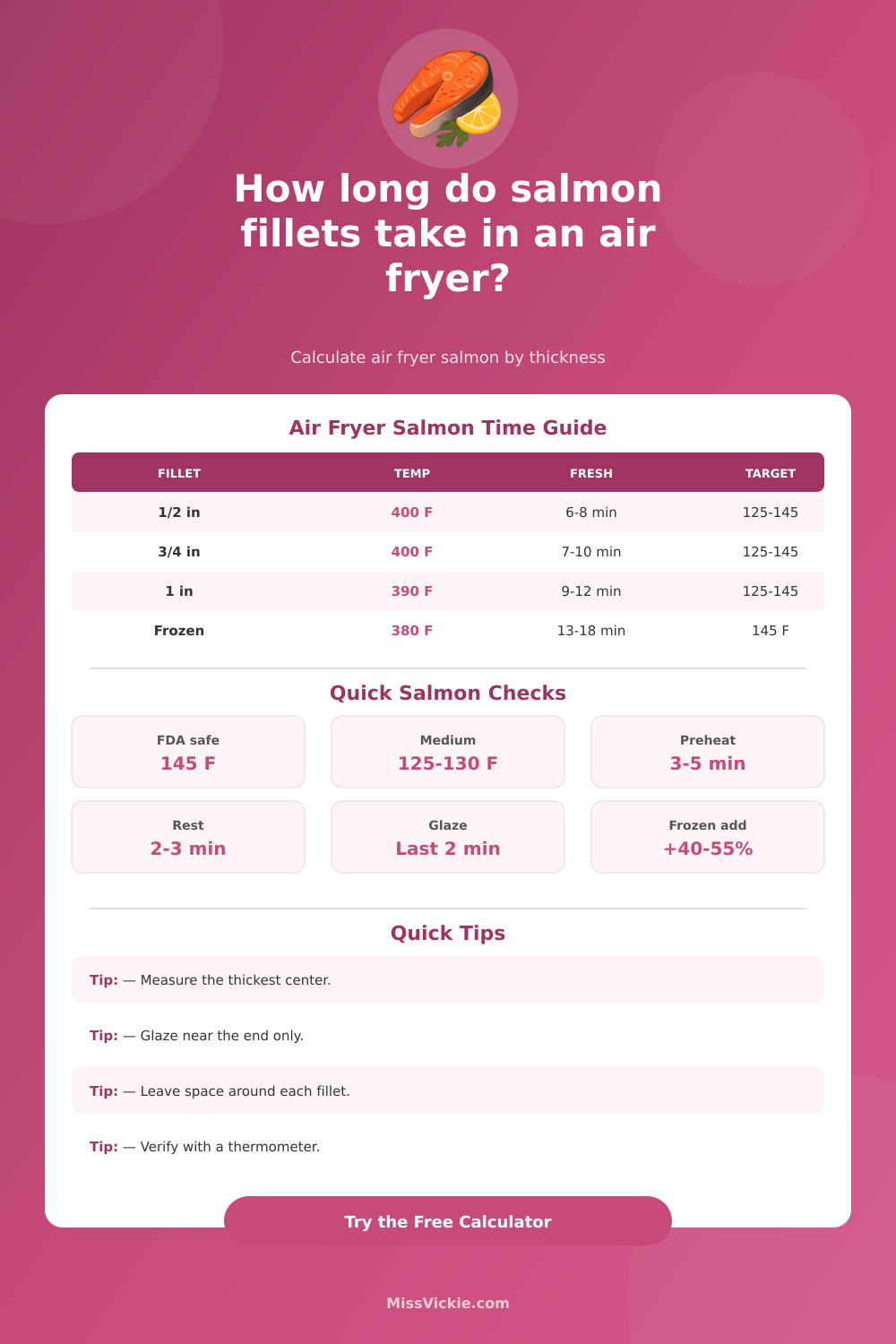
| 1/2 inch / 1.3 cm | 6 to 8 min | 7 to 9 min | 11 to 14 min | Check at 5 min; tail pieces climb quickly. |
| 3/4 inch / 1.9 cm | 7 to 10 min | 8 to 11 min | 13 to 16 min | Best range for common 5 to 6 oz portions. |
| 1 inch / 2.5 cm | 9 to 12 min | 10 to 13 min | 15 to 19 min | Probe from the side into the thickest center. |
| 1 1/4 inch / 3.2 cm | 11 to 14 min | 12 to 15 min | 18 to 22 min | Lower heat helps the outside avoid drying. |
| 1 1/2 inch / 3.8 cm | 13 to 16 min | 14 to 18 min | 20 to 25 min | Use 370 to 385°F for thick center cuts. |
| Doneness Choice | Pull Temperature | Final Range After Rest | Texture | Best Use |
|---|---|---|---|---|
| Medium-rare | 120 to 123°F / 49 to 51°C | 122 to 126°F / 50 to 52°C | Very moist, translucent center | Fresh high-quality fillets, personal preference |
| Medium | 125 to 128°F / 52 to 53°C | 127 to 132°F / 53 to 56°C | Moist flakes, slightly rosy center | Most weeknight salmon portions |
| Medium-well | 135 to 138°F / 57 to 59°C | 137 to 142°F / 58 to 61°C | Opaque and firm but not dry | Glazed fillets and mixed doneness tables |
| FDA/USDA safe minimum | 142 to 145°F / 61 to 63°C | 145°F / 63°C or higher | Fully opaque, flakes easily | Highest safety margin for fish |
| Cooked salmon reheat | 160 to 162°F / 71 to 72°C | 165°F / 74°C | Hot throughout | Leftovers and meal prep reheating |
| Air Fryer Factor | Setting | Time Adjustment | Temperature Adjustment | Why It Matters |
|---|---|---|---|---|
| Preheat | Full 3 to 5 min, short, or none | No preheat adds about 8% to 12% | No heat change | A hot basket starts surface cooking immediately. |
| Basket load | Open, touching, full, oven tray, or split | Touching +8%; full +18%; oven tray +10% | Full baskets often need 5°F lower heat | Crowding slows airflow and browns unevenly. |
| Skin | Skin down, skin up, skinless, foil, or crisp finish | Foil +8%; crisp finish adds 1 to 2 min | Crisp finish can use 400°F | Skin buffers heat and protects delicate flesh. |
| Glaze | Dry rub, butter, citrus, sweet glaze, miso, crumb | Sweet glaze usually -3% after heat drop | Sweet glaze: lower 10 to 15°F | Sugar scorches before the center finishes. |
| Starting state | Tempered, chilled, frozen raw, or cooked chilled | Frozen raw +40% to +55%; reheat shorter | Frozen starts better at 370 to 385°F | Frozen centers lag while surfaces dry fast. |
| Fillet Weight | Typical Thickness | Suggested Temp | Fresh Baseline | Serving Note |
|---|---|---|---|---|
| 4 oz / 115 g | 1/2 to 3/4 inch | 390 to 400°F | 6 to 9 min | Small portions overcook quickly; check early. |
| 6 oz / 170 g | 3/4 to 1 inch | 385 to 400°F | 8 to 12 min | Most common single-serving fillet size. |
| 8 oz / 225 g | 1 to 1 1/4 inch | 375 to 390°F | 10 to 14 min | Good candidate for a short rest. |
| 10 to 12 oz / 285 to 340 g | 1 1/4 to 1 1/2 inch | 370 to 385°F | 13 to 18 min | Thick pieces need thermometer checks. |
📊 Method Comparison Grid
Fast browning and strong airflow; best for single-layer fillets.
Gentler batch cooking; less crisp skin unless finished hot.
Best skin contact, but thicker fillets may need oven finishing.
Lower temperature protects cooked salmon from drying out.
💡 Air Fryer Salmon Tips
Salmon is a time bomb for most home cooks in air fryer: You set the timer, cross your fingers that you haven’t set it too low, then anxiously wait to see if smell of burnt fish overtakes the kitchen. It’s true: When cooking delicate protein, thickness (not necessarily weight) make all the difference.
Even two pieces of salmon of equal weight may be quite different in thickness. One a thin tail piece, another a thick center cut. Because heat penetrates the outside in, these pieces will cook through on very different timeline. With this, you spare yourself from having to guess about whether your fillet is dry or safe.
How to Cook Salmon in an Air Fryer
The tool’s input fields are filled with actual physical variables like thickness (the thing that most affects how air flows and cooks things), which is also what the air fryer does. It circulate hot air all around the outside of the food. So it starts cooking from the outside in. If you’ve got a really fat one, then the outside might be well-done while the inside isn’t even close to medium-rare yet.
To compensate for this, the tool take into account how long it would take given the thickness of your fillet: half an inch or an inch and a quarter. Always measure at the thickest part of the fish. There’s a big difference between meaty middle and the more tapered end towards the tail, which will cook much quickerer. Going with average results in burnt edges or still-raw middles.
Another element that alters things is the basket load. Because air fryers are tiny convection ovens, they only has so much room inside them. Don’t jam too many fillet into your basket. This blocks the airflow that makes an air fryer work and will affect final outcome. To make up for less-efficient heat distribution due to crowding, the calculator adds more time. Ideally, just cook one or two batches; don’t crowd the tray (this causes steaming not frying).
Skin placement matters here too. Cooking with skin-on provides a bit of protection between the tender flesh and the searing-hot surface below. This allow the meat to stay moist but also renders out some of the fat. For people who want crispy skin, the calculator recommends cooking it at a lower temperature initially, then finishing on high briefly, instead of cooking it at high-heat all along.
When novices try air frying salmon, one of the first places they run into trouble is with the glaze. Teriyaki, honey and other sugary sauces burn quickly well before salmon has cooked through. To avoid that risk, the calculator suggest reducing the time (or lowering the temp) if you’re using a sweet glaze. One tip: apply your sticky sauce during the final couple minutes of cook time. That allows you to infuse the flavor without having to worry about burning the food. It is a minor adjustment in timing, but it makes the difference between burnt and glistening results, and a happy dinner versus an unhappy meal.
With frozen fillets, the starting point is far colder than room-temperature fish, so they needs even more patience. The calculator tacks on lots of extra time for a frozen start, which can mean adding as much as 40 to 50 percent more then it would take for fresh fish.
While everyone’s preference for how done their fish should be is different, safe isn’t up for debate: the FDA advises aiming for 145 degrees Fahrenheit at the center of cooked fish. Chefs, however, tend to believe that salmon gets dry when cooked to such high temperatures; they say to aim for about 125-130 instead (juicier). The calculator will suggest the appropriate pull time based off the doneness you select. Just remember that visual indicators are sometimes deceiving (depending on your kitchen light), so the best way to ensure accuracy is with a thermometer.
Once the fish is removed from heat, let it rest for several minutes to allow the juices to spread through the fillet. Otherwise, all those delicious liquids simply stream down the plate and you end up with dry flakes.
Now that you understand those factors, cooking salmon isn’t a guessing game anymore. It becomes a predictable process. No need to worry if it’s finished or not; just learn how long it takes at what thickness and go from there. Instead of fearing the air fryer, you trust it. Armed with knowledge about the relationships between thickness, airflow, and sweetness, you’ll never feel nervous again cooking another piece of fish. And believe me, knowing it will turn out well each time is better than shaving off 10 minutes of prep time. It means having enough faith to sit down to enjoy dinner as soon as it’s hot, rather than worrying if youve gotten the timing right.