Salmon Fillet Cooking Time Oven Calculator
Estimate oven salmon bake time from fillet thickness, oven temperature, starting temperature, doneness target, skin, glaze, pan type, oven mode, crowding, and carryover rest.
🍲 Oven Salmon Presets
Choose a starting point for common salmon fillet situations, then fine tune the thickness, oven heat, doneness, pan, glaze, and rest.
⚖ Salmon and Oven Details
Oven salmon timing
Enter your salmon details to estimate a bake window and thermometer pull point.
Calculation Breakdown
Cook Schedule
- Measure the thickest part before baking.
- Pull early so carryover can finish the center.
🌡 Salmon Oven Timing Reference
Food safety agencies list 145°F as the safe minimum internal temperature for finfish. Many cooks pull salmon lower for texture, but the safe-temperature option is included for conservative cooking.
📋 Oven Temperature and Thickness Table
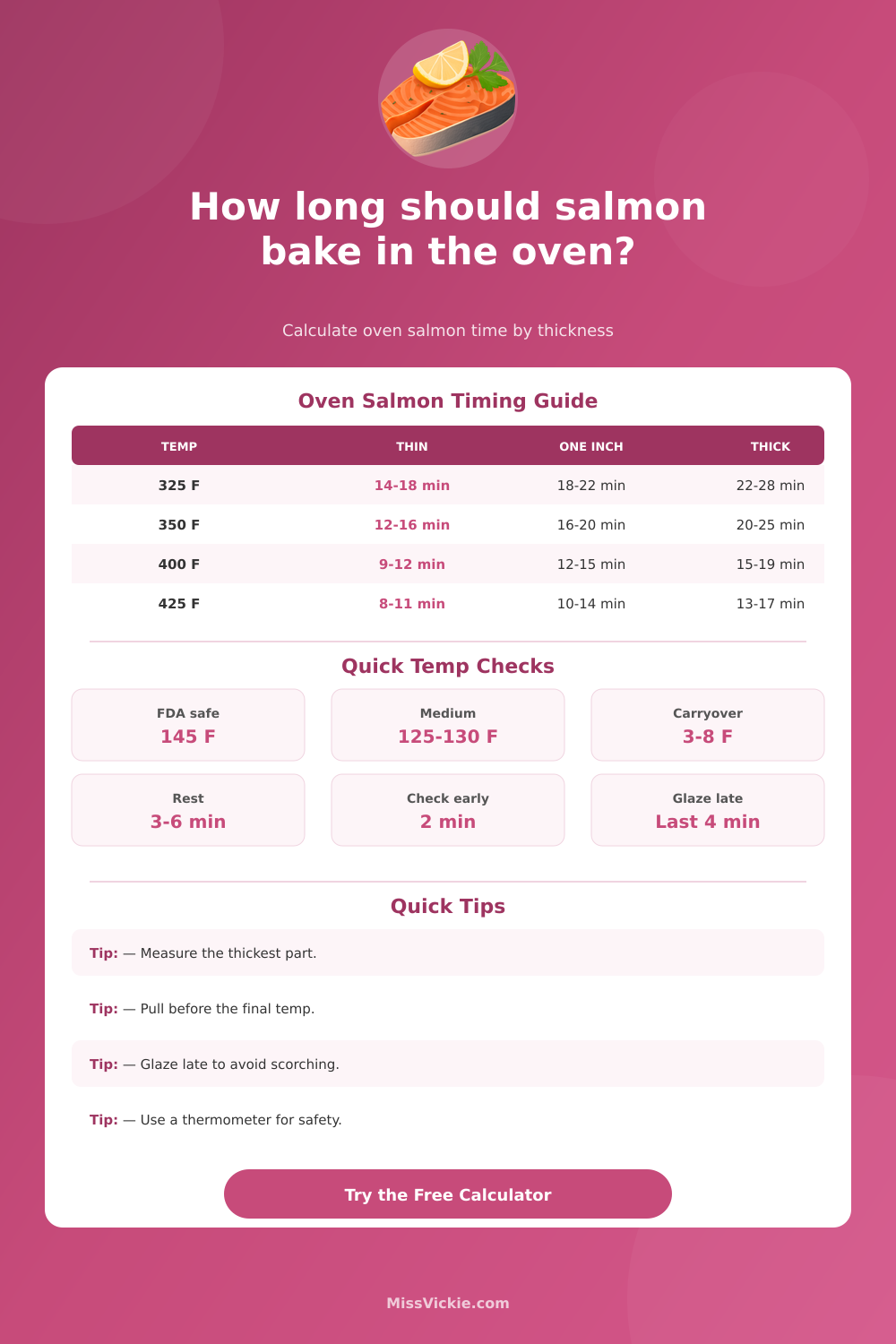
| Oven Setting | 3/4 Inch Fillet | 1 Inch Fillet | 1 1/4 Inch Fillet | Best Use |
|---|---|---|---|---|
| 300 to 325°F | 14 to 18 min | 18 to 22 min | 22 to 28 min | Gentle, silky salmon with less albumin on the surface. |
| 350 to 375°F | 11 to 16 min | 15 to 20 min | 19 to 25 min | Balanced baking for moist fillets and whole sides. |
| 400°F | 9 to 12 min | 12 to 15 min | 15 to 19 min | Weeknight fillets with light browning and predictable timing. |
| 425 to 450°F | 7 to 11 min | 10 to 14 min | 13 to 17 min | Hot roasting, crisp edges, glazes added late, and broil finishes. |
| Internal Temperature | Texture | When to Pull | Rest Expectation | Food Safety Note |
|---|---|---|---|---|
| 120 to 125°F | Soft medium-rare center, translucent at the core | 116 to 121°F if resting 3 to 5 min | Rises 3 to 5°F in small fillets | Below the conservative safe minimum; use personal judgment. |
| 125 to 130°F | Moist medium flakes, still glossy | 121 to 126°F with normal carryover | Rises 4 to 6°F in thick fillets | Popular restaurant-style target but not the official safe minimum. |
| 135 to 140°F | Medium-well, opaque, firmer flakes | 129 to 136°F depending on cover and thickness | Rises 4 to 7°F | Closer to fully cooked while keeping some moisture. |
| 145°F | Fully cooked and flaky | 137 to 142°F if resting; 145°F if no rest | Rises 3 to 8°F | FDA and USDA safe minimum internal temperature for fish. |
| 165°F | Hot reheated cooked salmon | 158 to 162°F if covered briefly | Rises 3 to 6°F | Use for reheating previously cooked leftovers. |
| Oven Salmon Factor | Calculator Setting | Time Effect | Temperature Effect | Practical Cue |
|---|---|---|---|---|
| Starting temperature | Tempered, fridge-cold, very cold, thawed, partly frozen, or frozen | Tempered trims time; partly frozen can add 35%; frozen can nearly double time | No oven change unless frozen solid | Probe the coldest center, especially after thawing. |
| Skin and placement | Skin down, skinless, skin up, rack, or parchment | Skin down is baseline; rack cooks a little faster; parchment slows the bottom | Skin up may need a lower finish to avoid dry flesh | Skin protects flesh when placed down on a hot pan. |
| Glaze or topping | Dry, butter, miso, sugar glaze, crust, or stuffing | Crumbs and stuffing add time; sugary glaze should be added late | Sugar glazes prefer 375 to 400°F or a short finish | Dark glaze color can appear done before the center is ready. |
| Pan type | Sheet, glass, cast iron, foil, rack, or stoneware | Cast iron speeds the underside; glass and stoneware lag slightly | Covered foil keeps heat moist and gentle | Heavy pans need a full preheat for repeatable results. |
| Oven mode | Standard, convection, roast, broil finish, or not preheated | Convection shortens time; underheated ovens add ramp time | Fan ovens may need 25°F less than standard bake | Use broil only at the end after the center is close. |
| Pan spacing | Spaced, close, touching, vegetables, or two pans | Touching pieces and two pans add time | No set-temp change; rotate pans if using two racks | Air gaps matter more than total ounces for small fillets. |
| Cut or Scenario | Typical Thickness | Good Oven Range | Common Time | Timing Note |
|---|---|---|---|---|
| Thin tail fillet | 1/2 to 3/4 inch | 375 to 425°F | 7 to 12 min | Check early; thin edges dry quickly. |
| Individual center-cut fillet | 1 to 1 1/4 inch | 375 to 425°F | 12 to 18 min | The most predictable oven salmon shape. |
| Whole side of salmon | 3/4 to 1 1/4 inch | 325 to 400°F | 16 to 25 min | Use the thickest middle as the thermometer point. |
| Stuffed or topped fillet | 1 to 1 1/2 inch | 350 to 400°F | 17 to 28 min | Topping insulates the fish and may brown first. |
| Frozen fillet | 3/4 to 1 inch | 375 to 425°F | 20 to 30 min | Covered start helps thaw; uncover to finish. |
🔍 Method Comparison Grid
Best for small fillets, lightly oiled surfaces, and quick browned edges.
Reliable for 1 inch fillets, sheet pans, and weeknight timing.
Best for moist texture, thick pieces, and whole sides served tender.
Steamy and forgiving, but the surface will not brown or crisp.
💡 Salmon Timing Tips
When the salmon’s edge is cooked through and middle still looks raw, you might freak out. Most of us are trained to think “time” is the main variable, but it isn’t; it’s thickness. By plugging in your fillet measurements into the calculator above, it do the math for you so you don’t have to guess if a thin tail-off section require only half the cooking time of a chunky center cut.
Heat transfer is not instant; it is slow. You don’t just throw that tray in the four hundred degree oven and poof, done. No. The outer layers responds first; middle takes longer. Watching the clock means you’ll almost always overcook surface long before center is safe. So no matter what, you must measure before baking. With your finger. You can also use a ruler.
Why Salmon Thickness Matters More Than Time
How do you think an eight-ounce fillet could cook in minutes? Answer: if it’s only half-inch thick. And how about another eight-ounce piece that’s four times as tall; stacked two inches high? That call for patience and some gentle handling. Weight betrays you. Vertical depth tells the truth.
The other half of this equation are quieter, but no less crucial: starting temperature. Your fish fresh from the fridge is a heat sink, taking away energy before it has a chance to seep into the meat. Twenty minutes on the counter bridged that gap substantialy. Don’t leave it out until it is warm to the touch; just leave it long enough to take the chill off and let the heat spread evenly through the meat. The heat retention here are accounted for by the calculator, shifting the window to avoid pulling a frozen-in-the-center result out of the oven five minutes too soon.
Another common problem; glazing, is recipe for disaster that too many cook get wrong. Teriyaki or any other sugary sauce burns at far lower temps then salmon requires for doneness. Slap it on in the beginning and you’ll end up with raw in the middle and burnt on top before anything’s cooked. The secret: Bake the unadorned fish first, then brush on glaze during the last few minutes. You get your browning, but no bitterness.
This is all about timing; it is the difference between a restaurant dish and one from hell in your own kitchen.
The type of pan will also determine whether it’s cooking evenly on top and bottom. If you use a dish that sits directly on metal, it’ll brown faster, but has potential for getting stuck if you don’t oil well. The heavy-duty dishes takes longer to heat up (think glass dishes) so overall cooking time may be longer as well. Using something like a wire rack under the fillet help air circulate around the fish, resulting in an even cook on all sides.
Where most home cooks drop the ball is at rest time. Carryover heat in salmon mean it’s still cooking even when it comes out of the oven. While plating it, its internal temp will increase by several degree. That’s why when you take it out and digital thermometer says exactly what you wanted in the oven, what hits the dinner table is probably going to be dry. Letting it go a couple of degrees shy and then letting it finish gently via leftover heat are the way to keep it moist. Sounds counterintuitive, but that’s really how you do it.
In short: Cooking salmon isn’t so much about remembering one timer as it is about knowing that all proteins cooks differently (i.e., depending on how heat moves through them). If your fillet’s really thick, or if there’s too much stuff crammed onto the pan, following a recipe to the letter won’t save you; you’ll still screw up. This calculator will take those factors into account, explain them for you, and remove the guesswork. It gives you a starting point, and then you can use your eyes and nose to check things two minutes before it is predicted to finish.
As long as you respect the thickness of the fish, and allow the carryover heat to come to play, you no longer fight against the clock, you embrace it, and enjoy eating what you made. That mental switch makes the process go from being a stressful chore to a reliable ritual.
You should of checked the temp earlier too.